

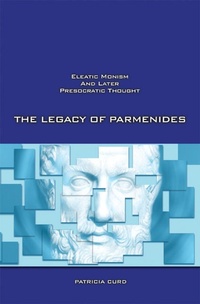
The Legacy of Parmenides
Eleatic Monism and Later Presocratic Thought
Will be published approx. on 30. November 2004
Book
Paperback/Softback
309 pages
978-1-930972-15-5 (ISBN)
Description
Parmenides of Elea was the most important and influential philosopher before Plato. Patricia Curd here reinterprets Parmenides' views and offers a new account of his relation to his predecessors and successors.
In the traditional interpretation, Parmenides argues that generation, destruction, and change are unreal and that only one thing exists. He therefore rejected as impossible the scientific inquiry practiced by the earlier Presocratic philosophers. But the philosophers who came after Parmenides attempted to explain natural change and they assumed the reality of a plurality of basic entities. Thus, on the traditional interpretation, the later Presocratics either ignored or contradicted his arguments. In this book, Patricia Curd argues that Parmenides sought to reform rather than to reject scientific inquiry and offers a more coherent account of his influence on the philosophers who came after him.
The Legacy of Parmenides provides a detailed examination of Parmenides' arguments, considering his connection to earlier Greek thought and how his account of ""what-is"" could serve as model for later philosophers. It then considers the theories of those who came after him, including the Pluralists (Anaxagoras and Empedocles), the Atomists (Leucippus and Democritus), the later Eleatics (Zeno and Melissus), and the later Presocratics (Philolaus of Croton and Diogenes of Apollonia). The book closes with a discussion of the importance of Parmenides' views for the development of Plato's Theory of Forms.
This first-time in paperback edition includes a new Introduction by the author in which she clarifies her position on the following points: Monism, Internal and External Negations, Locomotion and the Specification of How What-is Is, and Doxa. Also added is a Supplementary Bibliography. (The Legacy of Parmenides was first published in hardcover in 1997 by Princeton University Press).
In the traditional interpretation, Parmenides argues that generation, destruction, and change are unreal and that only one thing exists. He therefore rejected as impossible the scientific inquiry practiced by the earlier Presocratic philosophers. But the philosophers who came after Parmenides attempted to explain natural change and they assumed the reality of a plurality of basic entities. Thus, on the traditional interpretation, the later Presocratics either ignored or contradicted his arguments. In this book, Patricia Curd argues that Parmenides sought to reform rather than to reject scientific inquiry and offers a more coherent account of his influence on the philosophers who came after him.
The Legacy of Parmenides provides a detailed examination of Parmenides' arguments, considering his connection to earlier Greek thought and how his account of ""what-is"" could serve as model for later philosophers. It then considers the theories of those who came after him, including the Pluralists (Anaxagoras and Empedocles), the Atomists (Leucippus and Democritus), the later Eleatics (Zeno and Melissus), and the later Presocratics (Philolaus of Croton and Diogenes of Apollonia). The book closes with a discussion of the importance of Parmenides' views for the development of Plato's Theory of Forms.
This first-time in paperback edition includes a new Introduction by the author in which she clarifies her position on the following points: Monism, Internal and External Negations, Locomotion and the Specification of How What-is Is, and Doxa. Also added is a Supplementary Bibliography. (The Legacy of Parmenides was first published in hardcover in 1997 by Princeton University Press).
Reviews / Votes
This book by Patricia Curd (C. hereafter), professor of Purdue University (Indiana, USA), was published for the first time in 1998 (by Princeton University Press). The present paperback version of the book contains a few small changes in the main text and is prefaced by a new detailed introduction, in which C. answers criticism and clarifies her present position. The book is supplied with detailed indexes, bibliography and abundant footnotes. This introduction allows the reader to understand the C.'s intentions and the nature of her interest in Parmenidean doctrine. The introduction also maps the book: it refers to the parts of the book where the reader can find a detailed exposition of C.'s particular claims. Abridged"". - Bryn Mawr Classical Review AbridgedMore details
Language
English
Place of publication
Las Vegas
United States
Target group
College/higher education
Dimensions
Height: 229 mm
Width: 162 mm
Thickness: 22 mm
Weight
485 gr
ISBN-13
978-1-930972-15-5 (9781930972155)
Copyright in bibliographic data and cover images is held by Nielsen Book Services Limited or by the publishers or by their respective licensors: all rights reserved.
Schweitzer Classification
Other editions
Additional editions
E-Book
10/2004
Parmenides Publishing
€37.99
Available for download
Person
Patricia Curd is professor at Purdue University, USA in the field of ancient philosophy. She is coeditor of Readings in Ancient Greek Philosophy and the editor of A Presocratic Reader.