

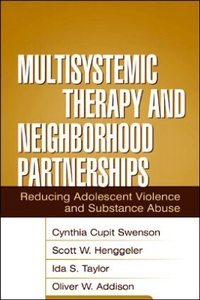
Multisystemic Therapy and Neighborhood Partnerships
Reducing Adolescent Violence and Substance Abuse
1st Edition
Published on 23. December 2004
Book
Hardback
272 pages
978-1-59385-109-5 (ISBN)
Description
Based on the proven technology of Multisystemic Therapy (MST), this unique book provides an exemplary approach to empowering communities to reduce youth violence and substance abuse and promote school success. Effective strategies for working with at-risk youth are embedded in a comprehensive framework that enlists the talents and resources of clinicians, human service professionals, neighborhood residents, community organizations, and outside stakeholders. Using an extended case example to illustrate all aspects of implementing MST on a neighborhood-wide scale, the volume covers empirical and clinical foundations, program planning, and strategies for building collaboration with key community players.
Reviews / Votes
This book contains unusually informative, insightful, and practical information on developing and implementing effective juvenile delinquency programs in very troubled neighborhoods. Remarkably, it will appeal to practitioners, students, and researchers alike--a very rare quality. This is the most user-friendly book of its type I have seen. The format is excellent for optimizing learning. I particularly appreciated the concise introduction and concluding review of critical points in each chapter. In the classroom, this book would make a very appealing, appropriate supplemental text for courses in community psychology, social work, and juvenile justice.--James C. Howell, PhD, Department of Criminology and Criminal Justice, University of South CarolinaSwenson and her colleagues have taken evidence-based interventions to a new level of sophistication and applied them in a culturally sensitive and empathetic way in a community setting. Detailed and practical, this book will be useful to students and professionals alike who are committed to providing quality services to underserved clients from diverse communities. The bar for all future intervention texts has just been raised by this important work.--Jon R. Conte, PhD, School of Social Work, University of Washington
This book is extremely well written, in plain language. It contains a gold mine of descriptions concerning how to approach the challenging task of implementing a prevention intervention in a high-risk neighborhood in a sensitive and thoughtful fashion. I know of no other book that combines the application of a comprehensive, evidence-based intervention for high-risk youth with a thorough description of how to work from the grassroots in order to join effectively with local leaders. I highly recommend this book to any researcher, clinician, or policymaker interested in community-based prevention science.--Ray DeV. Peters, PhD, Better Beginnings, Better Futures Project, Queen's University, Canada
- The teachings of this book are useful to a wide range of practitioners and community leaders interested in enhancing the quality of life of people across settings....Readers learn how to support youth, families, and communities to achieve increased levels of safety and academic success, as well as decreased levels of substance abuse and dependence, using a systemic and ecological approach....A valuable resource book that speaks to multiple audiences by incorporating a wide range of voices and experiences. --Journal of Marital and Family Therapy, 1/28/2009?? The authors have presented a complex body of work in an easy-to-read text that can be used by both researchers and practitioners who want to address problems such as substance use and community violence among adolescents within neighborhoods....The text is a valuable tool because it provides both process and evidence-supported outcomes for effective implementation of similar projects....Neighborhood partnerships across the country can be strengthened through the use of the implementation strategies outlined. --PsycCRITIQUES, 1/28/2009?? The authors of this book have provided a good balance of theory and research along with the practical process element of MST. The book is informative, practical, and accessible to a wide audience of practitioners, students, and lay individuals who may be a part of the community in which the MST is undertaken. --British Journal of Forensic Practice, 8/3/2010
More details
Language
English
Place of publication
New York
United States
Target group
Professional and scholarly
Postgraduate, Professional, Professional Practice & Development, and Undergraduate
Dimensions
Height: 229 mm
Width: 152 mm
Weight
518 gr
ISBN-13
978-1-59385-109-5 (9781593851095)
Copyright in bibliographic data and cover images is held by Nielsen Book Services Limited or by the publishers or by their respective licensors: all rights reserved.
Schweitzer Classification
Other editions
Additional editions
Cynthia Cupit Swenson | Scott W. Henggeler | Ida S. Taylor
Multisystemic Therapy and Neighborhood Partnerships
Reducing Adolescent Violence and Substance Abuse
Book
03/2009
1st Edition
Guilford Publications
€52.23
Article exhausted; check different version
Persons
Cynthia Cupit Swenson is Associate Professor of Psychiatry and Behavioral Sciences at the Medical University of South Carolina (MUSC) and Associate Director of the Family Services Research Center. She conducted National Institute of Mental Health-funded research that led to an adaptation of Multisystemic Therapy for child maltreatment, now being implemented in the U.S. and internationally.
Scott W. Henggeler, PhD, is retired Professor of Psychiatry and Behavioral Sciences at the Medical University of South Carolina, where he was founding Director of the Family Services Research Center (FSRC) from 1992 to 2012. The mission of the FSRC is to develop, validate, and study the dissemination of clinically- and cost-effective mental health and substance abuse services for children with serious clinical problems and their families. Under Dr. Henggeler's leadership, the FSRC received the Annie E. Casey Families Count Award, GAINS Center National Achievement Award, and the Points of Light Foundation President's Award in recognition of excellence in community service directed at solving community problems. Dr. Henggeler has received several research and education awards from national organizations, including being named one of "the twelve people who saved rehabilitation" by the American Society of Criminology. Dr. Henggeler has published 10 books and more than 280 journal articles and book chapters. He was Associate Editor of the Journal of Consulting and Clinical Psychology and has been on the editorial boards of more than 10 journals.
Ida S. Taylor is Director of Gethsemani Community Center in North Charleston, South Carolina. A leader in the Union Heights community for over 20 years, Mrs. Taylor is involved in multiple community and village service projects in North Charleston and Ghana. In 2006, she was awarded a Doctor of Humane Letters degree by the Medical University of South Carolina.
Oliver W. Addison has been a leader in Union Heights for over 40 years and served on the neighborhood council for over 20 years. An advocate for children, he served on the Charleston County School Board for 8 years and served two different terms as the Board's chair. In 2006, he was awarded a Doctor of Humane Letters degree by the Medical University of South Carolina.
Scott W. Henggeler, PhD, is retired Professor of Psychiatry and Behavioral Sciences at the Medical University of South Carolina, where he was founding Director of the Family Services Research Center (FSRC) from 1992 to 2012. The mission of the FSRC is to develop, validate, and study the dissemination of clinically- and cost-effective mental health and substance abuse services for children with serious clinical problems and their families. Under Dr. Henggeler's leadership, the FSRC received the Annie E. Casey Families Count Award, GAINS Center National Achievement Award, and the Points of Light Foundation President's Award in recognition of excellence in community service directed at solving community problems. Dr. Henggeler has received several research and education awards from national organizations, including being named one of "the twelve people who saved rehabilitation" by the American Society of Criminology. Dr. Henggeler has published 10 books and more than 280 journal articles and book chapters. He was Associate Editor of the Journal of Consulting and Clinical Psychology and has been on the editorial boards of more than 10 journals.
Ida S. Taylor is Director of Gethsemani Community Center in North Charleston, South Carolina. A leader in the Union Heights community for over 20 years, Mrs. Taylor is involved in multiple community and village service projects in North Charleston and Ghana. In 2006, she was awarded a Doctor of Humane Letters degree by the Medical University of South Carolina.
Oliver W. Addison has been a leader in Union Heights for over 40 years and served on the neighborhood council for over 20 years. An advocate for children, he served on the Charleston County School Board for 8 years and served two different terms as the Board's chair. In 2006, he was awarded a Doctor of Humane Letters degree by the Medical University of South Carolina.
Content
Neighborhood Solutions for Neighborhood Problems: The Introduction
Neighborhood Solutions Timeline
I. The Empirical and Clinical Background for the Neighborhood Solutions Project
1. The Causes and Consequences of Youth Violence, Substance Abuse, and Community Violence
2. Evidence-Based Treatments: What Works, What Doesn't, and Why
3. Multisystemic Therapy: The Model
II. Implementing Prevention and Intervention Programs in Collaboration with Neighborhood Residents
4. Implementing a Neighborhood-Based Project
5. The MST Approach for Reducing Youth Antisocial Behavior
6. The MST Approach for Treating Adolescent Substance Abuse and Dependence
7. The MST Approach for Reducing School Problems and School Expulsion
8. Neighborhood-Designed Prevention Activities for Promoting Health and Wellness
9. Neighborhood-Based Health Services, with Carolyn Holbrook Jenkins
10. Neighborhood-Based Law Enforcement, with David Laurie, Donald Ward, and Harry M. Roper
III. Attaining and Sustaining Neighborhood-Based Programs
11. Funding Clinical Services and Neighborhood-Based Programs, with Marshall E. Swenson and Toby Smith
12. Summary and Conclusions
Neighborhood Solutions Timeline
I. The Empirical and Clinical Background for the Neighborhood Solutions Project
1. The Causes and Consequences of Youth Violence, Substance Abuse, and Community Violence
2. Evidence-Based Treatments: What Works, What Doesn't, and Why
3. Multisystemic Therapy: The Model
II. Implementing Prevention and Intervention Programs in Collaboration with Neighborhood Residents
4. Implementing a Neighborhood-Based Project
5. The MST Approach for Reducing Youth Antisocial Behavior
6. The MST Approach for Treating Adolescent Substance Abuse and Dependence
7. The MST Approach for Reducing School Problems and School Expulsion
8. Neighborhood-Designed Prevention Activities for Promoting Health and Wellness
9. Neighborhood-Based Health Services, with Carolyn Holbrook Jenkins
10. Neighborhood-Based Law Enforcement, with David Laurie, Donald Ward, and Harry M. Roper
III. Attaining and Sustaining Neighborhood-Based Programs
11. Funding Clinical Services and Neighborhood-Based Programs, with Marshall E. Swenson and Toby Smith
12. Summary and Conclusions