

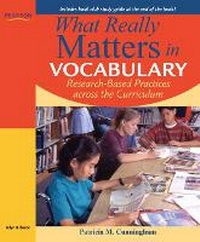
What Really Matters in Vocabulary
Research-based Practices across the Curriculum
Published on 16. May 2008
Book
Paperback/Softback
208 pages
978-0-205-57041-6 (ISBN)
Description
To Pat Cunningham vocabulary isn't just a predictor for comprehension it is a reminder of how much meaning vocabulary matters and how complex it is to teach children meanings for words.
In many ways, things are better in our schools for children who we used to call "underprivileged" and "disadvantaged."
Every state now has public kindergarten and pre K is available for our most needy children. The Internet and other technologies make "bringing words to life" a richer and more do-able goal. However, we still have many children coming to school with impoverished vocabularies. Many of these children come from underpriviledged families and many do not come with much English. Drawing on her experience as a classroom teacher, researcher, scholar, author, and co-founder of the Four-Blocks Literacy Framework Pat Cunningham offers elementary teachers a practical model and friendly strategies for helping ALL students develop their vocabularies. Guiding teachers to use all available resources to build rich meaning vocabularies, she helps to ensure every student's success in school and beyond. There is no way to overstate the importance of meaning vocabulary to comprehension. The size of a child's vocabulary is one of the best predictors of how well he or she will comprehend while listening or reading. Simply stated, what really matters is building bigger vocabulary to make all students better readers.
Features:
Practical strategies teachers can use to build meaning vocabulary throughout the school day.
Separate chapters for building vocabulary during math, science, social studies and the arts and physical education.
In many ways, things are better in our schools for children who we used to call "underprivileged" and "disadvantaged."
Every state now has public kindergarten and pre K is available for our most needy children. The Internet and other technologies make "bringing words to life" a richer and more do-able goal. However, we still have many children coming to school with impoverished vocabularies. Many of these children come from underpriviledged families and many do not come with much English. Drawing on her experience as a classroom teacher, researcher, scholar, author, and co-founder of the Four-Blocks Literacy Framework Pat Cunningham offers elementary teachers a practical model and friendly strategies for helping ALL students develop their vocabularies. Guiding teachers to use all available resources to build rich meaning vocabularies, she helps to ensure every student's success in school and beyond. There is no way to overstate the importance of meaning vocabulary to comprehension. The size of a child's vocabulary is one of the best predictors of how well he or she will comprehend while listening or reading. Simply stated, what really matters is building bigger vocabulary to make all students better readers.
Features:
Practical strategies teachers can use to build meaning vocabulary throughout the school day.
Separate chapters for building vocabulary during math, science, social studies and the arts and physical education.
Reviews / Votes
"I would buy her book because it used words across the curriculum and she has excellent examples for teachers to follow and to use in their classrooms."Tensil Clayton, Curriculum Supervisor, Grades 4-12 Martin County (North Carolina)
"Dr. Cunningham possesses the unique ability to write as if she is having a conversation with a teacher. .... I find it uniquely positive that teachers in all disciplines can easily find information pertinent to the area of concern to them. There is enough information in that respective section for the teacher to make changes in vocabulary instruction without necessarily having to read the book in its entirety. .... This book is very appealing to me and will, I believe, be one that in-service teachers will be anxious to add to their professional collections. I will definitely recommend it to others due to its potential impact on the quality of vocabulary instruction that is prevalent in our schools today."
Eve Hayes
"Pat continues to write in a very reader friendly manner. Her knowledge of words and classroom practice make a powerful combination and teachers will readily jump in and try the strategies she has proposed in this text. I think any practicing teacher will appreciate the thoroughness of explanation and the variety of strategies offered. The chapters make sense and the connection to content area is extremely essential in a vocabulary text so I think, once again, that teachers will grasp the concepts well."
Amanda Arens, Arens Consulting
"Pat has always been able to simplify difficult concepts without dumbing them down. She speaks to teachers in a way they understand and appreciate. .... This latest work by Pat Cunningham will fill a much-needed gap in the current spate of vocabulary books on the market. It is accessible because of the examples, the explanations of difficult concepts, and the writing style. I look forward to using it with teachers."
Sharon Moore, Osborn School District
More details
Language
English
Place of publication
United States
Publishing group
Pearson Education (US)
Target group
Professional and scholarly
Dimensions
Height: 232 mm
Width: 191 mm
Weight
318 gr
ISBN-13
978-0-205-57041-6 (9780205570416)
Copyright in bibliographic data and cover images is held by Nielsen Book Services Limited or by the publishers or by their respective licensors: all rights reserved.
Schweitzer Classification
Other editions
New editions
Patricia M. Cunningham
What Really Matters in Vocabulary
Research-Based Practices Across the Curriculum
Book
05/2013
2nd Edition
Pearson
€44.56
Article is exhausted; no reprint
Person
Pat Cunningham grew up in Rhode Island. For seven years, after graduating from The University of Rhode Island, she taught a variety of elementary grades in Florida and Indiana. She received her Ph. D in Reading Education from the University Of Georgia in 1974. After teaching at Ohio University and serving as Director of Reading for Alamance Co., North Carolina Schools, she came to Wake Forest University to direct the Elementary Education program in 1978.
Pat's particular interest has always been in finding alternative ways to teach children for whom learning to read is difficult. Reading and Writing in Elementary Classrooms, first published in 1978, is currently in its fourth edition. In 1991, She published Phonics they Use: Words for Reading and Writing, which is currently available in its fourth edition. Along with Richard Allington, She published Classrooms that Work and Schools that Work. Along with Dorothy Hall, she developed the Four Blocks Literacy framework, which is currently used as the balanced literacy framework in thousand of classrooms throughout the country. She and Dorothy Hall are co-directors of the Four Blocks Literacy Center, which is housed at Wake Forest University.
Pat's particular interest has always been in finding alternative ways to teach children for whom learning to read is difficult. Reading and Writing in Elementary Classrooms, first published in 1978, is currently in its fourth edition. In 1991, She published Phonics they Use: Words for Reading and Writing, which is currently available in its fourth edition. Along with Richard Allington, She published Classrooms that Work and Schools that Work. Along with Dorothy Hall, she developed the Four Blocks Literacy framework, which is currently used as the balanced literacy framework in thousand of classrooms throughout the country. She and Dorothy Hall are co-directors of the Four Blocks Literacy Center, which is housed at Wake Forest University.
Content
Chapter One: Why Meaning Vocabulary Matters
Chapter Two: Maximizing Vocabulary Growth from Reading
Chapter Three: Maximizing Vocabulary Development by Teaching Word Parts
Chapter Four: Maximizing Vocabulary Growth During Reading Lessons
Chapter Five: Maximizing Vocabulary Growth During Math
Chapter Six: Maximizing Vocabulary Growth During Science
Chapter Seven: Maximizing Vocabulary Growth During Social Studies
Chapter Eight: Maximizing Vocabulary Growth During Art, Music and P. E.
Chapter Nine: Words are Wonderful!
Chapter Two: Maximizing Vocabulary Growth from Reading
Chapter Three: Maximizing Vocabulary Development by Teaching Word Parts
Chapter Four: Maximizing Vocabulary Growth During Reading Lessons
Chapter Five: Maximizing Vocabulary Growth During Math
Chapter Six: Maximizing Vocabulary Growth During Science
Chapter Seven: Maximizing Vocabulary Growth During Social Studies
Chapter Eight: Maximizing Vocabulary Growth During Art, Music and P. E.
Chapter Nine: Words are Wonderful!