

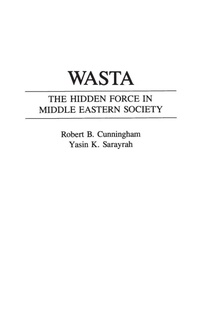
Wasta
The Hidden Force in Middle Eastern Society
Published on 20. April 1993
Book
Hardback
224 pages
978-0-275-94402-5 (ISBN)
Description
Wasta or mediation by a third party is traditional practice in most transactions in Middle Eastern societies. Senior members of the extended family intercede on behalf of younger or less privileged members in making arrangements for employment, overseas travel, business partnerships, university admissions, bank loans, marriages, and most other out-of-the-ordinary forms of negotiation. This book describes wasta's tribal foundation, its evolution in developing bureaucracies, and its present-day practice. The authors use Jordan as an example to illustrate the challenges of doing business with public organizations in Arab countries, where kinship, ethnicity, religion, locale, and class render some individuals more privileged than others.
Some wasta practices are legal and moral within a cultural context, resembling the services provided by attorneys, real estate brokers, and accountants in the West. Other wasta acts are illegal or questionable, but are mandated by family members in a traditional web of inter-connecting obligations. After describing wasta, the authors show how it functions to allocate scarce resources and obtain peace and justice in a desert environment. They then show how it has changed to adapt to modern governmental and bureaucratic situations in which special skills are required to deal with new and complicated rules and procedures. Settings where wasta may be observed in action are described in detail, such as the customs office, the university, government ministries, and local businesses. Personal profiles and family situations lend color to the sociological and political analyses of wasta as it is shown in both its empowering and restrictive aspects. To summarize the impact of wasta, the authors use common theory to explain why persons turn public resources to private benefit, spreading the costs over the entire community and supporting the view that wasta can have a negative effect on economic development. The authors present a solution by suggesting that wastas themselves be enlisted in alleviating the social ills created by overdependence on the wasta system, and that past Arab and Islamic traditions should be explored for answers to modern problems.
Some wasta practices are legal and moral within a cultural context, resembling the services provided by attorneys, real estate brokers, and accountants in the West. Other wasta acts are illegal or questionable, but are mandated by family members in a traditional web of inter-connecting obligations. After describing wasta, the authors show how it functions to allocate scarce resources and obtain peace and justice in a desert environment. They then show how it has changed to adapt to modern governmental and bureaucratic situations in which special skills are required to deal with new and complicated rules and procedures. Settings where wasta may be observed in action are described in detail, such as the customs office, the university, government ministries, and local businesses. Personal profiles and family situations lend color to the sociological and political analyses of wasta as it is shown in both its empowering and restrictive aspects. To summarize the impact of wasta, the authors use common theory to explain why persons turn public resources to private benefit, spreading the costs over the entire community and supporting the view that wasta can have a negative effect on economic development. The authors present a solution by suggesting that wastas themselves be enlisted in alleviating the social ills created by overdependence on the wasta system, and that past Arab and Islamic traditions should be explored for answers to modern problems.
More details
Language
English
Place of publication
United States
Publishing group
Bloomsbury Publishing Plc
Target group
College/higher education
Interest Age: From 7 to 17 years
Dimensions
Height: 240 mm
Width: 161 mm
Thickness: 17 mm
Weight
502 gr
ISBN-13
978-0-275-94402-5 (9780275944025)
Copyright in bibliographic data and cover images is held by Nielsen Book Services Limited or by the publishers or by their respective licensors: all rights reserved.
Schweitzer Classification
Persons
ROBERT B. CUNNINGHAM is Associate Professor of Political Science at the University of Tennessee. He has written three other books, including The Bank and the Bureau (Praeger, 1988), on organizational development in the Middle East, as well as more than a dozen articles in academic and professional journals.
YASIN K. SARAYRAH is Assistant Professor in the Department of Public Administration at Yarmouk University in Jordan. He has worked for eight years in the Jordanian government, given papers at several international conferences, and has designed and delivered management training programs in the Middle East and the United States.
YASIN K. SARAYRAH is Assistant Professor in the Department of Public Administration at Yarmouk University in Jordan. He has worked for eight years in the Jordanian government, given papers at several international conferences, and has designed and delivered management training programs in the Middle East and the United States.
Content
Introduction
The Practice of Wasta
Logic, Theory, and Method
Tradition and Transition
Family
The Customs Department
A Transition Stalled
Wasta in Jordanian Society
Palestinians
Christians and Circassians
Seeking Employment
Wasta Pressures From the Close Family
Wasta in the University
Faculty
Students
Wasta and Political Theory
Arena Theory
Victimless Wasta
Wasta And Development
The Bureaucratic Solution
The Structural Solution
The Privatization Solution
The Cultural Solution
Conclusion
Bibliography
Index
The Practice of Wasta
Logic, Theory, and Method
Tradition and Transition
Family
The Customs Department
A Transition Stalled
Wasta in Jordanian Society
Palestinians
Christians and Circassians
Seeking Employment
Wasta Pressures From the Close Family
Wasta in the University
Faculty
Students
Wasta and Political Theory
Arena Theory
Victimless Wasta
Wasta And Development
The Bureaucratic Solution
The Structural Solution
The Privatization Solution
The Cultural Solution
Conclusion
Bibliography
Index