

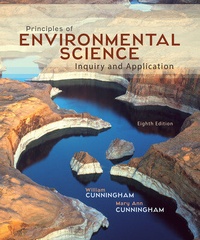
Principles of Environmental Science
8th Edition
Published on 16. February 2016
Book
Paperback/Softback
464 pages
978-0-07-803607-1 (ISBN)
Description
Rather than the 25 to 30 chapters found in most environmental science textbooks, the authors have limited Principles of Environmental Science: Inquiry and Applications to 16 chapters--perfect for the one-semester, non-majors environmental science course. True to its title, the goal of this concise text is to provide an up-to-date, introductory view of essential themes in environmental science along with offering students numerous opportunities to practice scientific thinking and active learning.
More details
Edition
8th edition
Language
English
Place of publication
New York
United States
Publishing group
McGraw-Hill Education - Europe
Target group
College/higher education
US School Grade: College Freshman
Illustrations
293 Illustrations
Dimensions
Height: 274 mm
Width: 234 mm
Thickness: 18 mm
Weight
1071 gr
ISBN-13
978-0-07-803607-1 (9780078036071)
Copyright in bibliographic data and cover images is held by Nielsen Book Services Limited or by the publishers or by their respective licensors: all rights reserved.
Schweitzer Classification
Other editions
Previous edition
Book
01/2013
7th Edition
McGraw-Hill Professional
€194.35
Article exhausted; check for reprint
Persons
William Cunningham is an Emeritus Professor at the University of Minnesota where he taught for 36 years in the Departments of Botany and Genetics and Cell Biology as well as the Conservation Biology Program, the Institute for Social, Economic, and Ecological Sustainability, the Center for Environmental Learning and Leadership, and the McArthur Program in Global Change. He received his Ph.D. in Botany from the University of Texas in 1963 and spent two years at Purdue University as a postdoctoral fellow. At various times, he has been a visiting scholar in Sweden, Norway, Indonesia, and China, as well as several universities and research institutions in the United States.Dr. Cunningham has devoted himself to education and teaching development at the undergraduate level in biology. He began his educational career in structural biology but for the last 10-15 years has concentrated on environmental science, teaching courses such as Social Uses of Biology; Garbage, Government, and the Globe; Environmental Ethics; and Conservation History. Within the past four years, he has received both of the two highest teaching honors that the University of Minnesota bestows -- The Distinguished Teaching Award and a $15,000 Amoco Alumni Award. He has served as a Faculty Mentor for younger faculty at the university, sharing the knowledge and teaching skills that he has gained during his distinguished career.
Mary Ann Cunningham teaches geography and geographic information systems (GIS), and environmental studies at Vassar College, Poughkeepsie, NY. Her research involves using GIS to assess landscape-level problems in conservation and biodiversity. In particular, she is interested in understanding the nature of fragmentation in grassland environments and the effects of fragmentation on the make-up of bird communities. The agricultural landscapes where she has been working represent a complex and fascinating interaction of issues concerning working landscapes, resource use, remnant wildlife habitat, and landscape aesthetics. It is at the intersection of these issues that she likes to try and understand the geography of physical environments. Mary Ann earned a PhD in Geography at the University of Minnesota, an MA in Geography at the University of Oregon, and a BA in Geology at Carleton College.
Mary Ann Cunningham teaches geography and geographic information systems (GIS), and environmental studies at Vassar College, Poughkeepsie, NY. Her research involves using GIS to assess landscape-level problems in conservation and biodiversity. In particular, she is interested in understanding the nature of fragmentation in grassland environments and the effects of fragmentation on the make-up of bird communities. The agricultural landscapes where she has been working represent a complex and fascinating interaction of issues concerning working landscapes, resource use, remnant wildlife habitat, and landscape aesthetics. It is at the intersection of these issues that she likes to try and understand the geography of physical environments. Mary Ann earned a PhD in Geography at the University of Minnesota, an MA in Geography at the University of Oregon, and a BA in Geology at Carleton College.
Content
Chapter 1: Understanding Our Environment Chapter 2: Environmental Systems: Matter and Energy of LifeChapter 3: Evolution, Species Interactions, and Biological Communities Chapter 4: Human Populations Chapter 5: Biomes and Biodiversity Chapter 6: Environmental Conservation: Forests, Grasslands, Parks, and Nature Preserves Chapter 7: Food and Agriculture Chapter 8: Environmental Health and Toxicology Chapter 9: ClimateChapter 10: Air Pollution Chapter 11: Water: Resources and PollutionChapter 12: Environmental Geology and Earth Resources Chapter 13: Energy Chapter 14: Solid and Hazardous Waste Chapter 15: Economics and Urbanization Chapter 16: Environmental Policy and Sustainability