

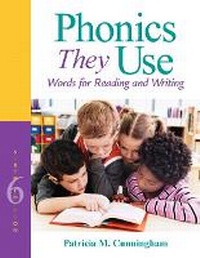
Phonics They Use
Words for Reading and Writing
6th Edition
Published on 15. January 2013
Book
Paperback/Softback
264 pages
978-0-13-294409-0 (ISBN)
Description
Written by an outstanding scholar, Phonics They Use, seamlessly weaves together the complex and varied strategic approaches needed to help students develop reading and writing skills and offers a collection of strategies and hands-on activities that provide a framework for teaching phonics. Building on previous editions, it focuses on how students use phonics to read and write, not just how much phonics a student knows. Each chapter is filled with developmentally appropriate activities that help students with fluency, rhyme-based decoding, spelling, and more. This edition includes three chapters on assessment, more suggestions for adapting activities for English language learners, and new phonics interventions for older struggling readers.
New to the Sixth Edition:
A new chapters on Assessment and Differentiation of Early Reading Concepts (Chapter 5), Fluency Assessment and Interventions (Chapter 8), and Phonics Assessment, Coaching and Interventions (Chapter 13)
More suggestions For English Language Learners show how teachers have adapted the Phonics They Use activities to meet the needs of their students who are learning English.
Phonics interventions for older struggling readers focus on activities such as "Brand Name Phonics," "The Wheel," and "Mystery Word Match" to help older students learn basic phonics skills.
Updated research, materials, and technology (Chapter 14) provides the latest findings on phonics and its impact on reading and writing.
New to the Sixth Edition:
A new chapters on Assessment and Differentiation of Early Reading Concepts (Chapter 5), Fluency Assessment and Interventions (Chapter 8), and Phonics Assessment, Coaching and Interventions (Chapter 13)
More suggestions For English Language Learners show how teachers have adapted the Phonics They Use activities to meet the needs of their students who are learning English.
Phonics interventions for older struggling readers focus on activities such as "Brand Name Phonics," "The Wheel," and "Mystery Word Match" to help older students learn basic phonics skills.
Updated research, materials, and technology (Chapter 14) provides the latest findings on phonics and its impact on reading and writing.
Reviews / Votes
A wonderful resource for someone who is tutoring children of different levels in reading. One book to help them with all of their children, what a bargain!- Christine M Eaton, Owner/Director, Little Learners Early Childhood Center, Inc., Olathe, KS
Dr. Cunningham's description of her "personal phonics history" lets the reader see that she truly understands what being a teacher is all about. It is no wonder that every book or article she authors is a best-seller!
I already own a previous edition, but the new material makes this book worth investing in once again.
- Tracy Hendrix, Academic Coach, Carnesville Elementary School, Carnesville, GA
All elementary (K through 5) teachers should own this book and implement the strategies and lessons Patricia Cunningham suggests.
- Christine Frazer, Title I Reading Specialist, Henry P. Fieler Elementary, Merrillville, IN
More details
Edition
6th edition
Language
English
Place of publication
United States
Publishing group
Pearson Education (US)
Target group
Professional and scholarly
Dimensions
Height: 276 mm
Width: 216 mm
Thickness: 14 mm
Weight
620 gr
ISBN-13
978-0-13-294409-0 (9780132944090)
Copyright in bibliographic data and cover images is held by Nielsen Book Services Limited or by the publishers or by their respective licensors: all rights reserved.
Schweitzer Classification
Other editions
New editions
Patricia Cunningham | Patricia M. Cunningham
Phonics They Use: Words for Reading and Writing
Words for Reading and Writing
Book
05/2016
7th Edition
Pearson
€70.99
Shipment within 15-20 days
Previous edition
Book
04/2009
5th Edition
Pearson
€50.94
Article exhausted; check for reprint
Person
Patricia Cunningham grew up in Rhode Island. For seven years, after graduating from The University of Rhode Island, she taught a variety of elementary grades in Florida and Indiana. She received her Ph. D in Reading Education from the University Of Georgia in 1974. After teaching at Ohio University and serving as Director of Reading for Alamance Co., North Carolina Schools, she came to Wake Forest University to direct the Elementary Education program in 1978. Pat's particular interest has always been in finding alternative ways to teach children for whom learning to read is difficult. Reading and Writing in Elementary Classrooms, first published in 1978, is currently in its fourth edition. In 1991, She published Phonics they Use: Words for Reading and Writing, which is currently available in its fourth edition. Along with Richard Allington, She published Classrooms that Work and Schools that Work. Along with Dorothy Hall, she developed the Four Blocks Literacy framework, which is currently used as the balanced literacy framework in thousand of classrooms throughout the country. She and Dorothy Hall are co-directors of the Four Blocks Literacy Center, which is housed at Wake Forest University.
Content
PART ONE: BUILDING THE FOUNDATION FOR PHONICS THEY CAN USE
1. Early Reading and Writing Activities
2. Phonological and Phonemic Awareness
3. Concrete Words, Letter Names, and Sounds
4. Making Words in Kindergarten
5. Early Reading Strategies: Assessment and Differentiation
PART TWO: FLUENCY
6. Fluency Activities
7. High-Frequency Words
8. Fluency: Assessment and Interventions
PART THREE: USING PHONICS AND SPELLING PATTERNS
9. Making Words
10. Rhyme-Based Decoding and Spelling Activities
11. Decoding and Spelling Big Words
12. Making Words in Upper Grades
13. Phonics Assessment, Coaching and Interventions
PART FOUR: RESEARCH AND TERMINOLOGY
14. The Theory and the Research-The Why Underlying the How
15. Phonics Terminology for Teachers
1. Early Reading and Writing Activities
2. Phonological and Phonemic Awareness
3. Concrete Words, Letter Names, and Sounds
4. Making Words in Kindergarten
5. Early Reading Strategies: Assessment and Differentiation
PART TWO: FLUENCY
6. Fluency Activities
7. High-Frequency Words
8. Fluency: Assessment and Interventions
PART THREE: USING PHONICS AND SPELLING PATTERNS
9. Making Words
10. Rhyme-Based Decoding and Spelling Activities
11. Decoding and Spelling Big Words
12. Making Words in Upper Grades
13. Phonics Assessment, Coaching and Interventions
PART FOUR: RESEARCH AND TERMINOLOGY
14. The Theory and the Research-The Why Underlying the How
15. Phonics Terminology for Teachers