

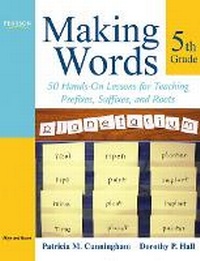
Making Words Fifth Grade
50 Hands-On Lessons for Teaching Prefixes, Suffixes, and Roots
Published on 9. May 2008
Book
Paperback/Softback
120 pages
978-0-205-58102-3 (ISBN)
Description
An active and innovative approach to making words that teachers and their students have grown to love is finally here!
Based on its highly successful parent text, Phonics They Use, this new grade-level series Making Words offers teachers a fresh multi-level activity and lesson series written for the kindergarten through fifth grade classroom. Pat Cunningham and Dottie Hall present classroom teachers with effective tools for strengthening phonics and spelling skills that encourage students to move beyond learning and into a world of word discovery. Each research-based volume includes a wealth of friendly, hands-on, manipulative activities that guide teachers in teaching the development of words--from phonemic awareness to spelling.
In Making Words Fifth Grade, Pat and Dottie introduce second grade teachers to 50 lessons that teach all the decoding and spelling skills included in most fifth grade curriculums. Each Making Words activity leads children through a systematic and sequential phonics curriculum. All lessons include practice with the decoding and spellings skills of segmenting and blending as children stretch out words they are making and blend the letters to make new words. Because teaching children letter-sound relationships is easier than teaching children to actually use these letter-sound relationships, all lessons include a transfer step in which children apply the sounds they are learning to spelling new words.
Making Words Fifth Grade is the best resource you can have on hand for motivating your students to learn words!
Features 50 fun and interactive lessons for building decoding and spelling skills.
Presents a concise method for involving students in the process of identifying common contractions and compound words and more complex vowel patterns within words.
Promotes student awareness of similarities in words that helps develop writing skills.
Includes reproducible letter tiles, record sheets for each lesson, and take-home sheets to copy, cut, and/or laminate.
Highlights a list of useful children's books to extend the Making Words lesson.
Based on its highly successful parent text, Phonics They Use, this new grade-level series Making Words offers teachers a fresh multi-level activity and lesson series written for the kindergarten through fifth grade classroom. Pat Cunningham and Dottie Hall present classroom teachers with effective tools for strengthening phonics and spelling skills that encourage students to move beyond learning and into a world of word discovery. Each research-based volume includes a wealth of friendly, hands-on, manipulative activities that guide teachers in teaching the development of words--from phonemic awareness to spelling.
In Making Words Fifth Grade, Pat and Dottie introduce second grade teachers to 50 lessons that teach all the decoding and spelling skills included in most fifth grade curriculums. Each Making Words activity leads children through a systematic and sequential phonics curriculum. All lessons include practice with the decoding and spellings skills of segmenting and blending as children stretch out words they are making and blend the letters to make new words. Because teaching children letter-sound relationships is easier than teaching children to actually use these letter-sound relationships, all lessons include a transfer step in which children apply the sounds they are learning to spelling new words.
Making Words Fifth Grade is the best resource you can have on hand for motivating your students to learn words!
Features 50 fun and interactive lessons for building decoding and spelling skills.
Presents a concise method for involving students in the process of identifying common contractions and compound words and more complex vowel patterns within words.
Promotes student awareness of similarities in words that helps develop writing skills.
Includes reproducible letter tiles, record sheets for each lesson, and take-home sheets to copy, cut, and/or laminate.
Highlights a list of useful children's books to extend the Making Words lesson.
More details
Language
English
Place of publication
United States
Publishing group
Pearson Education (US)
Target group
Professional and scholarly
Dimensions
Height: 276 mm
Width: 216 mm
Weight
280 gr
ISBN-13
978-0-205-58102-3 (9780205581023)
Copyright in bibliographic data is held by Nielsen Book Services Limited or its licensors: all rights reserved.
Schweitzer Classification
Persons
Patricia M. Cunningham
The day I entered first grade, I decided I wanted to teach first grade. In 1965, I graduated from the University of Rhode Island and began my teaching career teaching first grade in Key West, Florida. For the next several years, I taught a variety of grades and worked as a curriculum coordinator and special reading teacher in Florida and Indiana.
From the very beginning, I worried about children who struggled learning to read and devised a variety of alternative strategies to teach them to read. In 1974, I received my Ph. D. in Reading Education from the University of Georgia. I developed the Making Words activity while working with Title One teachers in North Carolina where I was the Director of Reading for Alamance County Schools. I have been the Director of Elementary Education at Wake Forest University in Winston Salem, North Carolina since 1980 and have worked with numerous teachers to develop hands-on engaging ways to teach phonics and spelling. In 1991, I published Phonics they Use: Words for Reading and Writing, which is currently available in its fourth edition. Along with Richard Allington, I published Classrooms that Work and Schools that Work.
Dottie Hall and I have worked together on many projects. In 1989, we began developing the Four Blocks Framework, a comprehensive approach to literacy which is used in many schools in the United States and Canada. Dottie Hall and I have worked together to produce many books, including the first Making Words books and the Month by Month Phonics Books. These Making Words by Grade Level books are in response to requests by teachers across the years to have making words lessons with a scope and sequence tailored to their grade level. We hope you and your students will enjoy these making words lessons and we would love to hear your comments and suggestions.
Dorothy P. Hall
I always wanted to teach young children too! After graduating from Worcester State College in Massachusetts I taught first and second grade. After two years, I moved to North Carolina where I continued teaching in the primary grades. Many children I worked with struggled to learn to read in the newly integrated schools. I wanted to learn more and received my M ED and Ed D in Reading from the University of North Carolina at Greensboro.
I also worked at Wake Forest University where I met and began to work with Pat Cunningham. After three years teaching at the college level I returned to the public schools and taught third and fourth grade as well being a reading and curriculum coordinator for my school district. At this time Pat Cunningham and I began to collaborate on a number of projects. In 1989, we developed the Four Blocks Framework, a comprehensive approach to literacy in grades one, two, and three which we later expanded to kindergarten, calling it Building Blocks, and the upper grades, calling it Big Blocks. By 1999 Pat and I had written four Making Words books, a series of Month by Month Phonics Books, and The Teacher's Guided to Four Blocks and I retired from the school system to devote more time to consulting and writing. I also went back to work at Wake Forest University where I taught courses in Reading, Children's Literature, and Language Arts Instruction for elementary education students. I am now Director of the Four Blocks Center at Wake Forest University and enjoy working with teachers and administrators around the country presenting workshops on Four Blocks, Building Blocks, Guided Reading Strategies, and Phonics Instruction. I have also written several books with teachers. One request Pat and I have had for a number of years is to revise the Making Words by grade level and include a scope and sequence for the phonics instruction taught. Here it is-Enjoy!
The day I entered first grade, I decided I wanted to teach first grade. In 1965, I graduated from the University of Rhode Island and began my teaching career teaching first grade in Key West, Florida. For the next several years, I taught a variety of grades and worked as a curriculum coordinator and special reading teacher in Florida and Indiana.
From the very beginning, I worried about children who struggled learning to read and devised a variety of alternative strategies to teach them to read. In 1974, I received my Ph. D. in Reading Education from the University of Georgia. I developed the Making Words activity while working with Title One teachers in North Carolina where I was the Director of Reading for Alamance County Schools. I have been the Director of Elementary Education at Wake Forest University in Winston Salem, North Carolina since 1980 and have worked with numerous teachers to develop hands-on engaging ways to teach phonics and spelling. In 1991, I published Phonics they Use: Words for Reading and Writing, which is currently available in its fourth edition. Along with Richard Allington, I published Classrooms that Work and Schools that Work.
Dottie Hall and I have worked together on many projects. In 1989, we began developing the Four Blocks Framework, a comprehensive approach to literacy which is used in many schools in the United States and Canada. Dottie Hall and I have worked together to produce many books, including the first Making Words books and the Month by Month Phonics Books. These Making Words by Grade Level books are in response to requests by teachers across the years to have making words lessons with a scope and sequence tailored to their grade level. We hope you and your students will enjoy these making words lessons and we would love to hear your comments and suggestions.
Dorothy P. Hall
I always wanted to teach young children too! After graduating from Worcester State College in Massachusetts I taught first and second grade. After two years, I moved to North Carolina where I continued teaching in the primary grades. Many children I worked with struggled to learn to read in the newly integrated schools. I wanted to learn more and received my M ED and Ed D in Reading from the University of North Carolina at Greensboro.
I also worked at Wake Forest University where I met and began to work with Pat Cunningham. After three years teaching at the college level I returned to the public schools and taught third and fourth grade as well being a reading and curriculum coordinator for my school district. At this time Pat Cunningham and I began to collaborate on a number of projects. In 1989, we developed the Four Blocks Framework, a comprehensive approach to literacy in grades one, two, and three which we later expanded to kindergarten, calling it Building Blocks, and the upper grades, calling it Big Blocks. By 1999 Pat and I had written four Making Words books, a series of Month by Month Phonics Books, and The Teacher's Guided to Four Blocks and I retired from the school system to devote more time to consulting and writing. I also went back to work at Wake Forest University where I taught courses in Reading, Children's Literature, and Language Arts Instruction for elementary education students. I am now Director of the Four Blocks Center at Wake Forest University and enjoy working with teachers and administrators around the country presenting workshops on Four Blocks, Building Blocks, Guided Reading Strategies, and Phonics Instruction. I have also written several books with teachers. One request Pat and I have had for a number of years is to revise the Making Words by grade level and include a scope and sequence for the phonics instruction taught. Here it is-Enjoy!
Content
Introduction 1
Lesson 1 l watermelons 9
Lesson Focus: er/est, meaning more and most
re, meaning back or again
Lesson 2 l grandchildren 10
Lesson Focus: er, meaning person or thing that does something
Lesson 3 l cheerleaders 12
Lesson Focus: er, meaning person or thing that does something
re, meaning back or again
Lesson 4 l earthquakes 14
Lesson Focus: er, meaning person or thing that does something
re, meaning back or again
Lesson 5 l fingerprints 16
Lesson Focus: er/est, meaning more and most
er, meaning person or thing that does something
re, meaning back or again
Lesson 6 l quarterbacks 18
Lesson Focus: er, meaning person or thing that does something
Lesson 7 l searchlight 20
Lesson Focus: er/est, meaning more and most
ist, meaning person
Lesson 8 l planetarium 22
Lesson Focus: un, meaning not or opposite
im, meaning in
re, meaning back or again
er, meaning person or thing that does something
Lesson 9 l unfriendly 24
Lesson Focus: un, meaning not or opposite
re, meaning back or again
ly, changing part of speech
y, changing part of speech
Lesson 10 l unfriendliest 26
Lesson Focus: un, meaning not or opposite
under, meaning under or less
re, meaning back or again
er, meaning person or thing that does something
Lesson 11 l unfriendliness 28
Lesson Focus: un, meaning not or opposite
under, meaning under or less
re, meaning back or again
less, meaning less or without
ness, changing part of speech
Lesson 12 l personality 30
Lesson Focus: er/ist, meaning person or thing that does something
re, meaning back or again
ly, changing part of speech
Lesson 13 l carelessly 32
Lesson Focus: less, meaning less or without
ly, changing part of speech
y, changing part of speech
re, meaning back or again
Lesson 14 l meaningless 34
Lesson Focus: less, meaning less or without
ness, changing part of speech
Lesson 15 l mercilessly 36
Lesson Focus: er, meaning person or thing that does something
re, meaning back or again
less, meaning less or without
ly, changing part of speech
y, changing part of speech
Lesson 16 l gracefully 38
Lesson Focus: ful, meaning full or with
re, meaning back or again
ly, changing part of speech
y, changing part of speech
Lesson 17 l unfortunately 39
Lesson Focus: un, meaning not or opposite
en, changing part of speech
ly, changing part of speech
Lesson 18 l unworkable 40
Lesson Focus: able, meaning able to
un, meaning not or opposite
er, meaning person or thing that does something
en, changing part of speech
Lesson 19 l unbreakable 41
Lesson Focus: un, meaning not or opposite
en, meaning to make
able, meaning able to
er, meaning person or thing that does something
Lesson 20 l undesirable 42
Lesson Focus: un, meaning not or opposite
dis, meaning not or opposite
en, meaning to make
re, meaning back or again
able, meaning able to
er, meaning person or thing that does
Lesson 21 l questionable 44
Lesson Focus: un, meaning opposite
en, meaning to make
able, meaning able to
tion, changing part of speech
Lesson 22 l unpredictable 46
Lesson Focus: un, meaning not or opposite
re, meaning back or again
in, meaning not or opposite
able, meaning able to
Lesson 23 l uncomfortable 48
Lesson Focus: un, meaning not or opposite
re, meaning back or again
ful, meaning full or with
able, meaning able to
Lesson 24 l undependable 49
Lesson Focus: un, meaning not or opposite
able, meaning able to
re, meaning back or again
en, meaning to make
Lesson 25 l disagreeable 50
Lesson Focus: dis, meaning opposite
er, meaning person or thing that does something
re, meaning back or again
able, meaning able to
Lesson 26 l disagreement 52
Lesson Focus: er/est, meaning more and most
dis, meaning opposite
ee, meaning person
ment, changing part of speech
Lesson 27 l reinforcements 54
Lesson Focus: er/est, meaning more and most
re, meaning back or again
er, meaning person or thing that does something
ment, changing part of speech
Lesson 28 l imperfectly 55
Lesson Focus: ly, changing part of speech
y, changing part of speech
re, meaning back or again
im, meaning not or opposite
Lesson 29 l irresponsible 56
Lesson Focus: less, meaning less or without
re, meaning back or again
er, meaning person or thing that does something
ir, meaning opposite
ible, meaning able to
Lesson 30 l misunderstand 58
Lesson Focus: dis, meaning not or opposite
in, meaning not or opposite
un, meaning not or opposite
mis, meaning wrong or badly
er/est, meaning more/most
Lesson 31 l misunderstood 59
Lesson Focus: dis, meaning not or opposite
mis, meaning wrong or badly
en, changing part of speech
Lesson 32 l interactively 60
Lesson Focus: inter, meaning between
in, meaning not or opposite
ee, meaning person
ly, changing part of speech
Lesson 33 l interactions 62
Lesson Focus: er/est, meaning more and most
re, meaning back or again
inter, meaning between
in, meaning not or opposite
er/or/ist, meaning person or thing that does something
tion, changing part of speech
Lesson 34 l international 63
Lesson Focus: inter, meaning between
in, meaning not or opposite
al, changing part of speech
tion, changing part of speech
Lesson 35 l mysteriously 64
Lesson Focus: mis, meaning wrong or badly
y, changing part of speech
ly, changing part of speech
ous, changing part of speech
Lesson 36 l dangerously 65
Lesson Focus: un, meaning not or opposite
re, meaning back or again
ly, changing part of speech
ous, changing part of speech
Lesson 37 l independently 66
Lesson Focus: in, meaning not or opposite (independent)
in, meaning in (indent)
en, meaning to make
y, changing part of speech
ly, changing part of speech
Lesson 38 l dependability 68
Lesson Focus: in, meaning not or opposite
en, changing part of speech
y, changing part of speech
ly, changing part of speech
Lesson 39 l encouragement 69
Lesson Focus: er/or, meaning person
re, meaning back or again
en, meaning to make
ment, changing part of speech
Lesson 40 l arrangements 70
Lesson Focus: er/est, meaning more/most
re, meaning back or again
er, meaning person
ment, changing part of speech
Lesson 41 l replacements 72
Lesson Focus: er/est, meaning more/most
re, meaning back or again
er, meaning person
al, changing part of speech
ment, changing part of speech
Lesson 42 l underweight 74
Lesson Focus: under, meaning under or less
re, meaning back or again
er, meaning person or thing that does something
er, meaning more
Lesson 43 l underestimate 76
Lesson Focus: under, meaning under or less
re, meaning back or again
ee, meaning person
mis, meaning wrong or badly
en, meaning to make
Lesson 44 l overestimate 78
Lesson Focus: over, meaning over or more
er, meaning person or thing that does something
Lesson 45 l performances 79
Lesson Focus: en, meaning to make
er, meaning person or thing that does something
ance, changing part of speech
Lesson 46 l resistance 80
Lesson Focus: er/est, meaning more/most
re, meaning back or again
en, meaning to make
er/ee, meaning person
ance, changing part of speech
Lesson 47 l disappearance 81
Lesson Focus: dis, meaning not or opposite
pre, meaning before
en, meaning to make
er, meaning person or thing that does something
ance, changing part of speech
Lesson 48 l predictions/description 82
Lesson Focus: er/or, meaning person
er/est, meaning more/most
tion, changing part of speech
Lesson 49 l reproduction 84
Lesson Focus: er/or, meaning person
un, meaning not or opposite
re, meaning back or again
tion, changing part of speech
Lesson 50 l contradictions 86
Lesson Focus: or/ist, meaning person
tion, changing part of speech
l Reproducible Letter Strips 87
l Reproducible Take-Home Sheet 107
Lesson 1 l watermelons 9
Lesson Focus: er/est, meaning more and most
re, meaning back or again
Lesson 2 l grandchildren 10
Lesson Focus: er, meaning person or thing that does something
Lesson 3 l cheerleaders 12
Lesson Focus: er, meaning person or thing that does something
re, meaning back or again
Lesson 4 l earthquakes 14
Lesson Focus: er, meaning person or thing that does something
re, meaning back or again
Lesson 5 l fingerprints 16
Lesson Focus: er/est, meaning more and most
er, meaning person or thing that does something
re, meaning back or again
Lesson 6 l quarterbacks 18
Lesson Focus: er, meaning person or thing that does something
Lesson 7 l searchlight 20
Lesson Focus: er/est, meaning more and most
ist, meaning person
Lesson 8 l planetarium 22
Lesson Focus: un, meaning not or opposite
im, meaning in
re, meaning back or again
er, meaning person or thing that does something
Lesson 9 l unfriendly 24
Lesson Focus: un, meaning not or opposite
re, meaning back or again
ly, changing part of speech
y, changing part of speech
Lesson 10 l unfriendliest 26
Lesson Focus: un, meaning not or opposite
under, meaning under or less
re, meaning back or again
er, meaning person or thing that does something
Lesson 11 l unfriendliness 28
Lesson Focus: un, meaning not or opposite
under, meaning under or less
re, meaning back or again
less, meaning less or without
ness, changing part of speech
Lesson 12 l personality 30
Lesson Focus: er/ist, meaning person or thing that does something
re, meaning back or again
ly, changing part of speech
Lesson 13 l carelessly 32
Lesson Focus: less, meaning less or without
ly, changing part of speech
y, changing part of speech
re, meaning back or again
Lesson 14 l meaningless 34
Lesson Focus: less, meaning less or without
ness, changing part of speech
Lesson 15 l mercilessly 36
Lesson Focus: er, meaning person or thing that does something
re, meaning back or again
less, meaning less or without
ly, changing part of speech
y, changing part of speech
Lesson 16 l gracefully 38
Lesson Focus: ful, meaning full or with
re, meaning back or again
ly, changing part of speech
y, changing part of speech
Lesson 17 l unfortunately 39
Lesson Focus: un, meaning not or opposite
en, changing part of speech
ly, changing part of speech
Lesson 18 l unworkable 40
Lesson Focus: able, meaning able to
un, meaning not or opposite
er, meaning person or thing that does something
en, changing part of speech
Lesson 19 l unbreakable 41
Lesson Focus: un, meaning not or opposite
en, meaning to make
able, meaning able to
er, meaning person or thing that does something
Lesson 20 l undesirable 42
Lesson Focus: un, meaning not or opposite
dis, meaning not or opposite
en, meaning to make
re, meaning back or again
able, meaning able to
er, meaning person or thing that does
Lesson 21 l questionable 44
Lesson Focus: un, meaning opposite
en, meaning to make
able, meaning able to
tion, changing part of speech
Lesson 22 l unpredictable 46
Lesson Focus: un, meaning not or opposite
re, meaning back or again
in, meaning not or opposite
able, meaning able to
Lesson 23 l uncomfortable 48
Lesson Focus: un, meaning not or opposite
re, meaning back or again
ful, meaning full or with
able, meaning able to
Lesson 24 l undependable 49
Lesson Focus: un, meaning not or opposite
able, meaning able to
re, meaning back or again
en, meaning to make
Lesson 25 l disagreeable 50
Lesson Focus: dis, meaning opposite
er, meaning person or thing that does something
re, meaning back or again
able, meaning able to
Lesson 26 l disagreement 52
Lesson Focus: er/est, meaning more and most
dis, meaning opposite
ee, meaning person
ment, changing part of speech
Lesson 27 l reinforcements 54
Lesson Focus: er/est, meaning more and most
re, meaning back or again
er, meaning person or thing that does something
ment, changing part of speech
Lesson 28 l imperfectly 55
Lesson Focus: ly, changing part of speech
y, changing part of speech
re, meaning back or again
im, meaning not or opposite
Lesson 29 l irresponsible 56
Lesson Focus: less, meaning less or without
re, meaning back or again
er, meaning person or thing that does something
ir, meaning opposite
ible, meaning able to
Lesson 30 l misunderstand 58
Lesson Focus: dis, meaning not or opposite
in, meaning not or opposite
un, meaning not or opposite
mis, meaning wrong or badly
er/est, meaning more/most
Lesson 31 l misunderstood 59
Lesson Focus: dis, meaning not or opposite
mis, meaning wrong or badly
en, changing part of speech
Lesson 32 l interactively 60
Lesson Focus: inter, meaning between
in, meaning not or opposite
ee, meaning person
ly, changing part of speech
Lesson 33 l interactions 62
Lesson Focus: er/est, meaning more and most
re, meaning back or again
inter, meaning between
in, meaning not or opposite
er/or/ist, meaning person or thing that does something
tion, changing part of speech
Lesson 34 l international 63
Lesson Focus: inter, meaning between
in, meaning not or opposite
al, changing part of speech
tion, changing part of speech
Lesson 35 l mysteriously 64
Lesson Focus: mis, meaning wrong or badly
y, changing part of speech
ly, changing part of speech
ous, changing part of speech
Lesson 36 l dangerously 65
Lesson Focus: un, meaning not or opposite
re, meaning back or again
ly, changing part of speech
ous, changing part of speech
Lesson 37 l independently 66
Lesson Focus: in, meaning not or opposite (independent)
in, meaning in (indent)
en, meaning to make
y, changing part of speech
ly, changing part of speech
Lesson 38 l dependability 68
Lesson Focus: in, meaning not or opposite
en, changing part of speech
y, changing part of speech
ly, changing part of speech
Lesson 39 l encouragement 69
Lesson Focus: er/or, meaning person
re, meaning back or again
en, meaning to make
ment, changing part of speech
Lesson 40 l arrangements 70
Lesson Focus: er/est, meaning more/most
re, meaning back or again
er, meaning person
ment, changing part of speech
Lesson 41 l replacements 72
Lesson Focus: er/est, meaning more/most
re, meaning back or again
er, meaning person
al, changing part of speech
ment, changing part of speech
Lesson 42 l underweight 74
Lesson Focus: under, meaning under or less
re, meaning back or again
er, meaning person or thing that does something
er, meaning more
Lesson 43 l underestimate 76
Lesson Focus: under, meaning under or less
re, meaning back or again
ee, meaning person
mis, meaning wrong or badly
en, meaning to make
Lesson 44 l overestimate 78
Lesson Focus: over, meaning over or more
er, meaning person or thing that does something
Lesson 45 l performances 79
Lesson Focus: en, meaning to make
er, meaning person or thing that does something
ance, changing part of speech
Lesson 46 l resistance 80
Lesson Focus: er/est, meaning more/most
re, meaning back or again
en, meaning to make
er/ee, meaning person
ance, changing part of speech
Lesson 47 l disappearance 81
Lesson Focus: dis, meaning not or opposite
pre, meaning before
en, meaning to make
er, meaning person or thing that does something
ance, changing part of speech
Lesson 48 l predictions/description 82
Lesson Focus: er/or, meaning person
er/est, meaning more/most
tion, changing part of speech
Lesson 49 l reproduction 84
Lesson Focus: er/or, meaning person
un, meaning not or opposite
re, meaning back or again
tion, changing part of speech
Lesson 50 l contradictions 86
Lesson Focus: or/ist, meaning person
tion, changing part of speech
l Reproducible Letter Strips 87
l Reproducible Take-Home Sheet 107