

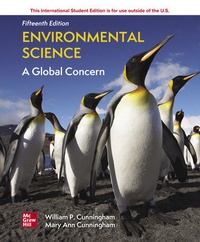
ISE Environmental Science: A Global Concern
15th Edition
Published on 5. March 2020
Book
Paperback/Softback
1280 pages
978-1-260-57510-1 (ISBN)
Description
Environmental Science: A Global Concern is a comprehensive presentation of environmental science for non-science majors which emphasizes critical thinking, environmental responsibility, and global awareness. This book is intended for use in a one or two-semester course in environmental science, human ecology, or environmental studies at the college or advanced placement high school level.
More details
Edition
15th edition
Language
English
Place of publication
OH
United States
Target group
College/higher education
US School Grade: From College Freshman to College Graduate Student
Illustrations
337 Illustrations
Dimensions
Height: 274 mm
Width: 229 mm
Thickness: 23 mm
Weight
1188 gr
ISBN-13
978-1-260-57510-1 (9781260575101)
Copyright in bibliographic data and cover images is held by Nielsen Book Services Limited or by the publishers or by their respective licensors: all rights reserved.
Schweitzer Classification
Persons
William Cunningham is an Emeritus Professor at the University of Minnesota where he taught for 36 years in the Departments of Botany and Genetics and Cell Biology as well as the Conservation Biology Program, the Institute for Social, Economic, and Ecological Sustainability, the Center for Environmental Learning and Leadership, and the McArthur Program in Global Change. He received his Ph.D. in Botany from the University of Texas in 1963 and spent two years at Purdue University as a postdoctoral fellow. At various times, he has been a visiting scholar in Sweden, Norway, Indonesia, and China, as well as several universities and research institutions in the United States.Dr. Cunningham has devoted himself to education and teaching development at the undergraduate level in biology. He began his educational career in structural biology but for the last 10-15 years has concentrated on environmental science, teaching courses such as Social Uses of Biology; Garbage, Government, and the Globe; Environmental Ethics; and Conservation History. Within the past four years, he has received both of the two highest teaching honors that the University of Minnesota bestows -- The Distinguished Teaching Award and a $15,000 Amoco Alumni Award. He has served as a Faculty Mentor for younger faculty at the university, sharing the knowledge and teaching skills that he has gained during his distinguished career.
Mary Ann Cunningham teaches geography and geographic information systems (GIS), and environmental studies at Vassar College, Poughkeepsie, NY. Her research involves using GIS to assess landscape-level problems in conservation and biodiversity. In particular, she is interested in understanding the nature of fragmentation in grassland environments and the effects of fragmentation on the make-up of bird communities. The agricultural landscapes where she has been working represent a complex and fascinating interaction of issues concerning working landscapes, resource use, remnant wildlife habitat, and landscape aesthetics. It is at the intersection of these issues that she likes to try and understand the geography of physical environments. Mary Ann earned a PhD in Geography at the University of Minnesota, an MA in Geography at the University of Oregon, and a BA in Geology at Carleton College.
Mary Ann Cunningham teaches geography and geographic information systems (GIS), and environmental studies at Vassar College, Poughkeepsie, NY. Her research involves using GIS to assess landscape-level problems in conservation and biodiversity. In particular, she is interested in understanding the nature of fragmentation in grassland environments and the effects of fragmentation on the make-up of bird communities. The agricultural landscapes where she has been working represent a complex and fascinating interaction of issues concerning working landscapes, resource use, remnant wildlife habitat, and landscape aesthetics. It is at the intersection of these issues that she likes to try and understand the geography of physical environments. Mary Ann earned a PhD in Geography at the University of Minnesota, an MA in Geography at the University of Oregon, and a BA in Geology at Carleton College.
Content
1 Understanding Our Environment
2 Principles of Science and Systems
3 Matter, Energy, and Life
4 Evolution, Biological Communities, and Species Interactions
5 Biomes: Global Patterns of Life
6 Population Biology
7 Human Populations
8 Environmental Health and Toxicology
9 Food and Hunger
10 Farming: Conventional and Sustainable Practices
11 Biodiversity: Preserving Species
12 Biodiversity: Preserving Landscapes
13 Restoration Ecology
14 Geology and Earth Resources
15 Climate Systems and Climate Change
16 Air Pollution
17 Water Use and Management
18 Water Pollution
19 Conventional Energy
20 Sustainable Energy
21 Solid, Toxic, and Hazardous Waste
22 Urbanization and Sustainable Cities
23 Ecological Economics
24 Environmental Policy, Law, and Planning
25 What Then Shall We Do?
2 Principles of Science and Systems
3 Matter, Energy, and Life
4 Evolution, Biological Communities, and Species Interactions
5 Biomes: Global Patterns of Life
6 Population Biology
7 Human Populations
8 Environmental Health and Toxicology
9 Food and Hunger
10 Farming: Conventional and Sustainable Practices
11 Biodiversity: Preserving Species
12 Biodiversity: Preserving Landscapes
13 Restoration Ecology
14 Geology and Earth Resources
15 Climate Systems and Climate Change
16 Air Pollution
17 Water Use and Management
18 Water Pollution
19 Conventional Energy
20 Sustainable Energy
21 Solid, Toxic, and Hazardous Waste
22 Urbanization and Sustainable Cities
23 Ecological Economics
24 Environmental Policy, Law, and Planning
25 What Then Shall We Do?