

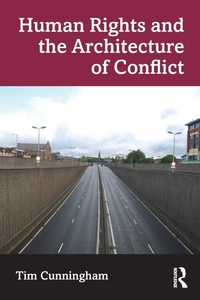
Human Rights and the Architecture of Conflict
1st Edition
Published on 15. September 2025
Book
Paperback/Softback
282 pages
978-1-032-07545-7 (ISBN)
Description
Human Rights and the Architecture of Conflict exposes how governments, public officials and private actors on both sides of the Atlantic entrenched racial and ethnic divisions through manipulation of the planning and design of the built environment.
Based on interviews, never-before-seen documents, and field work carried out in Belfast,Chicago, Miami, Washington D.C., and New York City, this book shows how the planning and design of our built environment impacts the physical, mental, social, economic, political, and environmental well-being of communities. Tim Cunningham, an urban scholar and human rights advocate, reveals how the British Army set about reconfiguring the urban fabric of Belfast as part of a counter-insurgency strategy in the 1970s. His research shows how the techniques used in Northern Ireland during this period mirror earlier processes deployed in U.S. cities under urban renewal and the Interstate Highway Program. A global genealogy of segregation, that examines the trajectory of colonial urbanism in the twentieth century, the text highlights the real-life walls and barriers that cleave communities along ethnic and racial lines and the role of architects, planners, developers, and public officials in erecting them. The final chapter considers some contemporary efforts to address the legacy of these practices through restorative architecture and planning initiatives that aim to deliver more cohesive, sustainable, and inclusive urban spaces.
This book is ideal reading for courses in architecture, city planning, community development, geography, human rights, sociology, transitional justice, urban studies, and Irish history.
Based on interviews, never-before-seen documents, and field work carried out in Belfast,Chicago, Miami, Washington D.C., and New York City, this book shows how the planning and design of our built environment impacts the physical, mental, social, economic, political, and environmental well-being of communities. Tim Cunningham, an urban scholar and human rights advocate, reveals how the British Army set about reconfiguring the urban fabric of Belfast as part of a counter-insurgency strategy in the 1970s. His research shows how the techniques used in Northern Ireland during this period mirror earlier processes deployed in U.S. cities under urban renewal and the Interstate Highway Program. A global genealogy of segregation, that examines the trajectory of colonial urbanism in the twentieth century, the text highlights the real-life walls and barriers that cleave communities along ethnic and racial lines and the role of architects, planners, developers, and public officials in erecting them. The final chapter considers some contemporary efforts to address the legacy of these practices through restorative architecture and planning initiatives that aim to deliver more cohesive, sustainable, and inclusive urban spaces.
This book is ideal reading for courses in architecture, city planning, community development, geography, human rights, sociology, transitional justice, urban studies, and Irish history.
Reviews / Votes
"An impressive exercise in urban forensics engaging infrastructure as social engineering. Case studies from the United States and Northern Ireland provide comparative analyses of strategies for urban segregation by law and by design. Cunningham provides an invaluable resource for understanding and ameliorating legacies of spatial injustice in our cities." - Richard Plunz, Professor Emeritus, Architecture, Planning and Preservation, Columbia University, New York City"For all those students and practitioners in urbanism, particularly those addressing the problems of deeply divided cities, where contested issues of identity and inequality overlap, this is a must-read book. It brings novel insight to the perennial problem of how you reconcile community cohesion and social inclusion by remaking urban space for connectedness over segregation. Perceptively, the book acknowledges the historic injustices of race, religion and class that have imprinted themselves in layers of spatial discrimination and containment that continue to obstruct opportunity for the most marginalised. In a very readable style, and with an impressive set of references, the book challenges us to respect this legacy and all its complexity." - Frank Gaffikin, Emeritus Professor, Queen's University Belfast.
"This is a timely book bringing important issues related to discrimination, exclusion and transformation in urban spaces to the fore, namely the relationship of the built
environment to the management and experience of conflict and inequality. Grounded in deep history of place and time Cunningham provides compelling, insightful and novel insights to these issues." - Prof Fionnuala Ni Aolain KC (Hons), Regents Professor, University of Minnesota Law School and Professor of Law, The Queen's University of Belfast
More details
Language
English
Place of publication
London
United Kingdom
Publishing group
Taylor & Francis Ltd
Target group
College/higher education
Professional and scholarly
Postgraduate, Professional, and Undergraduate Advanced
Illustrations
47 s/w Abbildungen, 47 s/w Photographien bzw. Rasterbilder
47 Halftones, black and white; 47 Illustrations, black and white
Dimensions
Height: 234 mm
Width: 156 mm
Thickness: 16 mm
Weight
462 gr
ISBN-13
978-1-032-07545-7 (9781032075457)
Copyright in bibliographic data and cover images is held by Nielsen Book Services Limited or by the publishers or by their respective licensors: all rights reserved.
Schweitzer Classification
Other editions
Additional editions
Tim Cunningham
Human Rights and the Architecture of Conflict
E-Book
09/2025
Routledge
€69.99
Available for download
Tim Cunningham
Human Rights and the Architecture of Conflict
E-Book
09/2025
Routledge
€69.99
Available for download
Tim Cunningham
Human Rights and the Architecture of Conflict
Book
09/2025
1st Edition
Routledge
€206.80
Shipment within 10-20 days
Person
After nearly two decades as a human rights advocate and researcher, Tim Cunningham earned a PhD from Ulster University's Transitional Justice Institute. He has held senior positions at non-governmental organizations and as a member of government bodies. As a member of Northern Ireland's Historic Monuments Council, he advised the government on preservation issues.
Content
1. The Architecture of Inequality. 2. The Origins of Urban Segregation. 3. Modernist Planning: A Road to Wreck and Ruin. 4. The Legacy of Coercive Architecture and Planning in Belfast. Case Study: The Redevelopment of the Crumlin Road Gaol & Girdwood Barracks. 5. The Legacy of Coercive Architecture in the U.S. 6. Restorative Architecture and the Politics of Reparations.