

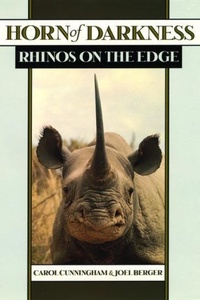
Horn of Darkness
Rhinos on the Edge
Published on 4. September 1997
Book
Hardback
256 pages
978-0-19-511113-2 (ISBN)
Description
The worlds rhinoceroses face extinction because a part of their anatomy is valued too much. Poachers hunt and slaughter them because their horns are treasured. Once an estimated 100,000 black rhinos roamed from the Sahara to the Cape of Good Hope but now less than 3% remain. In all of Africa, there is but a single infenced population numbering more than 100 individuals, in the inhospitable barrens of the Namib Desert.
The hunger for money has resulted in the deaths of more than 160 Zimbabwean poachers as they tried to kill fro the valuable horns, Few options remain to stop the deadly harvest, Although guarded sanctuaries may now be working in Kenya, elsewhere foot patrols, helicopters, and high tech solutions have been tried and most have failed. In 1989 a radical strategy has developed - cutting the horns, The rationale is simple. If a rhino has no horns, the incentive to kill it should disappear.
What has since unfolded is a biological and political drama, Carol Cunningham and Joel Berger describe their passionate quest to help conserve Africa's black rhinos. Arriving with their 19 month old daughter in the fiercely independent country of Namibia, they undertook a fascinating study to understand how horns are involved in the social lives of this charismatic species. This book blends natural history and biology, adventure and adrenaline. Africans and local attitudes. It moves beyond the typical nature study by bringing in real world components of conservation - the delicate mix of western science, politics and economics, and personal despair and hope.
The hunger for money has resulted in the deaths of more than 160 Zimbabwean poachers as they tried to kill fro the valuable horns, Few options remain to stop the deadly harvest, Although guarded sanctuaries may now be working in Kenya, elsewhere foot patrols, helicopters, and high tech solutions have been tried and most have failed. In 1989 a radical strategy has developed - cutting the horns, The rationale is simple. If a rhino has no horns, the incentive to kill it should disappear.
What has since unfolded is a biological and political drama, Carol Cunningham and Joel Berger describe their passionate quest to help conserve Africa's black rhinos. Arriving with their 19 month old daughter in the fiercely independent country of Namibia, they undertook a fascinating study to understand how horns are involved in the social lives of this charismatic species. This book blends natural history and biology, adventure and adrenaline. Africans and local attitudes. It moves beyond the typical nature study by bringing in real world components of conservation - the delicate mix of western science, politics and economics, and personal despair and hope.
Reviews / Votes
Vivid account of the struggle to stop the harvest of rhino horns. * BBC Wildlife * I take my hat off to the effort and energy the authors devoted to studying the rare black rhino in its last African stronghold in Namibia. It is an eloquent and revealing insight into the current life and times of field biologists in sub-Saharan Africa and does give the reader a feel for how difficult it is to collect data on a species with a reputation for bad temper. I would recommend it to anyone who dreams of studying wildlife in Africa. * Iain Gordon, Biologist (1998) 45 (1) * The determined, gutsy couple spent 197 nights with rhinos, with 1,030 hours of observation of about 100 known individuals - a truly tremendous achievement, for which they deserve huge credit. Their book is full of variety. * Brian Bertram, Nature, Vol. 388, 1997 * This book blends natural history, biology and adventure, giving an insight into Africans and local attitudes. It moves beyond the typical nature study by bringing in real world components of conservations, the delicate mix of western science, politics and economics. * Ethology, Ecology & Evolution 10:1998 * '... an entertaining tale of adventures on safari, plus the frustrations of being wildlife scientists, this book is for you ' The Times Higher Education Supplement ' This book is every bit as good as 'Out of Africa' but alot more good ecology in it' Bulletin of the British Ecological SocietyMore details
Language
English
Place of publication
New York
United States
Target group
Professional and scholarly
Product notice
sewn/stitched
Cloth over boards
With dust jacket
Illustrations
16 Fotos bzw. Rasterbilder
16 pp halftones
Dimensions
Height: 238 mm
Width: 163 mm
Thickness: 23 mm
Weight
640 gr
ISBN-13
978-0-19-511113-2 (9780195111132)
Copyright in bibliographic data and cover images is held by Nielsen Book Services Limited or by the publishers or by their respective licensors: all rights reserved.
Schweitzer Classification
Other editions
Additional editions
Book
03/2000
Oxford University Press Inc
€94.40
Shipment within 15-20 days
E-Book
04/1997
1st Edition
OUP eBook
€16.99
Available for download
Persons
Carol Cunningham works in the Department of Environmental and Resource Studies at the University of Nevada. Joel Berger works in the Department of Ecology, Evolution, and Conservation Biology at the University of Nevada.
Content
A Black Rhino Time Line
Map
I. YEAR OF THE MOPANE FLY [1991]
1: In the Rhino's Path
2: Bumbling around in the Bush
3: Trial by Fire
4: Etosha
5: Dark Nights and Moonlight
6: Mom
7: The Unforgiving Desert
8: A Tracker Appears
9: It Depends on Your Perspective
10: Through the Eyes of a Poacher
11: "The Missus"
II. YEAR OF THE TSONGOLOLO [1992]
12: A Caprivi Crossing
13: Rhino Illusions
14: Namib Edge
15: Buried in Sand
16: Lions and Hyenas
17: The Dead and the Brave
18: Concrete Corridors
19: Of Science and Ecology
III. YEAR OF THE SCORPION [1993]
20: The Europa Hof
21: Trails of Dust
22: Of Moths and Maggots
23: The Zimbabwe Massacre
24: Missing Calves
25: The Witch Doctor's Revenge
26: The Pelvis and the Lion
27: Horn Traders
IV. YEAR OF THE HUMAN [1994]
28: Rhino Rhetoric
29: Xenophobia
Epilogue
Postscript
Acknowledgments
Glossary
Selected Bibliography
Index
Map
I. YEAR OF THE MOPANE FLY [1991]
1: In the Rhino's Path
2: Bumbling around in the Bush
3: Trial by Fire
4: Etosha
5: Dark Nights and Moonlight
6: Mom
7: The Unforgiving Desert
8: A Tracker Appears
9: It Depends on Your Perspective
10: Through the Eyes of a Poacher
11: "The Missus"
II. YEAR OF THE TSONGOLOLO [1992]
12: A Caprivi Crossing
13: Rhino Illusions
14: Namib Edge
15: Buried in Sand
16: Lions and Hyenas
17: The Dead and the Brave
18: Concrete Corridors
19: Of Science and Ecology
III. YEAR OF THE SCORPION [1993]
20: The Europa Hof
21: Trails of Dust
22: Of Moths and Maggots
23: The Zimbabwe Massacre
24: Missing Calves
25: The Witch Doctor's Revenge
26: The Pelvis and the Lion
27: Horn Traders
IV. YEAR OF THE HUMAN [1994]
28: Rhino Rhetoric
29: Xenophobia
Epilogue
Postscript
Acknowledgments
Glossary
Selected Bibliography
Index