

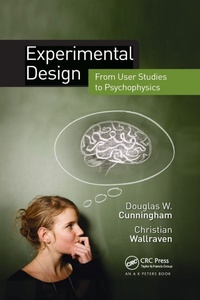
Experimental Design
From User Studies to Psychophysics
1st Edition
Published on 23. October 2019
Book
Paperback/Softback
407 pages
978-0-367-38215-5 (ISBN)
Description
As computers proliferate and as the field of computer graphics matures, it has become increasingly important for computer scientists to understand how users perceive and interpret computer graphics. Experimental Design: From User Studies to Psychophysics is an accessible introduction to psychological experiments and experimental design, covering the major components in the design, execution, and analysis of perceptual studies.
The book begins with an introduction to the concepts central to designing and understanding experiments, including developing a research question, setting conditions and controls, and balancing specificity with generality. The book then explores in detail a number of types of experimental tasks: free description, rating scales, forced-choice, specialized multiple choice, and real-world tasks as well as physiological studies. It discusses the advantages and disadvantages of each type and provides examples of that type of experiment from the authors' own work. The book also covers stimulus-related issues, including popular stimulus resources. It concludes with a thorough examination of statistical techniques for analyzing results, including methods specific to individual tasks.
The book begins with an introduction to the concepts central to designing and understanding experiments, including developing a research question, setting conditions and controls, and balancing specificity with generality. The book then explores in detail a number of types of experimental tasks: free description, rating scales, forced-choice, specialized multiple choice, and real-world tasks as well as physiological studies. It discusses the advantages and disadvantages of each type and provides examples of that type of experiment from the authors' own work. The book also covers stimulus-related issues, including popular stimulus resources. It concludes with a thorough examination of statistical techniques for analyzing results, including methods specific to individual tasks.
More details
Language
English
Place of publication
London
United Kingdom
Publishing group
Taylor & Francis Ltd
Target group
Professional and scholarly
Academic and Professional Practice & Development
Dimensions
Height: 229 mm
Width: 152 mm
Thickness: 22 mm
Weight
589 gr
ISBN-13
978-0-367-38215-5 (9780367382155)
Copyright in bibliographic data and cover images is held by Nielsen Book Services Limited or by the publishers or by their respective licensors: all rights reserved.
Schweitzer Classification
Other editions
Additional editions
Book
11/2011
1st Edition
A K Peters
€175.50
Shipment within 3-4 weeks
E-Book
11/2011
CRC Press
€86.99
Available for download
E-Book
11/2011
CRC Press
€86.99
Available for download
Persons
Cunningham, Douglas W.; Wallraven, Christian
Content
INTRODUCTION: What Is an Experiment? Designing an Experiment. RESPONSE MEASURES: The Task. Free Description. Rating Scales. Forced Choice. Specialized Multiple Choice. Real-World Tasks. Physiology. STIMULI: Choosing Stimuli. Presenting Stimuli: The Psychtoolbox. DATA ANALYSIS: Statistical Issues. Free Description, Questionnaires, and Rating Scales. Force and Multiple Choice. Bibliography.