

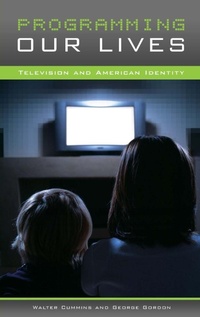
Programming Our Lives
Television and American Identity
Published on 30. June 2006
Book
Hardback
240 pages
978-0-275-99020-6 (ISBN)
Description
In this timely examination of television and American identity, Cummins and Gordon take readers on an informed walk through the changes that TV has already wrought-and those still likely to confront us.
Commercial television in America is less than 60 years old, yet it has had an enormous impact on what we like, what we do, what we know, and how we think. A family transplanted from the 1940s to the present day would certainly be stunned by a fundamentally different world: instead of gathering in the living room for a shared evening of radio, they would be scattered around the house to indulge their individual interests on one of a hundred cable channels; instead of a society with rigid racial and ethnic divisions, they would see people of different ethnicities in passionate embraces; and certainly they would see very different sets of values reflected across the board. They would, in short, find themselves in an unrecognizable America, one both reflected in and shaped by television, a medium that has been shown to have an unprecedented influence on our lives both for better and for worse.
By focusing on the development of television within the cultural context that surrounds it, and drawing on such phenomena as quiz shows, comedy hours, the Kennedy assassination, the Olympics, sitcoms, presidential ads, political debates, MTV, embedded journalism, and reality TV, the authors reveal television's impact on essential characteristics of American life. They cover topics as diverse as politics, crime, medicine, sports, our perceptions, our values, our assumptions about privacy, and our unquenchable need for more things. In addition, they consider the future of the medium in the light of the proliferation of programming options, the prevalence of cameras and receivers in our lives, the growing links between TV and computers, and the crossed boundaries of television throughout the world.
Commercial television in America is less than 60 years old, yet it has had an enormous impact on what we like, what we do, what we know, and how we think. A family transplanted from the 1940s to the present day would certainly be stunned by a fundamentally different world: instead of gathering in the living room for a shared evening of radio, they would be scattered around the house to indulge their individual interests on one of a hundred cable channels; instead of a society with rigid racial and ethnic divisions, they would see people of different ethnicities in passionate embraces; and certainly they would see very different sets of values reflected across the board. They would, in short, find themselves in an unrecognizable America, one both reflected in and shaped by television, a medium that has been shown to have an unprecedented influence on our lives both for better and for worse.
By focusing on the development of television within the cultural context that surrounds it, and drawing on such phenomena as quiz shows, comedy hours, the Kennedy assassination, the Olympics, sitcoms, presidential ads, political debates, MTV, embedded journalism, and reality TV, the authors reveal television's impact on essential characteristics of American life. They cover topics as diverse as politics, crime, medicine, sports, our perceptions, our values, our assumptions about privacy, and our unquenchable need for more things. In addition, they consider the future of the medium in the light of the proliferation of programming options, the prevalence of cameras and receivers in our lives, the growing links between TV and computers, and the crossed boundaries of television throughout the world.
Reviews / Votes
"Television has become such an everyday presence in contemporary America that most people take it for granted, rarely considering the role it has played in the ways society has changed in the past 60 years, according to Cummins and Gordon, a management consultant. They investigate television's impact on American news media, politics, and education; on attitudes toward law, crime, medicine, and sports; and on social interaction and perceptions. By shedding light on television's influence and suggesting ways to be more sophisticated viewers, the authors aim to encourage readers to be more effective parents, consumers, voters, and citizens." - Reference & Research Book NewsMore details
Language
English
Place of publication
United States
Publishing group
Bloomsbury Publishing Plc
Target group
College/higher education
Professional and scholarly
Dimensions
Height: 240 mm
Width: 161 mm
Thickness: 18 mm
Weight
529 gr
ISBN-13
978-0-275-99020-6 (9780275990206)
Copyright in bibliographic data and cover images is held by Nielsen Book Services Limited or by the publishers or by their respective licensors: all rights reserved.
Schweitzer Classification
Other editions
Additional editions
E-Book
06/2006
1st Edition
Praeger Publishers Inc
€55.99
Available for download
Persons
Walter Cummins is Professor Emeritus of English at Farleigh Dickinson University's College at Florham, and Editor Emeritus for The Literary Review: An International Journal of Contemporary Writing. He is the co-author of The Literary Traveler with Thomas E. Kennedy, and the author of the story collections Witness and Where We Live. He serves on the editorial boards of Web Del Sol, Tiferet magazine, and the Fairleigh Dickinson University Press.
George Gordon has pursued a distinguished career as a partner of Hay Management Consultants, and president of its Research for Management Division. He was also a member of the faculty of Rutgers University, and a board member of a number of organizations. Over 50 of his articles and speeches have appeared in numerous business magazines, professional publications and books. These span such publications as Academy of Management Review, Directors and Boards, Research-Technology Management, and International Journal of Business. His previous book, Managing Management Climate, was co- authored with Walter Cummins.
George Gordon has pursued a distinguished career as a partner of Hay Management Consultants, and president of its Research for Management Division. He was also a member of the faculty of Rutgers University, and a board member of a number of organizations. Over 50 of his articles and speeches have appeared in numerous business magazines, professional publications and books. These span such publications as Academy of Management Review, Directors and Boards, Research-Technology Management, and International Journal of Business. His previous book, Managing Management Climate, was co- authored with Walter Cummins.
Content
Preface
Introduction: The Dominant Medium
Part I: Our Personal Lives
Chapter 1: Pictures in Our Heads: "Watching" Radio
Chapter 2: Learning to Watch: TV and Perception
Chapter 3: Watching Together or Alone: Uniting and Dividing
Chapter 4: Mainstreaming: How TV Creates Norms
Chapter 5: Amateurs Performing: "Reality" Television
Chapter 6: Airing Our Lives: Broadcast Revelations
Chapter 7: The Price of Admission: Commercials
Part II: Our Democracy
Chapter 8: Staggering Costs: TV and Elections
Chapter 9: Pressure through Pictures: Governing and TV
Chapter 10: Bleeding Leads: News Dissemination
Part III: Our Society
Chapter 11: Learning from the Screen:
Television and Education
Chapter 12: Doctors and Patients: Television and Medicine
Chapter 13: Criminal Justice: Television and the Law
Chapter 14: Financing the Game: TV and Professional Sports
Part IV: Our World
Chapter 15: Broadcast Cultures: TV in the World
Chapter 16: Multiplying Channels: Proliferation and Fragmentation
Chapter 17: Nothing Out of Range: The Prevalence of TV Cameras
Chapter 18: The Future of TV: Technology, Content, Effects
Conclusion
Chapter 19: American Life after Sixty Years of TV
References
Index
Introduction: The Dominant Medium
Part I: Our Personal Lives
Chapter 1: Pictures in Our Heads: "Watching" Radio
Chapter 2: Learning to Watch: TV and Perception
Chapter 3: Watching Together or Alone: Uniting and Dividing
Chapter 4: Mainstreaming: How TV Creates Norms
Chapter 5: Amateurs Performing: "Reality" Television
Chapter 6: Airing Our Lives: Broadcast Revelations
Chapter 7: The Price of Admission: Commercials
Part II: Our Democracy
Chapter 8: Staggering Costs: TV and Elections
Chapter 9: Pressure through Pictures: Governing and TV
Chapter 10: Bleeding Leads: News Dissemination
Part III: Our Society
Chapter 11: Learning from the Screen:
Television and Education
Chapter 12: Doctors and Patients: Television and Medicine
Chapter 13: Criminal Justice: Television and the Law
Chapter 14: Financing the Game: TV and Professional Sports
Part IV: Our World
Chapter 15: Broadcast Cultures: TV in the World
Chapter 16: Multiplying Channels: Proliferation and Fragmentation
Chapter 17: Nothing Out of Range: The Prevalence of TV Cameras
Chapter 18: The Future of TV: Technology, Content, Effects
Conclusion
Chapter 19: American Life after Sixty Years of TV
References
Index