

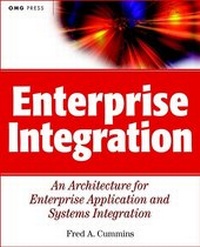
Enterprise Integration
An Architecture for Enterprise Application and Systems Integration
Published on 1. March 2002
Book
Paperback/Softback
XXVIII, 468 pages
978-0-471-40010-3 (ISBN)
Description
An expert guide to solving real business problems using components
This groundbreaking book gets developers up to speed on Enterprise JavaBeans, CORBA components, and other cutting edge technologies that are making it easier and cheaper than ever for companies to integrate all of their applications into unified systems to support corporate decision-making. Fred Cummins presents an overview of the integration architecture and then dives right into the details, including communications messaging techniques for integrating application components, the "publish and subscribe" mechanism for linking components and monitoring business activities, using "adapters" to integrate applications, integrating Web services, work-flow management, and he also supplies proven code solutions for an array of problems associated with integrating packaged and custom applications across the enterprise.
Companion Web site features source code and updates on the EAI architecture and underlying technologies.
More details
Product info
WebSite Associated w/Book
Series
Edition
1. Auflage
Language
English
Place of publication
New York
United States
Target group
College/higher education
Professional and scholarly
Product notice
Paperback (trade)
Unsewn / adhesive bound
Dimensions
Height: 235 mm
Width: 191 mm
Thickness: 27 mm
Weight
920 gr
ISBN-13
978-0-471-40010-3 (9780471400103)
Schweitzer Classification
Person
FRED A. CUMMINS is an Enterprise Consultant with EDS, chair of the Common Enterprise Models Domain Task Force for the OMG, and has over thirty years of experience in management consulting and information systems development. He also contributed to the UML Profile for Enterprise Distributed Object Computing specification.
Content
Foreword.
Introduction.
Acknowledgments.
Assessing the Technology Landscape.
Setting Enterprise Integration Design Objectives.
Defining the Enterprise Architecture.
Establishing the Enterprise Infrastructure.
Creating a Business System Domain.
Providing the Messaging Infrastructure.
Integrating Workflow Management.
Providing Web-Based User Access.
Integrating with XML.
Using Component Technology.
Ensuring Enterprise System Security.
Supporting Enterprise Intelligence.
Implementing the Architecture.
References.
Index.