

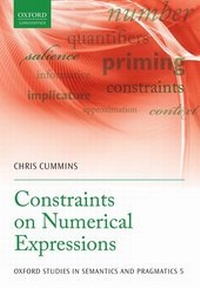
Constraints on Numerical Expressions
Published on 29. January 2015
Book
Hardback
228 pages
978-0-19-968790-9 (ISBN)
Description
This book considers how expressions involving number are used by speakers and understood by hearers. A speaker's choice of expression can be a complex problem even in relatively simple-looking domains. In the case of numerical expressions, there are often many choices that would be semantically acceptable: for instance, if 'more than 200' is true, then so is 'more than 199', 'more than 150', and 'more than 100', among others. A speaker does not choose between these options arbitrarily but also does not consistently follow any simple rule. The hearer is interested not just in what has been said but also in any further inferences that can be drawn.
Chris Cummins offers a set of criteria that individually influence the speaker's choice of expression. The process of choosing what to say is then treated as a problem of multiple constraint satisfaction. This approach enables multiple different considerations, drawn from principles of semantics, philosophy, psycholinguistics and the psychology of number, simultaneously to be integrated within a single coherent account. This constraint-based model offers novel predictions about usage and interpretation that are borne out experimentally and in corpus research. It also explains problematic data in numerical quantification that have previously been handled by more stipulative means, and offers a potential line of attack for addressing the problem of the speaker's choice in more general linguistic environments.
Chris Cummins offers a set of criteria that individually influence the speaker's choice of expression. The process of choosing what to say is then treated as a problem of multiple constraint satisfaction. This approach enables multiple different considerations, drawn from principles of semantics, philosophy, psycholinguistics and the psychology of number, simultaneously to be integrated within a single coherent account. This constraint-based model offers novel predictions about usage and interpretation that are borne out experimentally and in corpus research. It also explains problematic data in numerical quantification that have previously been handled by more stipulative means, and offers a potential line of attack for addressing the problem of the speaker's choice in more general linguistic environments.
More details
Series
Language
English
Place of publication
Oxford
United Kingdom
Target group
College/higher education
Dimensions
Height: 254 mm
Width: 181 mm
Thickness: 19 mm
Weight
590 gr
ISBN-13
978-0-19-968790-9 (9780199687909)
Copyright in bibliographic data and cover images is held by Nielsen Book Services Limited or by the publishers or by their respective licensors: all rights reserved.
Schweitzer Classification
Other editions
Additional editions
Chris Cummins
Constraints on Numerical Expressions
Book
01/2015
Oxford University Press
€73.00
Shipment within 15-20 days
Chris Cummins
Constraints on Numerical Expressions
E-Book
01/2015
1st Edition
OUP eBook
€29.49
Available for download
Person
Chris Cummins is a researcher in experimental semantics and pragmatics, currently employed as a Chancellor's Fellow at the University of Edinburgh. Prior to this, he worked at Bielefeld University within the DFG-funded Collaborative Research Centre (SFB) 673, 'Alignment in Communication'. He obtained his PhD from the University of Cambridge, supervised by Napoleon Katsos. His research interests include the mechanisms of implicature and presupposition, the psychology of dialogue, and more generally issues in experimental and statistical methodology.
Content
1. Introduction ; 2. Constructing a constraint-based model ; 3. Deriving predications from the constraint-based account ; 4. Towards a pragmatic account of superlative quantifier usage ; 5. Scalar implicatures from numerically-quantified expressions ; 6. Corpus evidence for constraints on numerical expressions ; 7. Overview and outlook ; Appendices ; References ; Index