

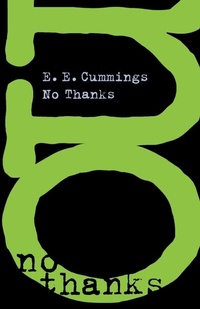
No Thanks
Will be published approx. on 17. December 1998
Book
Paperback/Softback
110 pages
978-0-87140-172-4 (ISBN)
Description
E. E. Cummings, along with Pound, Eliot, and Williams, helped bring about the twentieth-century revolution in literary expression. He is recognized as the author of some of the most beautiful lyric poems written in the English language and also as one of the most inventive American poets of his time. Fresh and candid, by turns earthy, tender, defiant, and romantic, Cummings's poems celebrate the uniqueness of each individual, the need to protest the dehumanizing force of organizations, and the exuberant power of love. No Thanks was first published in 1935; although Cummings was by then in mid-career, he had still not achieved recognition, and the title refers ironically to publishers' rejections. No Thanks contains some of Cummings's most daring literary experiments, and it represents most fully his view of life-romantic individualism. The poems celebrate an openly felt response to the beauties of the natural world, and they give first place to love, especially sexual love, in all its manifestations. The volume includes such favorites as "sonnet entitled how to run the world)," "may I feel said he," "Jehovah buried. Satan dead," "be of love (a little)," and the now-famous grasshopper poem.
More details
Language
English
Place of publication
London
United States
Publishing group
W W Norton & Co Ltd
Dimensions
Height: 216 mm
Width: 140 mm
Thickness: 7 mm
Weight
150 gr
ISBN-13
978-0-87140-172-4 (9780871401724)
Copyright in bibliographic data and cover images is held by Nielsen Book Services Limited or by the publishers or by their respective licensors: all rights reserved.
Schweitzer Classification
Other editions
Additional editions

Persons
E. E. Cummings (1894-1962) was among the most influential, widely read, and revered modernist poets. He was also a playwright, a painter, and a writer of prose. Born in Cambridge, Massachusetts, he studied at Harvard University and, during World War I, served with an ambulance corps in France. He spent three months in a French detention camp and subsequently wrote The Enormous Room, a highly acclaimed criticism of World War I. After the war, Cummings returned to the States and published his first collection of poetry, Tulips & Chimneys, which was characterized by his innovative style: pushing the boundaries of language and form while discussing love, nature, and war with sensuousness and glee. He spent the rest of his life painting, writing poetry, and enjoying widespread popularity and success. George J. Firmage edited many works by Cummings, including Erotic Poems; Complete Poems, 1904- 1962; and Fairy Tales.