

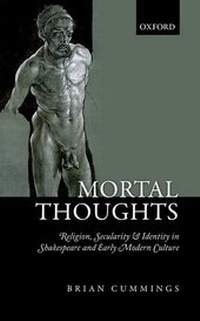
Mortal Thoughts
Religion, Secularity, & Identity in Shakespeare and Early Modern Culture
Published on 22. August 2013
Book
Hardback
384 pages
978-0-19-967771-9 (ISBN)
Description
Since the nineteenth century, it has been assumed that the concept of personal identity in the early modern period is bound up with secularization. Indeed, many explanations of the emergence of modernity have been based on this thesis, in which Shakespeare as a secular author has played a central role. However, the idea of secularization is now everywhere under threat. The secularity of modern society is less apparent than it was a generation ago. Shakespeare, too, has come to be seen in a religious perspective. What happens to human identity in this different framework? Mortal Thoughts asks what selfhood looks like if we do not assume that an idea of the self could only come into being as a result of an emptying out of a religious framework. It does so by examining human mortality. What it is to be human, and how a life is framed by its ending, are issues that cross religious confessions in early modernity, and interrogate the sacred and secular divide. A series of chapters examines literature and art in relation to concepts such as conscience, martyrdom, soliloquy, luck, suicide, and embodiment. Religious and philosophical creativity are revealed as poised around anxieties about finitude and contingency, challenging conventional divisions between kinds of literary and artistic endeavour. Mortal Thoughts considers incipient genres of life writing (More, Foxe and Montaigne) and life drawing (Duerer, Hans Baldung Grien) in relation to dramatic representation and literary narration (Shakespeare, Donne, Milton). In the process it asks whether the problem of human identity rewrites historical boundaries.
Reviews / Votes
a compelling bredth of reference, not merely to the early modern artists and writers who lend their names to the chapters...but to the entire range of classical authors on whom they drew. * Gerard Kilroy, The Times Literary Supplement. * The key concern here is human identity, and it is testament to the brilliance and intellectual verve of this book that such an extensively examined topic as early modern subjectivity has been set out in such a compellingly fresh fashion. * Travis Decook, Review of English Studies * Cummings most certainly succeeds in writing great criticism: his most stunning readings immerse us in the intricate workings of a simple gesture like the hand thrust into fire in John Foxe's Acts and Monuments or the naked body emerging from a dark door in Duerer's enigmatic self-portrait. * Julia Reinhard Lupton, Studies in English Literature 1500-1900 *More details
Language
English
Place of publication
Oxford
United Kingdom
Target group
College/higher education
Professional and scholarly
Illustrations
25 black-and-white halftones
Dimensions
Height: 223 mm
Width: 154 mm
Thickness: 30 mm
Weight
584 gr
ISBN-13
978-0-19-967771-9 (9780199677719)
Copyright in bibliographic data and cover images is held by Nielsen Book Services Limited or by the publishers or by their respective licensors: all rights reserved.
Schweitzer Classification
Other editions
Additional editions
Brian Cummings
Mortal Thoughts
Religion, Secularity, & Identity in Shakespeare and Early Modern Culture
Book
10/2018
Oxford University Press
€51.10
Shipment within 15-20 days
Brian Cummings
Mortal Thoughts
Religion, Secularity, & Identity in Shakespeare and Early Modern Culture
E-Book
08/2013
1st Edition
OUP eBook
€20.99
Available for download
Person
Brian Cummings is Anniversary Professor at the University of York in the Department of English & Related Literature. He previously taught at Trinity College, Cambridge and the University of Sussex, and has held Visiting Fellowships in California, Munich, and Oxford. From 2009-2012 he held a Leverhulme Trust Major Research Fellowship. He is the author of The Literary Culture of the Reformation: Grammar and Grace (2002) and editor of The Book of Common Prayer: the Texts of 1549, 1559, and 1662 (2011), both published by OUP.
Content
Introduction: Secularization and Identity ; The Mortal Self: Durer and Montaigne ; The Reformed Consicence: Thomas More ; The Writer as Martyr: Cranmer and Foxe ; Public Oathes and Private Selves: More, Foxe, and Shakespeare ; Soliloquy and Secularisation: Shakespeare ; Hamlet's Luck: Shakespeare and the Renaissance Bible ; Freedom, Suicide, and Selfhood: Montaigne, Shakespeare, Donne ; Soft Selves: Adam, Eve, and the Art of Embodiement ; Bibliography