

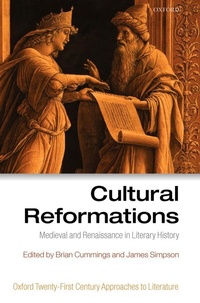
Cultural Reformations
Medieval and Renaissance in Literary History
Published on 24. June 2010
Book
Hardback
704 pages
978-0-19-921248-4 (ISBN)
Description
The original essays in Oxford Twenty-First Century Approaches to Literature mean to provoke rather than reassure, to challenge rather than codify. Instead of summarizing existing knowledge scholars working in the field aim at opening fresh discussion; instead of emphasizing settled consensus they direct their readers to areas of enlivened and unresolved debate.
The deepest periodic division in English literary history has been between the medieval and the early modern, not least because the cultural investments in maintaining that division are exceptionally powerful. Narratives of national and religious identity and freedom; of individual liberties; of the history of education and scholarship; of reading or the history of the book; of the very possibility of persuasive historical consciousness itself: each of these narratives (and more) is motivated by positing a powerful break around 1500.
None of the claims for a profound historical and cultural break at the turn of the fifteenth into the sixteenth centuries is negligible. The very habit of working within those periodic bounds (either medieval or early modern) tends, however, simultaneously to affirm and to ignore the rupture. It affirms the rupture by staying within standard periodic bounds, but it ignores it by never examining the rupture itself. The moment of profound change is either, for medievalists, just over an unexplored horizon; or, for Early Modernists, a zero point behind which more penetrating examination is unnecessary. That situation is now rapidly changing. Scholars are building bridges that link previously insular areas. Both periods are starting to look different in dialogue with each other.
The change underway has yet to find collected voices behind it. Cultural Reformations volume aims to provide those voices. It will give focus, authority, and drive to a new area.
The deepest periodic division in English literary history has been between the medieval and the early modern, not least because the cultural investments in maintaining that division are exceptionally powerful. Narratives of national and religious identity and freedom; of individual liberties; of the history of education and scholarship; of reading or the history of the book; of the very possibility of persuasive historical consciousness itself: each of these narratives (and more) is motivated by positing a powerful break around 1500.
None of the claims for a profound historical and cultural break at the turn of the fifteenth into the sixteenth centuries is negligible. The very habit of working within those periodic bounds (either medieval or early modern) tends, however, simultaneously to affirm and to ignore the rupture. It affirms the rupture by staying within standard periodic bounds, but it ignores it by never examining the rupture itself. The moment of profound change is either, for medievalists, just over an unexplored horizon; or, for Early Modernists, a zero point behind which more penetrating examination is unnecessary. That situation is now rapidly changing. Scholars are building bridges that link previously insular areas. Both periods are starting to look different in dialogue with each other.
The change underway has yet to find collected voices behind it. Cultural Reformations volume aims to provide those voices. It will give focus, authority, and drive to a new area.
Reviews / Votes
An ambitious volume ... should hold great appeal to students and scholars seeking fresh perspectives on familiar topics. * Studies in English Literature: 1500-1900 * There is a wonderful diversity of texts, approaches and ideas on offer here...an exciting and diverse volume. * Mike Rodman Jones, Journal of Northern Renaissance *More details
Series
Language
English
Place of publication
Oxford
United Kingdom
Target group
College/higher education
Professional and scholarly
Illustrations
Frontispiece and five black-and-white halftones
Dimensions
Height: 250 mm
Width: 175 mm
Thickness: 42 mm
Weight
1370 gr
ISBN-13
978-0-19-921248-4 (9780199212484)
Copyright in bibliographic data and cover images is held by Nielsen Book Services Limited or by the publishers or by their respective licensors: all rights reserved.
Schweitzer Classification
Other editions
Additional editions
Book
12/2016
Oxford University Press
€61.36
Shipment within 15-20 days
Brian Cummings | James Simpson
Cultural Reformations: Medieval and Renaissance in Literary History
Medieval and Renaissance in Literary History
E-Book
06/2010
1st Edition
OUP Oxford
€120.00
Available for download
Persons
Brian Cummings is Professor of English at the University of Sussex and was founding Director of the Centre for Early Modern Studies from 2004 to 2008. He received his BA and PhD at Cambridge University, and before moving to Sussex was Fellow of Trinity College, Cambridge. He is the author of The Literary Culture of the Reformation: Grammar and Grace (Oxford University Press, 2002), a Times Literary Supplement Book of the Year for 2003. A paperback edition of this book appeared in July 2007. He has also published widely in journals such as English Literary Renaissance and Studies in Church History , and is a contributor to The Cambridge History of Medieval English Literature (1999) and The Oxford Dictionary of National Biography (2004).
James Simpson is Donald P. and Katherine B. Loker Professor of English at Harvard University (2004-). He was previously Professor of Medieval and Renaissance English at the University of Cambridge (1999-2003). He is a Life Fellow of Fellow of Girton College and an Honorary Fellow of the Australian Academy of the Humanities. His books include Piers Plowman: An Introduction to the B-Text (Longman, 1990); Sciences and the Self in Medieval Poetry (Cambridge University Press, 1995); Reform and Cultural Revolution, being volume 2 in the Oxford English Literary History (Oxford University Press, 2002) (winner of the British Academy Sir Israel Gollancz Prize, 2007); and Burning to Read: English Fundamentalism and its Reformation Opponents (Harvard University Press, 2007) (winner of the Silver Medal, 2008 Independent Publisher Book Awards, religion category). He is currently writing about iconoclasm in the Anglo-American tradition.
James Simpson is Donald P. and Katherine B. Loker Professor of English at Harvard University (2004-). He was previously Professor of Medieval and Renaissance English at the University of Cambridge (1999-2003). He is a Life Fellow of Fellow of Girton College and an Honorary Fellow of the Australian Academy of the Humanities. His books include Piers Plowman: An Introduction to the B-Text (Longman, 1990); Sciences and the Self in Medieval Poetry (Cambridge University Press, 1995); Reform and Cultural Revolution, being volume 2 in the Oxford English Literary History (Oxford University Press, 2002) (winner of the British Academy Sir Israel Gollancz Prize, 2007); and Burning to Read: English Fundamentalism and its Reformation Opponents (Harvard University Press, 2007) (winner of the Silver Medal, 2008 Independent Publisher Book Awards, religion category). He is currently writing about iconoclasm in the Anglo-American tradition.
Content
INTRODUCTION: MEDIEVAL AND RENAISSANCE IN LITERARY HISTORY; HISTORIES; SPATIALITIES; DOCTRINES; LEGALITIES; OUTSIDE THE LAW; LITERATURE; COMMUNITIES; LABOUR; SELFHOOD; INDEX