

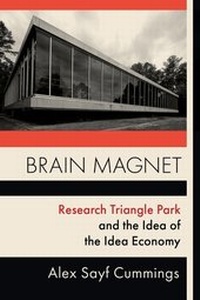
Brain Magnet
Research Triangle Park and the Idea of the Idea Economy
Published on 28. April 2020
Book
Hardback
264 pages
978-0-231-18490-8 (ISBN)
Description
Beginning in the 1950s, a group of academics, businesspeople, and politicians set out on an ambitious project to remake North Carolina's low-wage economy. They pitched the universities of Raleigh, Durham, and Chapel Hill as the kernel of a tech hub, Research Triangle Park, which would lure a new class of highly educated workers. In the process, they created a blueprint for what would become known as the knowledge economy: a future built on intellectual labor and the production of intellectual property.
In Brain Magnet, Alex Sayf Cummings reveals the significance of Research Triangle Park to the emergence of the high-tech economy in a postindustrial United States. She analyzes the use of ideas of culture and creativity to fuel economic development, how workers experienced life in the Triangle, and the role of the federal government in bringing the modern technology industry into being. As Raleigh, Durham, and Chapel Hill were transformed by high-tech development, the old South gave way to a distinctly new one, which welded the intellectual power of universities to a vision of the suburban good life. Cummings pinpoints how the story of the Research Triangle sheds new light on the origins of today's urban landscape, in which innovation, as exemplified by the tech industry, is lauded as the engine of economic growth against a backdrop of gentrification and inequality. Placing the knowledge economy in a broader cultural and intellectual context, Brain Magnet offers vital insight into how tech-driven development occurs and the people and places left in its wake.
In Brain Magnet, Alex Sayf Cummings reveals the significance of Research Triangle Park to the emergence of the high-tech economy in a postindustrial United States. She analyzes the use of ideas of culture and creativity to fuel economic development, how workers experienced life in the Triangle, and the role of the federal government in bringing the modern technology industry into being. As Raleigh, Durham, and Chapel Hill were transformed by high-tech development, the old South gave way to a distinctly new one, which welded the intellectual power of universities to a vision of the suburban good life. Cummings pinpoints how the story of the Research Triangle sheds new light on the origins of today's urban landscape, in which innovation, as exemplified by the tech industry, is lauded as the engine of economic growth against a backdrop of gentrification and inequality. Placing the knowledge economy in a broader cultural and intellectual context, Brain Magnet offers vital insight into how tech-driven development occurs and the people and places left in its wake.
Reviews / Votes
From tobacco and plow to computer and creative economy, this rich and eloquent history shows how a group of civic leaders put rural North Carolina at the forefront of the postindustrial revolution. In California, they say Silicon Valley is one of a kind; this marvelous book proves otherwise. -- Fred Turner, author of <i>From Counterculture to Cyberculture: Stewart Brand, the Whole Earth Network, and the Rise of Digital Utopianism</i> North Carolina's Research Triangle emerged a half century or so ago as one of a veritable handful of the original suburban high-tech "office parks." Though its allure has been challenged by the rise of urban tech and the return of innovation and high-tech industries to big cities, the Triangle persists. Brain Magnet provides a much-needed historical account of the rise and challenges of this model of high-tech development. -- Richard Florida, author of <i>The Rise of the Creative Class: And How It's Transforming Work, Leisure, Community, and Everyday Life</i> Alex Cummings has written a brilliant history of the unlikely making of North Carolina's Research Triangle Park. The RTP has proven to be a grand success-but not for everyone. Cummings's site-specific account of the idea economy gives us much to ponder. -- David Farber, author of <i> Crack: Rock Cocaine, Street Capitalism, and the Decade of Greed</i> Brain Magnet does essential work in connecting the historical processes of urban development to the social, spatial, and intellectual influences of universities. There are many more cases like RTP across the nation. Now scholars have a blueprint to better analyze them. -- Walter D. Greason, author of <i>Suburban Erasure: How the Suburbs Ended the Civil Rights Movement in New Jersey</i> In an excellent treatment of the emergence of the postindustrial economy in the U.S. South, Cummings does a great job of chronicling the seeds of economic transformation using an underexplored case study. -- Bill Graves, coeditor of <i>Charlotte, NC: The Global Evolution of a New South City</i> Smart and insightful...eminently readable. -- Peter Coclanis * Triangle Business Journal * A stellar contribution to multiple historical subfields, Brain Magnet exemplifies the best of the History of Capitalism. Demystifying the rhetoric of boosters and underscoring the uneven outcomes of postindustrial capitalism, the book adds to the growing urban history literature on the high tech economy, * Metropole * Demonstrates that the economic revolution that transformed the Triangle in the last half of the twentieth century was as much a national story as a local one. * North Carolina Historical Review *More details
Series
Language
English
Place of publication
New York
United States
Target group
Professional and scholarly
Product notice
Trade binding
Illustrations
19 b&w figures
Dimensions
Height: 229 mm
Width: 152 mm
ISBN-13
978-0-231-18490-8 (9780231184908)
Copyright in bibliographic data and cover images is held by Nielsen Book Services Limited or by the publishers or by their respective licensors: all rights reserved.
Schweitzer Classification
Other editions
Additional editions
Book
04/2020
Columbia University Press
€31.00
Article not available at the moment

E-Book
04/2020
1st Edition
Columbia University Press
€29.49
Available for download
Person
Alex Sayf Cummings is associate professor of history at Georgia State University. She is the author of Democracy of Sound: Music Piracy and the Remaking of American Copyright in the Twentieth Century (2013).
Content
Acknowledgments
Preface: RTP Donuts
Introduction: From Textiles and Tobacco to the City of Ideas
1. Imagining the Triangle: The Unlikely Origins of the Creative City in the Cold War South
2. "Not a Second Ruhr": Building a Postindustrial Economy in the 1960s
3. Welcome to Parkwood: Newcomers Find Their Way in the Emerging Triangle
Interlude: Sweet Gums, Traffic Jams, and Cilantro
4. "The Greatest Concentration of PhDs in the Country": The Idea Economy Comes of Age in the Triangle
5. Cary, SAS, and the Search for the Good Life
Interlude: The Islamic School in Parkwood
6. "We Think a Lot": The Triangle in the Age of Gentrification
Epilogue: The Figure of the Knowledge Worker
Notes
Index
Preface: RTP Donuts
Introduction: From Textiles and Tobacco to the City of Ideas
1. Imagining the Triangle: The Unlikely Origins of the Creative City in the Cold War South
2. "Not a Second Ruhr": Building a Postindustrial Economy in the 1960s
3. Welcome to Parkwood: Newcomers Find Their Way in the Emerging Triangle
Interlude: Sweet Gums, Traffic Jams, and Cilantro
4. "The Greatest Concentration of PhDs in the Country": The Idea Economy Comes of Age in the Triangle
5. Cary, SAS, and the Search for the Good Life
Interlude: The Islamic School in Parkwood
6. "We Think a Lot": The Triangle in the Age of Gentrification
Epilogue: The Figure of the Knowledge Worker
Notes
Index