

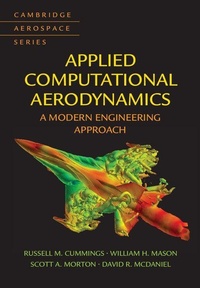
Applied Computational Aerodynamics
A Modern Engineering Approach
Published on 27. April 2015
Book
Hardback
888 pages
978-1-107-05374-8 (ISBN)
Description
This computational aerodynamics textbook is written at the undergraduate level, based on years of teaching focused on developing the engineering skills required to become an intelligent user of aerodynamic codes. This is done by taking advantage of CA codes that are now available and doing projects to learn the basic numerical and aerodynamic concepts required. This book includes a number of unique features to make studying computational aerodynamics more enjoyable. These include: * The computer programs used in the book's projects are all open source and accessible to students and practicing engineers alike on the book's website, www.cambridge.org/aerodynamics. The site includes access to images, movies, programs, and more * The computational aerodynamics concepts are given relevance by CA Concept Boxes integrated into the chapters to provide realistic asides to the concepts * Readers can see fluids in motion with the Flow Visualization Boxes carefully integrated into the text.
Reviews / Votes
'Based on the authors' teaching and research experience, they have succeeded in composing a volume for students in aeronautical and aerospace engineering by including a number of unique features to enthuse the readers. ... I strongly recommend this textbook for aeronautical or aerospace students at either undergraduate or postgraduate level. Aerospace engineers/researchers will also find it useful as a handbook. This comprehensive volume can be used by those with little background in fluid mechanics, aerodynamics or CFD as a self-contained learning material.' Ning Qin, The Aeronautical Journal '... the text has an easy style, with useful quotes, insets containing biographies of people who work in the field, and concept boxes that summarize the most important ideas. There are also projects included for most chapters, together with traditional problems. These features definitely make the text captivating and should help undergraduate students become passionate about the field ... especially useful from the point of view of the practitioner. The text helps the student get familiar with various visualization techniques used not only by computational aerodynamicists but also by experimentalists ... I really like the practical emphasis of the presentation and recommend it as an excellent material for an undergraduate class in computational aerodynamics.' Daniel Livescu, AIAA Journal 'An excellent textbook with a lot of useful information regarding computational aerodynamics.' Xiaofeng Liu, San Diego State UniversityMore details
Series
Language
English
Place of publication
Cambridge
United Kingdom
Target group
College/higher education
Illustrations
Worked examples or Exercises; 25 Tables, unspecified; 596 Halftones, unspecified; 45 Line drawings, unspecified
Dimensions
Height: 260 mm
Width: 183 mm
Thickness: 52 mm
Weight
1838 gr
ISBN-13
978-1-107-05374-8 (9781107053748)
Copyright in bibliographic data and cover images is held by Nielsen Book Services Limited or by the publishers or by their respective licensors: all rights reserved.
Schweitzer Classification
Other editions
Additional editions
Russell M. Cummings | William H. Mason | Scott a. Morton
Applied Computational Aerodynamics
A Modern Engineering Approach
E-Book
04/2015
Cambridge University Press
€97.49
Available for download
E-Book
04/2015
Cambridge University Press
€88.99
Available for download
Persons
Russell M. Cummings is a professor of aeronautics at the US Air Force Academy, where he teaches fluid mechanics, aerodynamics, and numerical methods, in addition to computational aerodynamics. Professor Cummings is the coauthor of Aerodynamics for Engineers, 6th edition, and is also professor emeritus of aerospace engineering at California Polytechnic State University. Professor Cummings has specialized in high angle of attack aerodynamics and manoeuvring aircraft simulation for most of his career. William H. Mason is a professor emeritus of aerospace engineering at Virginia Polytechnic Institute and State University. As a member of the Virginia Tech community since 1989, Mason has advised many undergraduate and graduate students in the aerospace engineering degree program and has served as graduate advisor for twenty-three master's thesis students and nine doctoral students. In addition, he advised numerous undergraduate aircraft-design teams, with nine first-place honors in international design competitions and ten second- or third-place honors. He was the advisor to the Virginia Tech student chapter of the American Institute of Aeronautics and Astronautics (AIAA) and to the Design Build Fly Team. Scott A. Morton is a researcher at the University of Dayton Research Institute and is the principal software developer for the Kestrel Fixed Wing Aircraft Product of the Computational Research and Engineering Acquisition Tools and Environments (CREATE) Program, part of the DoD High Performance Computing Modernization Program Office. He leads a team of thirteen aerodynamicists, structural dynamicists and software engineers in a twelve year project to produce a production quality tool integrating aerodynamics, dynamic stability and control, structures, propulsion, and store and cargo separation into a single simulation on a peta-flop class machine. Dr Morton served as a professor of aeronautics at the US Air Force Academy from 1998 to 2006, at which time he retired from the Air Force at the rank of Lt Colonel. Dr Morton has specialized in the areas of high angle of attack aerodynamics, aeroelasticity, and computational stability and control in his twenty-nine-year career. David R. McDaniel began his career serving in the US Air Force conducting flight tests to assess the stability and control characteristics of various military aircraft. He later taught aerodynamics and thermodynamics at the US Air Force Academy where he first entered into the world of computational aerodynamics. He worked as a researcher in the Aeronautics Lab at the Academy for several years developing computational techniques for simulating various multidisciplinary problems. Dr McDaniel currently is a Research Associate Professor at the University of Alabama, Birmingham where he works on the Kestrel fixed-wing product development team as part of the CREATE effort managed by the DoD High Performance Computing Modernization Program.
Content
1. Introduction to computational aerodynamics; 2. Computers, codes, and engineering; 3. Getting ready for computational aerodynamics: fluid-mechanics foundations; 4. Getting ready for computational aerodynamics: aerodynamics concepts; 5. Classical linear-theory computational aerodynamics; 6. Introduction to computational fluid dynamics; 7. Geometry and grids: a key consideration in computational aerodynamics; 8. Viscosity and turbulence modeling in computational aerodynamics; 9. Flow visualization: the art of computational aerodynamics; 10. Applications of computational aerodynamics; Appendix A: geometry for aerodynamicists; Appendix B: sources of aerodynamic data for code validation; Appendix C: potential-flow review; Appendix D: computational aerodynamics programs; Appendix E: structured grid transformations; Appendix F: commonly used turbulence models.