

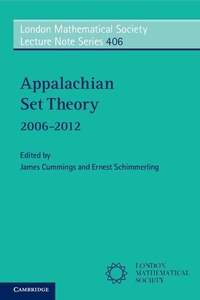
Appalachian Set Theory
2006-2012
Published on 15. November 2012
Book
Paperback/Softback
432 pages
978-1-107-60850-4 (ISBN)
Description
This volume takes its name from a popular series of intensive mathematics workshops hosted at institutions in Appalachia and surrounding areas. At these meetings, internationally prominent set theorists give one-day lectures that focus on important new directions, methods, tools and results so that non-experts can begin to master these and incorporate them into their own research. Each chapter in this volume was written by the workshop leaders in collaboration with select student participants, and together they represent most of the meetings from the period 2006-2012. Topics covered include forcing and large cardinals, descriptive set theory, and applications of set theoretic ideas in group theory and analysis, making this volume essential reading for a wide range of researchers and graduate students.
More details
Series
Language
English
Place of publication
Cambridge
United Kingdom
Target group
Professional and scholarly
Product notice
Paperback (trade)
Illustrations
Worked examples or Exercises; 1 Halftones, unspecified; 9 Line drawings, unspecified
Dimensions
Height: 229 mm
Width: 152 mm
Thickness: 25 mm
Weight
697 gr
ISBN-13
978-1-107-60850-4 (9781107608504)
Copyright in bibliographic data and cover images is held by Nielsen Book Services Limited or by the publishers or by their respective licensors: all rights reserved.
Schweitzer Classification
Other editions
Additional editions
E-Book
03/2013
1st Edition
Cambridge University Press
€70.99
Available for download
E-Book
11/2012
Cambridge University Press
€58.99
Available for download
Persons
James Cummings is a Professor of Mathematical Sciences at Carnegie Mellon University in Pittsburgh, Pennsylvania. Ernest Schimmerling is a Professor of Mathematical Sciences at Carnegie Mellon University in Pittsburgh, Pennsylvania.
Content
Contributors; Introduction; 1. An introduction to Pmax forcing Paul B. Larson, Peter Lumsdaine and Yimu Yin; 2. Countable Borel equivalence relations Simon Thomas and Scott Schneider; 3. Set theory and operator algebras Ilijas Farah and Eric Wofsey; 4. Set mapping reflection Justin Moore and David Milovich; 5. An introduction to hyperlinear and sofic groups Vladimir G. Pestov and Aleksandra Kwiatkowska; 6. Aronszajn trees and the SCH Itay Neeman and Spencer Unger; 7. Iterated forcing and the continuum hypothesis Todd Eisworth, Justin Tatch Moore and David Milovich; 8. Short extender forcing Moti Gitik and Spencer Unger; 9. The complexity of classification problems in ergodic theory Alexander S. Kechris and Robin D. Tucker-Drob; 10. On the strengths and weaknesses of weak squares Menachem Magidor and Chris Lambie-Hanson; 11. Proper forcing remastered Boban Velickovic and Giorgio Venturi; 12. Set theory and von Neumann algebras Asger Toernquist and Martino Lupini; 13. The HOD dichotomy W. Hugh Woodin, Jacob Davis and Daniel Rodriguez.