

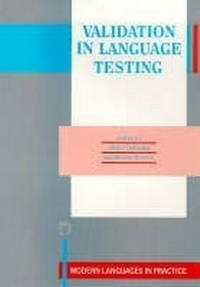
Validation in Language Testing
Published on 22. September 1995
Book
Hardback
264 pages
978-1-85359-296-6 (ISBN)
Description
The validation of language tests is widely discussed and expected, but only in recent years have researchers adopted a variety of innovative techniques for developing, assessing and validating specific tests of second or foreign language proficiency and their impact on education and society. Indeed, as the present volume clearly demonstrates, many different techniques for empirical analysis and types of evidence may be used to assess and interpret the validity of diverse aspects of language tests as well as the consequences they may have for language students, educators and society. The 12 chapters in this book are by leading researchers in different parts of the world, each originally presented at the 14th Annual Language Testing Research Colloquium. An introductory chapter reviews theories of test validation and distinguishes how each of the 12 chapters serves as a unique case study in establishing the validity of a specific language test, its uses, or its societal impact. The volume will be of interest to all persons working with language tests, educational and government administrators and researchers, and graduate students of evaluation in second or foreign languages.
More details
Series
Language
English
Place of publication
Bristol
United Kingdom
Publishing group
Channel View Publications Ltd
Target group
College/higher education
Professional and scholarly
Dimensions
Height: 210 mm
Width: 148 mm
Thickness: 20 mm
Weight
447 gr
ISBN-13
978-1-85359-296-6 (9781853592966)
Copyright in bibliographic data and cover images is held by Nielsen Book Services Limited or by the publishers or by their respective licensors: all rights reserved.
Schweitzer Classification
Other editions
Additional editions
Alister Cumming | Richard Berwick
Validation in Language Testing
Book
09/1995
Multilingual Matters
€54.61
Article exhausted; check different version
Persons
Alister Cumming is Head of the Modern Language Centre and Associate Professor of Curriculum at the Ontario Institute for Studies in Education where he teaches graduate courses and conducts research on curriculum, instruction, learning, and evaluation in second-language education. Richard Berwick is Assistant Professor in the Department of Language Education at the University of British Columbia, where he teaches graduate and undergraduate courses and conducts research on second-language testing, learning, teaching and curriculum.
Content
Alister Cumming: Introduction: The Concept of Validation in Language Testing
SECTION I. EVIDENTIAL BASES OF TEST INTERPRETATION
l.i. Validation of New Instruments and Procedures: Feasibility, Reliability, and Model-Fitting
1. Michael Milanovic, Nick Saville, Alastair Pollitt and Annette Cook: Developing Rating Scales for CASE: Theoretical Concerns and Analyses
2. Belle Tyndall and Dorry Mann Kenyon: Validation of a New Holistic Rating Scale Using Rasch Multi-faceted Analysis
I.ii. Criterion Evidence in Test Interpretation: Hypothesis Testing for Construct Validation
3. Sara Cushing Weigle and Brian Lynch: Hypothesis Testing in Construct Validation
4. Alister Cumming and Dean Mellow: An Investigation into the Validity of Written Indicators of Second Language Proficiency
I.iii. Concurrent Validation: Comparing Alternative Test Methods
5. Ari Huhta and Elina Randell: Multiple-choice Summary: A Measure of Text Comprehension
6. Michel Laurie: Using the Information Curve to Assess Language CAT Efficiency
SECTION II. EVIDENTIAL BASES OF LANGUAGE TEST USE
II.i. Criterion Evidence in Test Use: Expert Judgments
7. Charles W. Stansfield and Dorry Mann Kenyon: Comparing the Scaling of Speaking Tasks by Language Teachers and by the ACTFL Guidelines
II.ii. Tracing Learners' Cognitive Processes and Domain-Specific Knowledge in Test Use
8. Ingrid F. Wijgh: A Communicative Test in Analysis: Strategies in Reading Authentic Texts
9. Caroline Clapham: What Makes an ESP Reading Test Appropriate for its Candidates?
SECTION III. CONSEQUENTIAL BASES OF LANGUAGE TESTING: IMPACTS ON EDUCATIONAL AND PROFESSIONAL SYSTEMS
10. Dianne Wall and J. Charles Alderson: Examining Washback: The Sri Lankan Impact Study
11. Alan Davies: The Role of the Segmental Dictionary in Professional Validation: Constructing a Dictionary of Language Testing
12. Kathleen M. Bailey and James Dean Brown: Language Testing Courses: What Are They?
SECTION I. EVIDENTIAL BASES OF TEST INTERPRETATION
l.i. Validation of New Instruments and Procedures: Feasibility, Reliability, and Model-Fitting
1. Michael Milanovic, Nick Saville, Alastair Pollitt and Annette Cook: Developing Rating Scales for CASE: Theoretical Concerns and Analyses
2. Belle Tyndall and Dorry Mann Kenyon: Validation of a New Holistic Rating Scale Using Rasch Multi-faceted Analysis
I.ii. Criterion Evidence in Test Interpretation: Hypothesis Testing for Construct Validation
3. Sara Cushing Weigle and Brian Lynch: Hypothesis Testing in Construct Validation
4. Alister Cumming and Dean Mellow: An Investigation into the Validity of Written Indicators of Second Language Proficiency
I.iii. Concurrent Validation: Comparing Alternative Test Methods
5. Ari Huhta and Elina Randell: Multiple-choice Summary: A Measure of Text Comprehension
6. Michel Laurie: Using the Information Curve to Assess Language CAT Efficiency
SECTION II. EVIDENTIAL BASES OF LANGUAGE TEST USE
II.i. Criterion Evidence in Test Use: Expert Judgments
7. Charles W. Stansfield and Dorry Mann Kenyon: Comparing the Scaling of Speaking Tasks by Language Teachers and by the ACTFL Guidelines
II.ii. Tracing Learners' Cognitive Processes and Domain-Specific Knowledge in Test Use
8. Ingrid F. Wijgh: A Communicative Test in Analysis: Strategies in Reading Authentic Texts
9. Caroline Clapham: What Makes an ESP Reading Test Appropriate for its Candidates?
SECTION III. CONSEQUENTIAL BASES OF LANGUAGE TESTING: IMPACTS ON EDUCATIONAL AND PROFESSIONAL SYSTEMS
10. Dianne Wall and J. Charles Alderson: Examining Washback: The Sri Lankan Impact Study
11. Alan Davies: The Role of the Segmental Dictionary in Professional Validation: Constructing a Dictionary of Language Testing
12. Kathleen M. Bailey and James Dean Brown: Language Testing Courses: What Are They?