

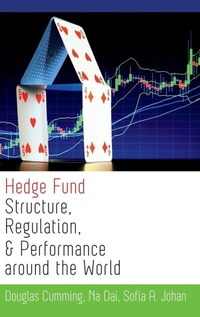
Hedge Fund Structure, Regulation, and Performance around the World
Published on 7. March 2013
Book
Hardback
312 pages
978-0-19-986256-6 (ISBN)
Description
Hedge funds and their managers have been vilified in recent times for their high-risk activities and relative lack of regulatory oversight. A recurrent concern shared by market participants and regulators around the world is that the increasing size of the hedge fund industry coupled with potential agency problems, activist investment practices, and herding behavior may exacerbate financial instability. However, while it is frequently suggested that hedge funds are unregulated, they are in fact regulated to some degree in every country around the world.
It is important to consider differences in legal and institutional settings across countries as they directly affect the structure, governance, and performance of hedge funds. In this book, the authors consider data from a multitude of countries to understand how and why hedge fund markets differ around the world. While hedge funds are hardly regulated in the US, other jurisdictions implement different and sometimes more onerous sets of regulatory requirements. As explained in the book, international differences in hedge fund regulation include, but are not limited to, minimum capitalization requirements, restrictions on the location of key service providers, and different permissible distribution channels via private placements, banks, other regulated or non-regulated financial intermediaries, wrappers, investment managers, and fund distribution companies.
It is important to consider differences in legal and institutional settings across countries as they directly affect the structure, governance, and performance of hedge funds. In this book, the authors consider data from a multitude of countries to understand how and why hedge fund markets differ around the world. While hedge funds are hardly regulated in the US, other jurisdictions implement different and sometimes more onerous sets of regulatory requirements. As explained in the book, international differences in hedge fund regulation include, but are not limited to, minimum capitalization requirements, restrictions on the location of key service providers, and different permissible distribution channels via private placements, banks, other regulated or non-regulated financial intermediaries, wrappers, investment managers, and fund distribution companies.
Reviews / Votes
This book is a valuable contribution to the literature on the always-evolving nature of hedge funds in global capital markets. The authors do an excellent job demonstrating that not all capital markets are the same and that market structure and design matter for all stakeholders involved in the hedge fund industry. Regulators, scholars, and investors who want to truly understand the incentives that drive hedge fund managers in where, why, and how they operate should read Hedge Fund Structure, Regulation, and Performance around the World. * Ryan Barry, Managing Director, Diversified Global Asset Management *More details
Language
English
Place of publication
New York
United States
Target group
Professional and scholarly
College/higher education
Illustrations
15 illustrations
Dimensions
Height: 240 mm
Width: 161 mm
Thickness: 23 mm
Weight
695 gr
ISBN-13
978-0-19-986256-6 (9780199862566)
Copyright in bibliographic data and cover images is held by Nielsen Book Services Limited or by the publishers or by their respective licensors: all rights reserved.
Schweitzer Classification
Other editions
Additional editions
Douglas Cumming | Na Dai | Sofia A. Johan
Hedge Fund Structure, Regulation, and Performance around the World
E-Book
01/2013
1st Edition
OUP eBook
€40.49
Available for download
Douglas Cumming | Na Dai | Sofia A. Johan
Hedge Fund Structure, Regulation, and Performance around the World
E-Book
01/2013
1st Edition
OUP eBook
€40.49
Available for download
Persons
Douglas Cumming, JD, PhD, CFA, is a Professor of Finance and Entrepreneurship and the Ontario Research Chair at the Schulich School of Business, York University. His research spans areas that include entrepreneurship, entrepreneurial finance, venture capital, private equity, IPOs, law and finance, market surveillance, and hedge funds. He is a Co-Editor of Entrepreneurship Theory and Practice, and has been a guest editor 9 times for special issues of top journals. He has published 9 books, 28 book chapters, and 85 articles in leading refereed finance, entrepreneurship, management, and legal academic journals since completing his J.D./Ph.D. in 1999.
Na Dai is an Assistant Professor of Finance at the School of Business at the University of Albany (SUNY). Her primary research interests are corporate finance, the public and private offering, the financing of entrepreneurship and innovation, and hedge funds. Her scholarly works have appeared in leading finance journals and entrepreneurship journals.
Sofia Johan, J.D., Ph.D. is an Adjunct Professor of Law, Entrepreneurship and Finance at the Schulich School of Business, York University. Her research areas include entrepreneurship, entrepreneurial finance, venture capital, private equity, IPOs, law and finance, market surveillance and hedge funds.
Na Dai is an Assistant Professor of Finance at the School of Business at the University of Albany (SUNY). Her primary research interests are corporate finance, the public and private offering, the financing of entrepreneurship and innovation, and hedge funds. Her scholarly works have appeared in leading finance journals and entrepreneurship journals.
Sofia Johan, J.D., Ph.D. is an Adjunct Professor of Law, Entrepreneurship and Finance at the Schulich School of Business, York University. Her research areas include entrepreneurship, entrepreneurial finance, venture capital, private equity, IPOs, law and finance, market surveillance and hedge funds.
Author
Professor and Ontario Research ChairProfessor and Ontario Research Chair, York University - Schulich School of Business
Assistant Professor of FinanceAssistant Professor of Finance, SUNY at Albany
TILEC/AFM Senior Research FellowTILEC/AFM Senior Research Fellow, Tilburg Law and Economics Center
Content
Preface ; 1. Introduction to Hedge Funds ; 2. Agency Problems in Delegated Portfolio Management ; 3. International Perspectives on Hedge Fund Regulation ; 4. Overview of Empirical Finance Methods to Study Hedge Funds ; 5. Hedge Fund Forum Shopping ; 6. Hedge Fund Capital Raising ; 7. Hedge Fund Performance and Compensation ; 8. Hedge Fund Misreporting ; 9. Hedge Fund Performance Persistence ; 10. Hedge Fund Liquidation and Influence on the General Market ; 11. Conclusions, Unanswered Questions and the Future of the Hedge Fund Industry