

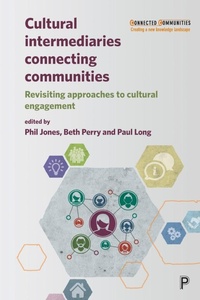
Cultural Intermediaries Connecting Communities
Revisiting Approaches to Cultural Engagement
Policy Press
1st Edition
Published on 12. June 2019
Book
Paperback/Softback
252 pages
978-1-4473-4501-5 (ISBN)
Description
Based on a four-year research project which highlights the important role of community organisations as intermediaries between community and culture, this book analyses the role played by cultural intermediaries who seek to mitigate the worst effects of social exclusion through engaging communities with different forms of cultural consumption and production. The authors challenge policymakers who see cultural intermediation as an inexpensive fix to social problems and explore the difficulty for intermediaries to rapidly adapt their activity to the changing public-sector landscape and offer alternative frameworks for future practice.
Reviews / Votes
"This book looks behind the bland statement that 'culture is good for you' and explores the messy, contradictory and hopeful space that exists in the intersection between cultural work and community development. Drawing on practice and academic thought, this book will be challenging and helpful to readers working in this area." Dave Beck, University of GlasgowMore details
Series
Edition
First Edition
Language
English
Place of publication
Bristol
United Kingdom
Publishing group
Bristol University Press
Target group
Professional and scholarly
Illustrations
2 s/w Abbildungen, 13 s/w Tabellen
13 Tables, black and white; 2 Illustrations, black and white
Dimensions
Height: 234 mm
Width: 156 mm
Thickness: 14 mm
Weight
392 gr
ISBN-13
978-1-4473-4501-5 (9781447345015)
Copyright in bibliographic data and cover images is held by Nielsen Book Services Limited or by the publishers or by their respective licensors: all rights reserved.
Schweitzer Classification
Other editions
Additional editions
Phil Jones | Beth Perry | Paul Long
Cultural Intermediaries Connecting Communities
Revisiting Approaches to Cultural Engagement
Book
06/2019
1st Edition
Policy Press
€106.40
Shipment within 15-20 days
Phil Jones | Beth Perry | Paul Long
Cultural Intermediaries Connecting Communities
Revisiting Approaches to Cultural Engagement
E-Book
06/2019
1st Edition
Policy Press
€231.99
Available for download
Phil Jones | Beth Perry | Paul Long
Cultural Intermediaries Connecting Communities
Revisiting Approaches to Cultural Engagement
E-Book
06/2019
1st Edition
Policy Press
€60.49
Available for download
Persons
Phil Jones is a Senior Lecturer in Cultural Geography, University of Birmingham.
Beth Perry is a Professional Fellow at the Urban Institute in the Faculty of Social Sciences at the University of Sheffield.
Paul Long is a Professor of Media and Cultural History at the School of Media, Birmingham City University.
Beth Perry is a Professional Fellow at the Urban Institute in the Faculty of Social Sciences at the University of Sheffield.
Paul Long is a Professor of Media and Cultural History at the School of Media, Birmingham City University.
Content
Chapter 1. Introduction: Bringing communities and culture together; Phil Jones, Beth Perry, Paul Long.
Section One: Changing Contexts
Chapter 2. The Creative Economy, The Creative Class, and Cultural Intermediation; Orian Brook, Dave O'Brien, and Mark Taylor.
Chapter 3. Mapping Cultural Intermediaries; Lisa De Propris.
Chapter 4. Towards cultural ecologies: why urban cultural policy must embrace multiple cultural agendas; Beth Perry and Jessica Symons.
Chapter 5. State-Sponsored Amateurism: Cultural Intermediation, Participation and Non-Professional Production; Paul Long.
Section Two: Practices of Cultural Intermediation
Chapter 6. 'An area lacking cultural activity': Researching Cultural Lives in Urban Space; Paul Long and Saskia Warren.
Chapter 7. Case Study: SOME CITIES; Dan Burwood.
Chapter 8. Governing the creative city: the practice, value and effectiveness of cultural intermediation; Beth Perry
Chapter 9. Participatory budgeting for culture: handing power to communities? Phil Jones
Chapter 10. Saadia Kiyani. Case study: Balsall Heath Legends; Saadia Kiyani.
Chapter 11. Screening films for social change: origins, aims and evolution of the Bristol Radical Film Festival; Laura Ager.
Section Three: Evaluation, Impact and Methodology
Chapter 12. Engineering cohesion: a reflection on academic practice in a community-based setting; Arshad Isakjee.
Chapter 13. Case study: Force Deep; Chris Jam
Chapter 14. Strategies for overcoming research obstacles: developing the Ordsall Method as a process for ethnographically-informed impact in communities; Jessica Symons
Chapter 15. Street Art, Faith and Cultural Engagement, Mohammed Ali.
Chapter 16. From the inside: reflections on cultural intermediation; Yvette Vaughan Jones.
Conclusion
Chapter 17. Conclusion. Where next for cultural intermediation? Phil Jones, Paul Long and Beth Perry.
Section One: Changing Contexts
Chapter 2. The Creative Economy, The Creative Class, and Cultural Intermediation; Orian Brook, Dave O'Brien, and Mark Taylor.
Chapter 3. Mapping Cultural Intermediaries; Lisa De Propris.
Chapter 4. Towards cultural ecologies: why urban cultural policy must embrace multiple cultural agendas; Beth Perry and Jessica Symons.
Chapter 5. State-Sponsored Amateurism: Cultural Intermediation, Participation and Non-Professional Production; Paul Long.
Section Two: Practices of Cultural Intermediation
Chapter 6. 'An area lacking cultural activity': Researching Cultural Lives in Urban Space; Paul Long and Saskia Warren.
Chapter 7. Case Study: SOME CITIES; Dan Burwood.
Chapter 8. Governing the creative city: the practice, value and effectiveness of cultural intermediation; Beth Perry
Chapter 9. Participatory budgeting for culture: handing power to communities? Phil Jones
Chapter 10. Saadia Kiyani. Case study: Balsall Heath Legends; Saadia Kiyani.
Chapter 11. Screening films for social change: origins, aims and evolution of the Bristol Radical Film Festival; Laura Ager.
Section Three: Evaluation, Impact and Methodology
Chapter 12. Engineering cohesion: a reflection on academic practice in a community-based setting; Arshad Isakjee.
Chapter 13. Case study: Force Deep; Chris Jam
Chapter 14. Strategies for overcoming research obstacles: developing the Ordsall Method as a process for ethnographically-informed impact in communities; Jessica Symons
Chapter 15. Street Art, Faith and Cultural Engagement, Mohammed Ali.
Chapter 16. From the inside: reflections on cultural intermediation; Yvette Vaughan Jones.
Conclusion
Chapter 17. Conclusion. Where next for cultural intermediation? Phil Jones, Paul Long and Beth Perry.