

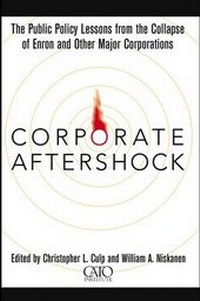
Corporate Aftershock
The Public Policy Lessons from the Collapse of Enron and Other Major Corporations
1st Edition
Published on 24. June 2003
Book
Hardback
352 pages
978-0-471-43002-5 (ISBN)
Description
The first book to address public policy in the light of recent corporate debacles
Corporate Aftershock is a reasoned, informed response to the numerous proposals to restrict derivatives, structured financing activities, and shareholder protection principles and practices following the failure of Enron and other corporations. Readers get a cogent analysis of the public policy world after recent corporate debacles. Corporate Aftershock provides a detailed background of the markets, players, regulations, and institutional environment surrounding these failures.
Christopher L. Culp, PhD (Chicago, IL), is a Principal at CP Risk Management LLC. William A. Niskanen, PhD (Washington, DC), is Chairman of the Cato Institute.
Reviews / Votes
"...with Corporate Aftershock as your guide, you'll learn what sensible solutions can be made..." (International Accountant, July 2006)More details
Edition
1., Auflage
Language
English
Place of publication
New York
United States
Target group
College/higher education
Professional and scholarly
Illustrations
Charts: 15 B&W, 0 Color; Tables: 10 B&W, 0 Color
Dimensions
Height: 23.5 cm
Width: 16.2 cm
Thickness: 2.8 cm
Weight
593 gr
ISBN-13
978-0-471-43002-5 (9780471430025)
Schweitzer Classification
Other editions
Additional editions
Christopher L. Culp | William A. Niskanen
Corporate Aftershock
The Public Policy Lessons from the Collapse of Enron and Other Major Corporations
E-Book
06/2003
Wiley
€27.99
Available for download
Persons
CHRISTOPHER L. CULP, PhD, is an Adjunct Professor of Finance at the University of Chicago's Graduate School of Business, a Principal at CP Risk Management LLC and Chicago Partners LLC, and a Senior Fellow in Financial Regulation at the Competitive Enterprise Institute. He is the author of three other books, Risk Transfer, The ART of Risk Management, and The Risk Management Process, all published by Wiley, and co-editor (with Merton H. Miller) of Corporate Hedging in Theory and Practice from Risk Publications. He holds a BA in economics from The Johns Hopkins University and a PhD in finance from the University of Chicago's Graduate School of Business.
WILLIAM A. NISKANEN, PhD, has been chairman of the Cato Institute since 1985. Previously, he was acting chairman of President Reagan's Council of Economic Advisors. One of the most highly regarded microeconomists in the nation, Niskanen has taught economics at the University of California at Berkeley and Los Angeles. He has also served as director of economics at Ford Motor Company and as a defense analyst for the Pentagon, the RAND Corporation, and the Institute for Defense Analyses. He holds a BA from Harvard and a PhD in economics from the University of Chicago.
Content
About the Editors.
About the Contributors.
Preface (Christopher L. Culp).
Acknowledgments.
Introduction (William A. Niskanen).
Editors' Note.
PART I. CORPORATE INNOVATION AND GOVERNANCE.
1. Empire of the Sun: A Neo-Austrian Economic Interpretation of Enron's Energy Business (Christopher L. Culp and Steve H. Hanke).
2. Corporate Accounting after Enron: Is the Cure Worse Than the Disease? (Richard Bassett and Mark Storrie).
3. Corporate Governance: Pre-Enron, Post-Enron (Alton B. Harris and Andrea S. Kramer).
PART II. ENERGY AND DERIVATIVES MARKETS AFTER ENRON.
4. Wholesale Electricity Markets and Products after Enron (Andrea M. P. Neves).
5. Regulation of Wholesale Electricity Trading after Enron (Andrea S. Kramer, et al.).
6. Online Trading and Clearing after Enron (John Herron).
7. Do Swaps Need More Regulation? (David Mengle).
PART III. STRUCTURED FINANCE AFTER ENRON.
8. An Introduction to the Business of Structured Finance (Barbara T. Kavanagh).
9. Structured Commodity Finance after Enron: Uses and Abuse of Prepaid Forwards and Swaps (Christopher L. Culp and Barbara T. Kavanagh).
10. Accounting and Disclosure Issues in Structured Finance (Keith A. Bockus, et al.).
PART IV. CREDIT RISK MITIGATION AFTER ENRON.
11. Credit Risk Management Lessons from Enron (Christopher L. Culp).
12. Credit Derivatives Post-Enron (Andrea S. Kramer and Alton B. Harris).
13. The Market for Complex Credit Risk (Paul Palmer).
PART V. REGULATING CORPORATE INNOVATION AFTER ENRON.
Chapter 14. Cowboys versus Cattle Thieves: The Role of Innovative Institutions in Managing Risks along the Frontier (Fred L. Smith, Jr.).
References.
Index.