

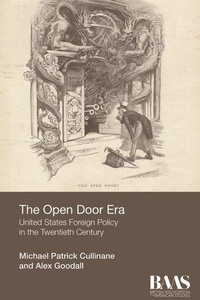
The Open Door Era
United States Foreign Policy in the Twentieth Century
Published on 22. February 2017
Book
Hardback
224 pages
978-1-4744-0130-2 (ISBN)
Description
Examines the Open Door, the most influential U.S. foreign policy of the twentieth century
In 1899, U.S. Secretary of State John Hay wrote six world powers calling for an 'Open Door' in China that would guarantee equal trading opportunities, curtail colonial annexation, and prevent conflict in the Far East. Within a year, the region had succumbed to renewed colonisation and war, but despite the apparent failure of Hay's diplomacy, the ideal of the Open Door emerged as the central component of U.S. foreign policy in the twentieth century. Just as visions of 'Manifest Destiny' shaped continental expansion in the nineteenth century, Woodrow Wilson used the Open Door to make the case for a world 'safe for democracy', Franklin Roosevelt developed it to inspire the fight against totalitarianism and imperialism, and Cold War containment policy envisioned international communism as the latest threat to a global system built upon peace, openness, and exchange. In a concise yet wide-ranging examination of its origins and development, readers will discover how the idea of the Open Door came to define the American Century.
Key Features
Uncovers the ideological wellspring of U.S. foreign policy in the twentieth centuryPresents debates over U.S. foreign policy, including the 'Wisconsin School' critique of the Open Door as a mechanism of informal empireReveals both the consistency of U.S. foreign policy thinking and offers a deeper context to critical foreign policy decisionsContextulises the roots of contemporary U.S. policy
In 1899, U.S. Secretary of State John Hay wrote six world powers calling for an 'Open Door' in China that would guarantee equal trading opportunities, curtail colonial annexation, and prevent conflict in the Far East. Within a year, the region had succumbed to renewed colonisation and war, but despite the apparent failure of Hay's diplomacy, the ideal of the Open Door emerged as the central component of U.S. foreign policy in the twentieth century. Just as visions of 'Manifest Destiny' shaped continental expansion in the nineteenth century, Woodrow Wilson used the Open Door to make the case for a world 'safe for democracy', Franklin Roosevelt developed it to inspire the fight against totalitarianism and imperialism, and Cold War containment policy envisioned international communism as the latest threat to a global system built upon peace, openness, and exchange. In a concise yet wide-ranging examination of its origins and development, readers will discover how the idea of the Open Door came to define the American Century.
Key Features
Uncovers the ideological wellspring of U.S. foreign policy in the twentieth centuryPresents debates over U.S. foreign policy, including the 'Wisconsin School' critique of the Open Door as a mechanism of informal empireReveals both the consistency of U.S. foreign policy thinking and offers a deeper context to critical foreign policy decisionsContextulises the roots of contemporary U.S. policy
Reviews / Votes
A welcome contribution to the field of American foreign relations. -- Andreas Sanchez-Padilla * Journal of Transatlantic Studies, 16:3 * In this engaging book, Michael Cullinane and Alex Goodall forensically dissect and analyse one of the great shibboleths of U.S. foreign relations. Though the Open Door arose from enlightened ideas of international engagement, the authors demonstrate both its limits when it came to policy implementation and how it became a contested symbol for critics at home and beyond. -- Jay Sexton, Kinder Institute Chair, University of MissouriMore details
Series
Language
English
Place of publication
Edinburgh
United Kingdom
Target group
Professional and scholarly
Product notice
sewn/stitched
Cloth over boards
Illustrations
7 black and white illustrations
Dimensions
Height: 234 mm
Width: 156 mm
Thickness: 14 mm
Weight
494 gr
ISBN-13
978-1-4744-0130-2 (9781474401302)
Copyright in bibliographic data and cover images is held by Nielsen Book Services Limited or by the publishers or by their respective licensors: all rights reserved.
Schweitzer Classification
Other editions
Additional editions
Michael Patrick Cullinane | Alex Goodall
Open Door Era
United States Foreign Policy in the Twentieth Century
E-Book
01/2017
1st Edition
Edinburgh University Press
€26.49
Available for download
Persons
Michael Patrick Cullinane is Professor of U.S. History and the Rob and Melani Walton Chair of Theodore Roosevelt Studies at Dickinson State University in North Dakota. He is the author of The Open Door Era: U.S. Foreign Policy in the Twentieth Century (Edinburgh University Press, 2017), Theodore Roosevelt's Ghost: The History and Memory of an American Icon (Louisiana State University Press, 2017) and Liberty and American Anti-Imperialism: 1898-1909 (Palgrave Macmillan, 2012). With Sylvia Ellis, he is the series editor of New Perspectives on the American Presidency (Edinburgh University Press) and co-editor of Constructing Presidential Legacy: How we Remember the American President (Edinburgh University Press, 2018). Alex Goodall is a Senior Lecturer in International History at UCL and the author of Loyalty and Liberty: American Countersubversion from World War One to the McCarthy Era.
Content
Introduction
The Open Door Idea, 1893-1904
Imposing the Open Door, 1904-1917
The Global Open Door, 1917-1929
The Open Door in a Closed World, 1929-1945
The Open Door and the Cold War, 1945-1968
The Open Door Triumphant, 1968-1991
Conclusion
Select Bibliography
The Open Door Idea, 1893-1904
Imposing the Open Door, 1904-1917
The Global Open Door, 1917-1929
The Open Door in a Closed World, 1929-1945
The Open Door and the Cold War, 1945-1968
The Open Door Triumphant, 1968-1991
Conclusion
Select Bibliography