

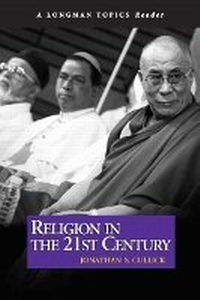
Religion in the 21st Century ( A Longman Topics Reader)
Published on 12. February 2009
Book
Paperback/Softback
256 pages
978-0-205-56779-9 (ISBN)
Description
The compelling readings in Faith and Religion in the 21st Century reflect the wide variety of ways in which people use writing to think and communicate about issues of religion-a timely topic in 21st century America.
More details
Language
English
Place of publication
United States
Publishing group
Pearson Education (US)
Target group
College/higher education
Dimensions
Height: 210 mm
Width: 140 mm
Weight
286 gr
ISBN-13
978-0-205-56779-9 (9780205567799)
Copyright in bibliographic data and cover images is held by Nielsen Book Services Limited or by the publishers or by their respective licensors: all rights reserved.
Schweitzer Classification
Content
Each reading is followed by Questions about Content and Rhetorical Analysis
Chapter One: Religion in Personal Writing
Introduction: How do individuals write about religion?
Ranya Idliby, Suzanne Oliver, and Priscilla Warner, from The Faith Club: A Muslim, A Christian, A Jew-Three Women Search for Understanding
Three mothers form a group to learn, and to help their children learn, about each other's faith.
Patricia Monaghan, "Physics and Grief"
Monaghan struggles to find meaning in the death of her husband.
Lindsey Crittenden, "The Water Will Hold You"
The writer tries to find comfort in prayer as her mother battles a terminal illness.
Karen Armstrong, from The Spiral Staircase: My Climb Out of Darkness
During a trip to Jerusalem, the author discovers beauty and compassion not only in her own religion of Christianity, but also in the unfamiliar faiths of Judaism and Islam.
Connecting the Readings
Writing Projects
For Further Reading
Chapter Two: Religion in Sacred Writing
Introduction: How do stories create and affirm religious belief?
Judaism: from the Torah (JPS)
The story of Abraham commanded to sacrifice his son Isaac.
Christianity: from the New Testament (NSRV)
The Sermon on the Mount and the Parable of the Good Samaratin
Islam: from the Qur'an
The story of Joseph, who was sold into slavery by his jealous brothers.
Hinduism: from The Bhagavad Gita
The story of Krisha revealing himself to the warrior Arjuna.
Buddhism: from Dhammapada by Siddhartha Gautama
The story of Siddhartha's birth, temptation, and discovery of suffering in the world.
Taoism: from Tao Te Ching by Lao Tzu
The riddles of the Tao: If the Tao can be understood, then it is not the Tao.
Connecting the Readings
Writing Projects
For Further Reading
Chapter Three: Religion in Academic Writing
Introduction: How do academic disciplines write about matters of religion?
Literary Studies: Jack Miles, "Can God's Life Be Written?" from God: A Biography
The author explores God as a character who is unlike any other character.
Religious Studies: Elaine Pagels and Karen King, "Reading Judas" from Reading Judas: The Gospel of Judas and the Shaping of Christianity.
Two scholars investigate the recent discovery of a new, unknown gospel and consider its implications.
Cognitive Science: Steven Pinker, "The Evolutionary Psychology of Religion"
The author-using biology, psychology, and neuroscience-explores how the human brain is "wired" to form beliefs.
Sociology: Christian Smith et al., from "Mapping American Adolescent Subjective
Religiosity and Attitudes of Alienation toward Religion" in the journal Sociology of
Religion
Researchers survey the attitudes of teenagers and college students.
Psychology: Paul Harris and Melissa Koenig, from "Trust in Testimony: How Children Learn about Science and Religion" in the journal Child Development
Two researchers perform experiments with children to find out at what stage of development human beings form beliefs.
Economics: Laurence R. Iannaccone, "Progress in the Economics of Religion."
An economist proposes that economics can be used to understand religious choices and the "marketplace" of religion.
Questions about Content and Rhetorical Analysis
Connecting the Readings
Writing Projects
For Further Reading
Chapter Four: Religion in Public Issues
Introduction: How are issues of religion written about in a pluralistic society?
What should the role of religion be in American society?
Jim Wallis, "Take Back the Faith"
Susan Jacoby, "One Nation Under Secularism"
Jeff Jacoby, "Atheists' Bleak Alternative"
Student Essay, "Is the U.S. a Christian Nation?"
This chapter presents two readings from a liberal perspective and two from a conservative perspective.
What is our responsibility to the environment?
Climate Change: An Evangelical Call to Action, by the Evangelical Climate Initiative
The Cornwall Declaration, by the Cornwall Alliance for the Stewardship of Creation
Two organizations take conservative and progressive approaches to the environment.
Should Evolution and Intelligent Design be Taught in Schools?
Michael J. Behe, "Teach Evolution, and Ask Hard Questions"
Gerald Graff, "To Debate or Not to Debate Intelligent Design?"
Stanley Fish, "Academic Cross-Dressing: How Intelligent Design Gets its Arguments from the Left"
Two professors-one in the sciences and one in the humanities-argue that schools should "teach the conflict" of evolution vs. intelligent design. A third professor explores the rhetoric of that argument.
Is a Religious Display on Public Property Acceptable?
Rod Smolla, "Why the Commandments Make for Such Messy Law"
An expert on law explores the strengths and weaknesses of both sides of the argument: should the Ten Commandments be displayed on public property?
Is there a "Culture War"?
Adam Cohen, "This Season's War Cry: Commercialize Christmas, or Else"
David Frum, "The Lord of Misrule is Coming to Town"
Is Christmas being banned from stores, schools, and public property? Two writers with different political perspectives debate this question about Christmas.
Questions about Content and Rhetorical Analysis
Connecting the Readings
Writing Projects
For Further Reading
Chapter Five: Religion in Our World
Introduction: How will we write about religion in the coming years?
Popular Culture
Student Essay, "E-Faith in the Shopping Mall"
The writer explores the impact of new developments such as electronic Bibles, video games, web sites, and mega-churches.
Islam
Michael Wolfe, "How Does It Feel?"
The author describes what life is like for a Muslim in the U.S. after 9/11.
Jane I. Smith, "Muslims in America"
A professor of Islamic studies describes Muslim communities and their struggle against prejudice.
Science
Paul Davies, "E.T. and God"
A scientists speculates: if we find life elsewhere in the universe, what effect will that discovery have on faith and religion here on earth?
Paul Bloom, "Is God an Accident?"
A scientist wonders how science in the future might discover why belief exists.
Questions about Content and Rhetorical Analysis
Connecting the Readings
Writing Projects
For Further Reading
Chapter One: Religion in Personal Writing
Introduction: How do individuals write about religion?
Ranya Idliby, Suzanne Oliver, and Priscilla Warner, from The Faith Club: A Muslim, A Christian, A Jew-Three Women Search for Understanding
Three mothers form a group to learn, and to help their children learn, about each other's faith.
Patricia Monaghan, "Physics and Grief"
Monaghan struggles to find meaning in the death of her husband.
Lindsey Crittenden, "The Water Will Hold You"
The writer tries to find comfort in prayer as her mother battles a terminal illness.
Karen Armstrong, from The Spiral Staircase: My Climb Out of Darkness
During a trip to Jerusalem, the author discovers beauty and compassion not only in her own religion of Christianity, but also in the unfamiliar faiths of Judaism and Islam.
Connecting the Readings
Writing Projects
For Further Reading
Chapter Two: Religion in Sacred Writing
Introduction: How do stories create and affirm religious belief?
Judaism: from the Torah (JPS)
The story of Abraham commanded to sacrifice his son Isaac.
Christianity: from the New Testament (NSRV)
The Sermon on the Mount and the Parable of the Good Samaratin
Islam: from the Qur'an
The story of Joseph, who was sold into slavery by his jealous brothers.
Hinduism: from The Bhagavad Gita
The story of Krisha revealing himself to the warrior Arjuna.
Buddhism: from Dhammapada by Siddhartha Gautama
The story of Siddhartha's birth, temptation, and discovery of suffering in the world.
Taoism: from Tao Te Ching by Lao Tzu
The riddles of the Tao: If the Tao can be understood, then it is not the Tao.
Connecting the Readings
Writing Projects
For Further Reading
Chapter Three: Religion in Academic Writing
Introduction: How do academic disciplines write about matters of religion?
Literary Studies: Jack Miles, "Can God's Life Be Written?" from God: A Biography
The author explores God as a character who is unlike any other character.
Religious Studies: Elaine Pagels and Karen King, "Reading Judas" from Reading Judas: The Gospel of Judas and the Shaping of Christianity.
Two scholars investigate the recent discovery of a new, unknown gospel and consider its implications.
Cognitive Science: Steven Pinker, "The Evolutionary Psychology of Religion"
The author-using biology, psychology, and neuroscience-explores how the human brain is "wired" to form beliefs.
Sociology: Christian Smith et al., from "Mapping American Adolescent Subjective
Religiosity and Attitudes of Alienation toward Religion" in the journal Sociology of
Religion
Researchers survey the attitudes of teenagers and college students.
Psychology: Paul Harris and Melissa Koenig, from "Trust in Testimony: How Children Learn about Science and Religion" in the journal Child Development
Two researchers perform experiments with children to find out at what stage of development human beings form beliefs.
Economics: Laurence R. Iannaccone, "Progress in the Economics of Religion."
An economist proposes that economics can be used to understand religious choices and the "marketplace" of religion.
Questions about Content and Rhetorical Analysis
Connecting the Readings
Writing Projects
For Further Reading
Chapter Four: Religion in Public Issues
Introduction: How are issues of religion written about in a pluralistic society?
What should the role of religion be in American society?
Jim Wallis, "Take Back the Faith"
Susan Jacoby, "One Nation Under Secularism"
Jeff Jacoby, "Atheists' Bleak Alternative"
Student Essay, "Is the U.S. a Christian Nation?"
This chapter presents two readings from a liberal perspective and two from a conservative perspective.
What is our responsibility to the environment?
Climate Change: An Evangelical Call to Action, by the Evangelical Climate Initiative
The Cornwall Declaration, by the Cornwall Alliance for the Stewardship of Creation
Two organizations take conservative and progressive approaches to the environment.
Should Evolution and Intelligent Design be Taught in Schools?
Michael J. Behe, "Teach Evolution, and Ask Hard Questions"
Gerald Graff, "To Debate or Not to Debate Intelligent Design?"
Stanley Fish, "Academic Cross-Dressing: How Intelligent Design Gets its Arguments from the Left"
Two professors-one in the sciences and one in the humanities-argue that schools should "teach the conflict" of evolution vs. intelligent design. A third professor explores the rhetoric of that argument.
Is a Religious Display on Public Property Acceptable?
Rod Smolla, "Why the Commandments Make for Such Messy Law"
An expert on law explores the strengths and weaknesses of both sides of the argument: should the Ten Commandments be displayed on public property?
Is there a "Culture War"?
Adam Cohen, "This Season's War Cry: Commercialize Christmas, or Else"
David Frum, "The Lord of Misrule is Coming to Town"
Is Christmas being banned from stores, schools, and public property? Two writers with different political perspectives debate this question about Christmas.
Questions about Content and Rhetorical Analysis
Connecting the Readings
Writing Projects
For Further Reading
Chapter Five: Religion in Our World
Introduction: How will we write about religion in the coming years?
Popular Culture
Student Essay, "E-Faith in the Shopping Mall"
The writer explores the impact of new developments such as electronic Bibles, video games, web sites, and mega-churches.
Islam
Michael Wolfe, "How Does It Feel?"
The author describes what life is like for a Muslim in the U.S. after 9/11.
Jane I. Smith, "Muslims in America"
A professor of Islamic studies describes Muslim communities and their struggle against prejudice.
Science
Paul Davies, "E.T. and God"
A scientists speculates: if we find life elsewhere in the universe, what effect will that discovery have on faith and religion here on earth?
Paul Bloom, "Is God an Accident?"
A scientist wonders how science in the future might discover why belief exists.
Questions about Content and Rhetorical Analysis
Connecting the Readings
Writing Projects
For Further Reading