

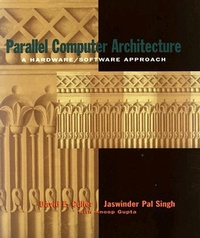
Parallel Computer Architecture
A Hardware/Software Approach
Published on 29. September 1998
Book
Hardback
1056 pages
978-1-55860-343-1 (ISBN)
Description
The most exciting development in parallel computer architecture is the convergence of traditionally disparate approaches on a common machine structure. This book explains the forces behind this convergence of shared-memory, message-passing, data parallel, and data-driven computing architectures. It then examines the design issues that are critical to all parallel architecture across the full range of modern design, covering data access, communication performance, coordination of cooperative work, and correct implementation of useful semantics. It not only describes the hardware and software techniques for addressing each of these issues but also explores how these techniques interact in the same system. Examining architecture from an application-driven perspective, it provides comprehensive discussions of parallel programming for high performance and of workload-driven evaluation, based on understanding hardware-software interactions.
More details
Series
Language
English
Place of publication
San Francisco
United States
Publishing group
Elsevier Science & Technology
Target group
Professional and scholarly
Product notice
sewn/stitched
Cloth over boards
Dimensions
Height: 246 mm
Width: 197 mm
Thickness: 55 mm
Weight
1961 gr
ISBN-13
978-1-55860-343-1 (9781558603431)
Copyright in bibliographic data and cover images is held by Nielsen Book Services Limited or by the publishers or by their respective licensors: all rights reserved.
Schweitzer Classification
Other editions
Additional editions
David Culler | Jaswinder Pal Singh | Anoop Gupta
Parallel Computer Architecture
A Hardware/Software Approach
E-Book
09/1998
Morgan Kaufmann
€103.00
Available for download
Persons
David Culler led the Berkeley
Network of Workstations (NOW) project, which sparked the
current commercial revolution in high-performance clusters.
Anoop Gupta co-led the Stanford DASH multiprocessor project,
which developed the shared-memory technology increasingly
used in commercial machines. Jaswinder Pal Singh led the
development of the SPLASH and SPLASH-2 suites of parallel
programs, which have defined the workloads and methodology
used to drive decisions and evaluate trade-offs in shared-
memory parallel architecture. Dr. Anoop Gupta is a Distinguished Scientist at Microsoft Research. He works on cross-disciplinary projects that have potential for large business or societal impact. His recent projects focus on areas of education, communication, collaboration, and natural user interfaces.
Network of Workstations (NOW) project, which sparked the
current commercial revolution in high-performance clusters.
Anoop Gupta co-led the Stanford DASH multiprocessor project,
which developed the shared-memory technology increasingly
used in commercial machines. Jaswinder Pal Singh led the
development of the SPLASH and SPLASH-2 suites of parallel
programs, which have defined the workloads and methodology
used to drive decisions and evaluate trade-offs in shared-
memory parallel architecture. Dr. Anoop Gupta is a Distinguished Scientist at Microsoft Research. He works on cross-disciplinary projects that have potential for large business or societal impact. His recent projects focus on areas of education, communication, collaboration, and natural user interfaces.
Content
1 Introduction 2 Parallel Programs 3 Programming for Performance 4 Workload-Driven Evaluation 5 Shared Memory Multiprocessors 6 Snoop-based Multiprocessor Design 7 Scalable Multiprocessors8 Directory-based Cache Coherence9 Hardware-Software Tradeoffs 10 Interconnection Network Design 11 Latency Tolerance 12 Future Directions APPENDIX A Parallel Benchmark Suites