

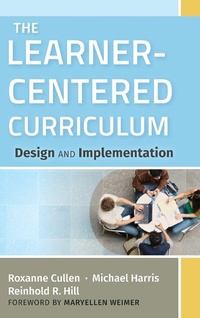
The Learner-Centered Curriculum
Design and Implementation
1st Edition
Published on 10. April 2012
Book
Hardback
272 pages
978-1-118-04955-6 (ISBN)
Description
THE LEARNER-CENTERED CURRICULUM
"If an institution is to be truly learner-centered, all processes and practices need to be learner-centered, and the curriculum is no exception."-From the Preface
The Learner-Centered Curriculum is for educators and administrators who envision an educational environment that produces students who are creative and autonomous learners. By encouraging an appreciation and adoption of learner-centered practices, educators can transform their curricula to become more focused on the learner.
The book presents a framework for curriculum design based on learner-centered principles while at the same time offering technical advice on implementation as well as the strategic use of assessment, technology, and physical spaces to support innovative design. The authors include several examples of existing curricula that illustrate their framework in practice. Throughout the book, they emphasize the need for assessment, both formative and summative, stressing the point that assessment is an effective driver of change. The book includes a wide variety of options both for individual classroom practice and for programmatic assessment.
The Learner-Centered Curriculum explores the current technology and tools available to educators that can support learner-centered practices and foster autonomous learning and demonstrates how technology can assist in removing some of the obstacles to achieving a learner-centered design. In addition, the authors explain the importance of physical spaces in relation to learner-centered curricular design and show how to tie renovation to curricular implementation to foster incentive to innovate and provide a physical manifestation of learner-centered principles.
"If an institution is to be truly learner-centered, all processes and practices need to be learner-centered, and the curriculum is no exception."-From the Preface
The Learner-Centered Curriculum is for educators and administrators who envision an educational environment that produces students who are creative and autonomous learners. By encouraging an appreciation and adoption of learner-centered practices, educators can transform their curricula to become more focused on the learner.
The book presents a framework for curriculum design based on learner-centered principles while at the same time offering technical advice on implementation as well as the strategic use of assessment, technology, and physical spaces to support innovative design. The authors include several examples of existing curricula that illustrate their framework in practice. Throughout the book, they emphasize the need for assessment, both formative and summative, stressing the point that assessment is an effective driver of change. The book includes a wide variety of options both for individual classroom practice and for programmatic assessment.
The Learner-Centered Curriculum explores the current technology and tools available to educators that can support learner-centered practices and foster autonomous learning and demonstrates how technology can assist in removing some of the obstacles to achieving a learner-centered design. In addition, the authors explain the importance of physical spaces in relation to learner-centered curricular design and show how to tie renovation to curricular implementation to foster incentive to innovate and provide a physical manifestation of learner-centered principles.
More details
Language
English
Place of publication
New York
United States
Publishing group
John Wiley & Sons Inc
Target group
Professional and scholarly
Product notice
Unsewn / adhesive bound
Paper over boards
With dust jacket
Dimensions
Height: 235 mm
Width: 157 mm
Thickness: 19 mm
Weight
542 gr
ISBN-13
978-1-118-04955-6 (9781118049556)
Copyright in bibliographic data and cover images is held by Nielsen Book Services Limited or by the publishers or by their respective licensors: all rights reserved.
Schweitzer Classification
Other editions
Additional editions
Roxanne Cullen | Michael Harris | Reinhold R. Hill
The Learner-Centered Curriculum
Design and Implementation
E-Book
02/2012
Jossey-Bass
€36.99
Available for download
Roxanne Cullen | Michael Harris | Reinhold R. Hill
The Learner-Centered Curriculum
Design and Implementation
E-Book
02/2012
Jossey-Bass
€36.99
Available for download
Persons
THE AUTHORS
Roxanne Cullen is a professor of English at Ferris State University in Big Rapids, Michigan, where she has also acted as associate vice president for academic affairs.
Michael Harris is the chancellor of Indiana University-Kokomo. He and Roxanne Cullen coauthored Leading the Learner-Centered Campus: An Administrative Framework for Improving Student Learning Outcomes from Jossey-Bass.
Reinhold R. Hill is dean of the College of Arts and Sciences at Governors State University in Illinois.
Roxanne Cullen is a professor of English at Ferris State University in Big Rapids, Michigan, where she has also acted as associate vice president for academic affairs.
Michael Harris is the chancellor of Indiana University-Kokomo. He and Roxanne Cullen coauthored Leading the Learner-Centered Campus: An Administrative Framework for Improving Student Learning Outcomes from Jossey-Bass.
Reinhold R. Hill is dean of the College of Arts and Sciences at Governors State University in Illinois.
Content
Foreword ix
Preface xiii
Acknowledgments xix
About the Authors xxi
1. Why Redesign Curriculum? 1
2. Curriculum Design in the Instructional Paradigm 23
3. The Learner-Centered Curriculum 45
4. Leading Curricular Implementation 73
5. Learner-Centered Design in Practice 105
6. Assessment Aimed at Learner Autonomy 127
7. Innovating Through Technology 159
8. Learning Spaces That Support Learner-Centered Curricula 183
Closing Thoughts 209
References 211
Index 227
Preface xiii
Acknowledgments xix
About the Authors xxi
1. Why Redesign Curriculum? 1
2. Curriculum Design in the Instructional Paradigm 23
3. The Learner-Centered Curriculum 45
4. Leading Curricular Implementation 73
5. Learner-Centered Design in Practice 105
6. Assessment Aimed at Learner Autonomy 127
7. Innovating Through Technology 159
8. Learning Spaces That Support Learner-Centered Curricula 183
Closing Thoughts 209
References 211
Index 227