

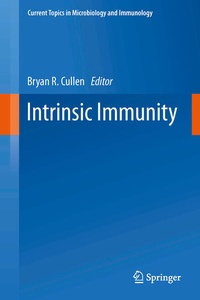
Intrinsic Immunity
1st Edition
Published on 3. June 2013
Book
Hardback
VII, 262 pages
978-3-642-37764-8 (ISBN)
Description
Recent research has focused attention on the importance of intrinsic antiviral immunity, i.e. immunity mediated by factors that are constitutively expressed in many cells. In this volume, leading experts provide a comprehensive overview of this relatively new and rapidly evolving field. They cover intrinsic proteinaceous antiviral immune effectors, such as the APOBEC3 and TRIM protein families as well as Tetherin and SAMHD1, which were initially discovered by researchers studying HIV-1. Furthermore, the role of RNA interference in antiviral defense in plants and invertebrates, as well as the interplay between microRNAs and viruses in mammalian cells, are analysed. One chapter discusses how intrinsic immunity and viral countermeasures to intrinsic immune effectors drive both pathogen and host evolution, and finally the emerging evidence that DNA damage response proteins restrict infection by DNA viruses is highlighted.
More details
Series
Language
English
Place of publication
Berlin
Germany
Publishing group
Springer Berlin
Target group
Professional and scholarly
Research
Illustrations
VII, 262 p.
Dimensions
Height: 241 mm
Width: 160 mm
Thickness: 20 mm
Weight
576 gr
ISBN-13
978-3-642-37764-8 (9783642377648)
DOI
10.1007/978-3-642-37765-5
Schweitzer Classification
Other editions
Additional editions
Content
The APOBEC3 Family of Retroelement Restriction Factors.- Inhibition of Retroviral Replication by Members of the TRIM Protein Family.- The Antiviral Activities of Tetherin.- Restriction of Retroviral Infection of Macrophages.- Rapid Adversarial Co-Evolution of Viruses and Cellular Restriction Factors.- RNA Interference-Mediated Intrinsic Antiviral Immunity in Plants.- RNA Interference-Mediated Intrinsic Antiviral Immunity in Invertebrates.- Roles of MicroRNAs in the Life Cycles of Mammalian Viruses.- Interplay Between DNA Tumor Viruses and the Host DNA Damage Response.