

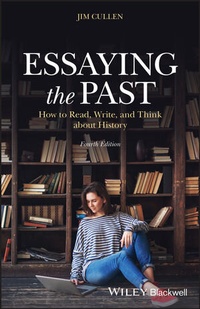
Essaying the Past
How to Read, Write, and Think about History
4th Edition
Published on 10. September 2020
Book
Paperback/Softback
240 pages
978-1-119-70839-1 (ISBN)
Description
Learn to craft the perfect historical research paper with this approachable and practical guide
Essaying the Past: How to Read, Write, and Think about History, 4th Edition continues the tradition of excellence established by the previous editions. Equal parts research manual, study guide, and introduction to the study of history, this book teaches readers how to write excellent historical prose with approachable strategies and actionable tips.
Noted teacher and writer Jim Cullen has created an invaluable resource for novices and experts in the field of historical study, offering practical insights into determining how questions should be framed, developing strong introduction and topic sentences, choosing evidence, and properly revising your work.
Essaying the Past includes six appendices covering the major issues facing students today, including the pitfalls and temptations of plagiarism and the role of the internet. It also contains an annotated case study outlining one student's process of writing an essay and demonstrating the application of the concepts contained within the book. Essaying the Past covers topics including:
* How to think and read about history and ask the right questions about what you're reading
* The three components of crafting a compelling argument
* How to deal with counterarguments and counterevidence
* How to properly construct a bibliography and insert footnotes
* How to assess the credibility of online resources
Perfect for students taking surveys or courses in methods or historiography, Essaying the Past also belongs on the bookshelf of anyone with even a passing interest in studying, researching, consuming, or writing about history.
Essaying the Past: How to Read, Write, and Think about History, 4th Edition continues the tradition of excellence established by the previous editions. Equal parts research manual, study guide, and introduction to the study of history, this book teaches readers how to write excellent historical prose with approachable strategies and actionable tips.
Noted teacher and writer Jim Cullen has created an invaluable resource for novices and experts in the field of historical study, offering practical insights into determining how questions should be framed, developing strong introduction and topic sentences, choosing evidence, and properly revising your work.
Essaying the Past includes six appendices covering the major issues facing students today, including the pitfalls and temptations of plagiarism and the role of the internet. It also contains an annotated case study outlining one student's process of writing an essay and demonstrating the application of the concepts contained within the book. Essaying the Past covers topics including:
* How to think and read about history and ask the right questions about what you're reading
* The three components of crafting a compelling argument
* How to deal with counterarguments and counterevidence
* How to properly construct a bibliography and insert footnotes
* How to assess the credibility of online resources
Perfect for students taking surveys or courses in methods or historiography, Essaying the Past also belongs on the bookshelf of anyone with even a passing interest in studying, researching, consuming, or writing about history.
More details
Other editions
Additional editions
E-Book
08/2020
4th Edition
Wiley
€27.99
Available for download
E-Book
08/2020
4th Edition
Wiley
€27.99
Available for download
Previous edition
Book
12/2016
3rd Edition
Wiley
Unfortunately, price unknown
Article exhausted; check for reprint
Person
JIM CULLEN, PHD, received his doctorate in American Studies from Brown University and is the author of many books and anthologies. His articles and reviews have appeared in prestigious publications, including The Washington Post, USA Today, CNN.com, the Journal of American History, and the American Historical Review. Jim has taught at Harvard University and Sarah Lawrence College and is a member of the faculty at the Greenwich Country Day School in Greenwich, Connecticut.
Content
Preface to the Second Edition
Preface to the Third Edition
Preface to the Fourth Edition
Acknowledgments
Introduction to the Student: Why Would You Look at a Book Like This?
Part I Thinking and Reading about History
1 History: It's about Time
2 What's the Story with History?
3 The Sources of History
4 Good Answers Begin with Good Questions
5 Search Engines, Research Ingenuity
6 How to Read a Book without Ever Getting to Chapter One
Part II Writing about History
7 Analysis: The Intersection of Reading and Writing
8 Making a Case: An Argument in Three Parts
9 Defining Introductions
10 Strong Bodies (I): The Work of Topic Sentences
11 Strong Bodies (II): Exposition and Evidence
12 Strong Bodies (III): Counterargument and Counterevidence
13 Surprising Conclusions
14 Scaling the Summit: Crystallizing Your Argument
15 Writing is Rewriting: The Art of Revision
16 Putting It All Together: The Research Essay (A Case Study)
Conclusion: The Love of History
Appendices
A Writing an Essay: Ten Easy Steps in Review
B Essay Varieties: DBQs, Reviews, and Comparison Assignments
C Let's Give a Hand: Bibliographies and Footnotes
D Credit Scams: The Dangers of Plagiarism
E Web of Lies? Weighing the Internet
F A Glossary of Key Terms
G More Reading about Writing
Index
Preface to the Third Edition
Preface to the Fourth Edition
Acknowledgments
Introduction to the Student: Why Would You Look at a Book Like This?
Part I Thinking and Reading about History
1 History: It's about Time
2 What's the Story with History?
3 The Sources of History
4 Good Answers Begin with Good Questions
5 Search Engines, Research Ingenuity
6 How to Read a Book without Ever Getting to Chapter One
Part II Writing about History
7 Analysis: The Intersection of Reading and Writing
8 Making a Case: An Argument in Three Parts
9 Defining Introductions
10 Strong Bodies (I): The Work of Topic Sentences
11 Strong Bodies (II): Exposition and Evidence
12 Strong Bodies (III): Counterargument and Counterevidence
13 Surprising Conclusions
14 Scaling the Summit: Crystallizing Your Argument
15 Writing is Rewriting: The Art of Revision
16 Putting It All Together: The Research Essay (A Case Study)
Conclusion: The Love of History
Appendices
A Writing an Essay: Ten Easy Steps in Review
B Essay Varieties: DBQs, Reviews, and Comparison Assignments
C Let's Give a Hand: Bibliographies and Footnotes
D Credit Scams: The Dangers of Plagiarism
E Web of Lies? Weighing the Internet
F A Glossary of Key Terms
G More Reading about Writing
Index