

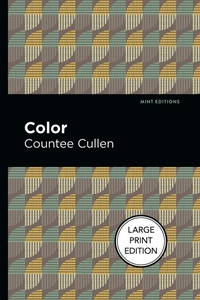
Color
Large Print Edition
Published on 1. September 2022
Book
Paperback/Softback
200 pages
978-1-5131-3717-9 (ISBN)
Description
"What is Africa to me?" In Color, his debut collection, Countee Cullen displays his mastery of traditional English poetry while examining his relationship with Africa, his life in America, and the realities faced by black people living in a hostile nation. His subjects include reflections on childhood, portraits of family, and statements of human and divine love.
More details
Edition
Large type / large print edition
Language
English
Place of publication
United States
Edition type
Large type / large print edition
Dimensions
Height: 229 mm
Width: 152 mm
Thickness: 11 mm
Weight
298 gr
ISBN-13
978-1-5131-3717-9 (9781513137179)
Copyright in bibliographic data and cover images is held by Nielsen Book Services Limited or by the publishers or by their respective licensors: all rights reserved.
Schweitzer Classification
Person
Countee Cullen (1903-1946) was an American poet, novelist, and playwright. In his youth, Cullen moved frequently with his mother Elizabeth Thomas Lucas before settling in Harlem at the age of nine, where he was raised by his grandmother Amanda Porter. In 1917, following her death, he was adopted by Reverend Frederick A. Cullen of Salem Methodist Episcopal Church, who led the largest congregation in Harlem and would later become president of the local NAACP chapter. He excelled in high school, graduating with honors to enroll at NYU, where he gained a reputation as a prize-winning poet whose works appeared in Harper's, Crisis, and Poetry. In 1925, he went to Harvard for a masters in English just as his first collection, Color (1925), was published to popular and critical acclaim. He graduated in 1926, after which he published two more collections-The Ballad of the Brown Girl (1927) and Copper Sun (1927)-cementing his reputation as a leading writer of the Harlem Renaissance. Cullen was known for his friendly and professional associations with such figures as Duke Ellington, Langston Hughes, and Alain Locke, defining artists and intellectuals of their generation. Throughout his life, Cullen struggled with his sexuality and shy demeanor, pursuing relationships with men and women alike. He received a 1928 Guggenheim Fellowship, using it to write The Black Christ and Other Poems, a controversial collection for its comparison of the crucifixion to the lynching of black Americans. Despite the backlash, he continued to write and publish for the next two decades, turning to plays and children's fiction at the end of his career and, at one point, mentoring a young James Baldwin. His translation of Euripides' tragedy Medea is considered the first of its kind by a black American writer. Often overshadowed by his more outspoken peers, Cullen's legacy is that of a master of traditional poetic forms who used his voice and tremendous intellect to uplift and examine the lives of all African Americans.