

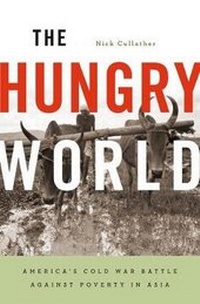
The Hungry World
America's Cold War Battle against Poverty in Asia
Published on 9. September 2013
Book
Paperback/Softback
368 pages
978-0-674-72581-2 (ISBN)
Description
Food was a critical front in the Cold War battle for Asia. "Where Communism goes, hunger follows" was the slogan of American nation builders who fanned out into the countryside to divert rivers, remodel villages, and introduce tractors, chemicals, and genes to multiply the crops consumed by millions. This "green revolution" has been credited with averting Malthusian famines, saving billions of lives, and jump-starting Asia's economic revival. Bono and Bill Gates hail it as a model for revitalizing Africa's economy. But this tale of science triumphant conceals a half century of political struggle from the Afghan highlands to the rice paddies of the Mekong Delta, a campaign to transform rural societies by changing the way people eat and grow food.
The ambition to lead Asia into an age of plenty grew alongside development theories that targeted hunger as a root cause of war. Scientific agriculture was an instrument for molding peasants into citizens with modern attitudes, loyalties, and reproductive habits. But food policies were as contested then as they are today. While Kennedy and Johnson envisioned Kansas-style agribusiness guarded by strategic hamlets, Indira Gandhi, Marcos, and Suharto inscribed their own visions of progress onto the land.
Out of this campaign, the costliest and most sustained effort for development ever undertaken, emerged the struggles for resources and identity that define the region today. As Obama revives the lost arts of Keynesianism and counter-insurgency, the history of these colossal projects reveals bitter and important lessons for today's missions to feed a hungry world.
The ambition to lead Asia into an age of plenty grew alongside development theories that targeted hunger as a root cause of war. Scientific agriculture was an instrument for molding peasants into citizens with modern attitudes, loyalties, and reproductive habits. But food policies were as contested then as they are today. While Kennedy and Johnson envisioned Kansas-style agribusiness guarded by strategic hamlets, Indira Gandhi, Marcos, and Suharto inscribed their own visions of progress onto the land.
Out of this campaign, the costliest and most sustained effort for development ever undertaken, emerged the struggles for resources and identity that define the region today. As Obama revives the lost arts of Keynesianism and counter-insurgency, the history of these colossal projects reveals bitter and important lessons for today's missions to feed a hungry world.
Reviews / Votes
Brilliant... Admirable... The Hungry World is an immensely important book... [Cullather] has performed a tremendous service, and written a book not just of interest but of lasting value in showing in detail and with great discernment just how new, and also how radical, development was when it first began to transform the ways powerful nations thought about everything from the specifics of warfighting (it is where the 'hearts and minds' doctrine was born, after all) to the broadest questions of national interest... If Cullather is right...then his account requires us to rewrite the diplomatic history of the second half of the twentieth century. The Hungry World is the invaluable beginning of that rewriting. -- David Rieff * The Nation * Cullather's book amounts to a thorough, gracefully written debunking of what might be called the green revolution master narrative... Cullather's brilliant, concise early chapter on the Green Revolution's birth in Mexico anchors his broader argument... By the end of the Mexico chapter, Cullather has already shattered the green revolution myth and exposed it as something like a lunge, and a not very well thought-out one, to replace other societies' farming systems with our own highly problematic one. -- Tom Philpott * Mother Jones * [This] is an utterly fascinating story-partially about the economics of famine, but mostly about the irrepressible postwar generation who genuinely believed American technology could win the battle for Asian hearts and minds, and stop communism in its tracks. -- Paul Grant * Books & Culture * The Hungry World furnishes a striking vantage on development policy, as well as on the decidedly mixed outcomes of American engagement with Asian politics. -- Katherine Maher * Bookforum * Nick Cullather's exploration of the critical linkages between power politics, scientific and technical assistance, famine alarms and schemes to increase food production is one of the most original and engaging books to date on the impact of the cold war on the emerging states of the developing world. -- Michael Adas, author of <i>Dominance by Design: Technological Imperatives and America's Civilizing Mission</i> Nick Cullather's pathbreaking book takes readers on a journey of understanding about the failures of the 'development' model so beloved by American policymakers from before the Cold War to the present. It may well become famous as a turning point about how to think about world poverty and to stimulate new answers to it. -- Lloyd Gardner, author of <i>Three Kings: The Rise of an American Empire in the Middle East after World War II</i> A pioneering and transformative work that tracks the politics of hunger from the invention of the calorie to Asia's Cold War ideological battlegrounds, The Hungry World explores, with a sharp, lively sense of irony, American scientists' and policy-makers' relentless and often futile efforts to transmute the conflictual politics of rural deprivation into a technocratic politics of agricultural production. -- Paul A. Kramer, author of <i>The Blood of Government: Race, Empire, the United States and the Philippines</i> Facing insurgencies, U.S. officials and expert advisers want to fight famine, alleviate hunger, and ameliorate the conditions on which terrorism thrives. Nick Cullather's new book-thoughtful, erudite, provocative-is a vivid and timely explication of the hopes and disappointments of past efforts to modernize and develop. -- Melvyn Leffler, author of <i>For the Soul of Mankind: The United States, the Soviet Union, and the Cold War</i>More details
Language
English
Place of publication
Cambridge, Mass
United States
Target group
College/higher education
Illustrations
9 halftones, 1 map in 8p mock insert
Dimensions
Height: 235 mm
Width: 156 mm
ISBN-13
978-0-674-72581-2 (9780674725812)
Copyright in bibliographic data and cover images is held by Nielsen Book Services Limited or by the publishers or by their respective licensors: all rights reserved.
Schweitzer Classification
Person
Nick Cullather is Professor of History and International Studies at Indiana University.