

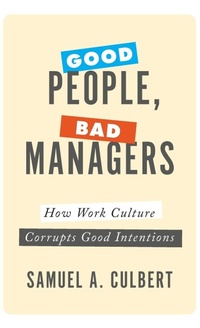
Good People, Bad Managers
How Work Culture Corrupts Good Intentions
Published on 27. July 2017
Book
Hardback
208 pages
978-0-19-065239-5 (ISBN)
Description
What's worse than a bad manager who everybody knows is bad? A bad manager who is well-intentioned and considered to be good. Yet these well-intentioned bad managers make up the bulk of management today. How did that happen? How did so many of today's managers end up with a self-preservation mindset that doesn't always translate to a productive and mission-oriented environment? How did so many good people become wedded to a work culture that saps morale, well-being and performance at both the individual and organizational levels?
an the well-intentioned doling it out realize... and even In Good People, Bad Managers: How Work Culture Corrupts Good Intentions, author Samuel A. Culbert sheds a light on the bad habits that are routinely followed by these well-intended managers. Managers need to understand the causes of their misguided practices. They need to become more aware of the damage they inflict, and the hollowness of the rationales they use to justify what they do. Company leaders, CEOs, and top-tier managers must become aware of how they have gone astray as a first step in implementing the truly beneficial management mentality that their companies, their managers and their employees require to succeed.
an the well-intentioned doling it out realize... and even In Good People, Bad Managers: How Work Culture Corrupts Good Intentions, author Samuel A. Culbert sheds a light on the bad habits that are routinely followed by these well-intended managers. Managers need to understand the causes of their misguided practices. They need to become more aware of the damage they inflict, and the hollowness of the rationales they use to justify what they do. Company leaders, CEOs, and top-tier managers must become aware of how they have gone astray as a first step in implementing the truly beneficial management mentality that their companies, their managers and their employees require to succeed.
Reviews / Votes
Addresses a relevant, significant problem: management culture is rife with deception. Regardless of one's level within a firm, all managers make subjective decisions, protect their own turf (i.e., pursue departmental goals at the expense of corporate goals), and do not treat all employees fairly as they have biases. This book is strong, in a practical sense, in that real-world examples are explored and approaches for improving the culture are given. Additionally, soft management skills (communication and psychology) are promoted in this text. Undoubtedly, managers who are able to better understand how they make decisions and improve their communication with employees will make better managers. * Personnel Psychology *More details
Language
English
Place of publication
New York
United States
Target group
Professional and scholarly
College/higher education
Product notice
sewn/stitched
Cloth over boards
Dimensions
Height: 207 mm
Width: 133 mm
Thickness: 20 mm
Weight
278 gr
ISBN-13
978-0-19-065239-5 (9780190652395)
Copyright in bibliographic data and cover images is held by Nielsen Book Services Limited or by the publishers or by their respective licensors: all rights reserved.
Schweitzer Classification
Other editions
Additional editions
E-Book
05/2017
1st Edition
OUP eBook
€18.49
Available for download
E-Book
05/2017
1st Edition
OUP eBook
€18.49
Available for download
Person
Samuel A. Culbert is an award winning author, researcher, and professor at UCLA's Anderson School of Management. His laboratory is the world of work where he puts conventional managerial assumptions under a microscope to uncover and replace dysfunctional practices. Widely recognized as a candid speaking expert and theoretician, he is author most recently of Get Rid of the Performance Review and Beyond Bullsh*t. SmartMoney Magazine named Beyond Bullsh*t to its 2008 list of ten top reads. Dr. Culbert is winner of a McKinsey Award for an article published in the Harvard Business Review, is a frequent contributor to management journals, and has authored numerous chapters in leading management books. His other authored and co-authored books include The Organization Trap, The Invisible War: The Pursuit of Self-Interests at Work, Radical Management, Mind-Set Management, and Don't Kill the Bosses!.
Content
Foreword by Henry Dubroff
PART I: What's Going On?
Chapter 1 Time to Face It: Bad Management is the Norm
Chapter 2 Doublethink: How Managers Convince Themselves Bad Behavior is Good Managing
Chapter 3 What People Skills Do Managers (Actually) Acquire?
PART II: Is Bad Management Here to Stay?
Chapter 4 Why Managers Feel So Very Vulnerable
Chapter 5 How Managers Self-Protect
Chapter 6 What Prevents Good Management
PART III: What Can Be Done?
Chapter 7 Overcoming Cultural Resistance to Good Management
Chapter 8 Getting Company Supports for Good Management
Chapter 9 Consciousness-Raising to Promote Other-Directedness in Management
PART I: What's Going On?
Chapter 1 Time to Face It: Bad Management is the Norm
Chapter 2 Doublethink: How Managers Convince Themselves Bad Behavior is Good Managing
Chapter 3 What People Skills Do Managers (Actually) Acquire?
PART II: Is Bad Management Here to Stay?
Chapter 4 Why Managers Feel So Very Vulnerable
Chapter 5 How Managers Self-Protect
Chapter 6 What Prevents Good Management
PART III: What Can Be Done?
Chapter 7 Overcoming Cultural Resistance to Good Management
Chapter 8 Getting Company Supports for Good Management
Chapter 9 Consciousness-Raising to Promote Other-Directedness in Management