

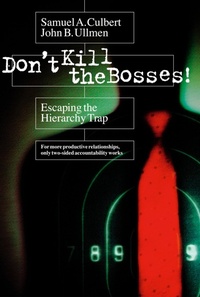
Don't Kill the Bosses! Escaping the Hierarchy Trap
Escaping the Hierarchy Trap
Published on 27. August 2001
Book
Hardback
200 pages
978-1-57675-161-9 (ISBN)
Description
The boss/subordinate relationship is an age-old problem cited in almost every management book and on-the-job survey as an area rife with dishonesty and inefficiency. All too often, subordinates spin the truth for those above while bosses fail to establish the conditions required for subordinates to tell it to them straight. The end result is warped communication, corrupt internal politics, illusionary teamwork, pass-the-buck accountability, and personal dispiriting-and the company is always the big loser.
Don't Kill the Bosses! reveals the "trap" created when people fail to differentiate between the positives of hierarchical structure and the negatives of hierarchical relationships. Far from being opposed to hierarchy, the authors believe strongly that an accurate and cleanly defined organization chart is vital. But they show how to implement an alternative model of hierarchy: two-sided accountability. Drawing on case studies from their consulting practice, Culbert and Ullmen show how this new model leads to a freer flow of information, more creative problem-solving, and quicker response to changing conditions.
Unlike other books that acknowledge boss/subordinate relationships as a systematic, continuing problem and offer skill development suggestions for dealing with it, Don't Kill the Bosses! tells how to think about the problem in a way that will enable readers to understand the steps they need to take to change things. It diagnoses what's missing in boss/subordinate relationships, connects what's wrong with them to personal and organizational outcomes, and defines the whole new mentality required to make them work successfully.
Don't Kill the Bosses! reveals the "trap" created when people fail to differentiate between the positives of hierarchical structure and the negatives of hierarchical relationships. Far from being opposed to hierarchy, the authors believe strongly that an accurate and cleanly defined organization chart is vital. But they show how to implement an alternative model of hierarchy: two-sided accountability. Drawing on case studies from their consulting practice, Culbert and Ullmen show how this new model leads to a freer flow of information, more creative problem-solving, and quicker response to changing conditions.
Unlike other books that acknowledge boss/subordinate relationships as a systematic, continuing problem and offer skill development suggestions for dealing with it, Don't Kill the Bosses! tells how to think about the problem in a way that will enable readers to understand the steps they need to take to change things. It diagnoses what's missing in boss/subordinate relationships, connects what's wrong with them to personal and organizational outcomes, and defines the whole new mentality required to make them work successfully.
More details
Language
English
Place of publication
San Francisco
United States
Target group
College/higher education
Product notice
sewn/stitched
Cloth over boards
With dust jacket
Dimensions
Height: 242 mm
Width: 163 mm
Thickness: 20 mm
Weight
472 gr
ISBN-13
978-1-57675-161-9 (9781576751619)
Copyright in bibliographic data and cover images is held by Nielsen Book Services Limited or by the publishers or by their respective licensors: all rights reserved.
Schweitzer Classification
Other editions
Additional editions
E-Book
09/2001
1st Edition
Berrett-Koehler Publishers
€67.29
Available for download
E-Book
01/2001
1st Edition
Berrett-Koehler Publishers
€24.19
Available for download
Person
Samuel A. Culbert has developed a blunt yet sensitive way of framing situations so that all forces driving people’s opinions and actions, including the subjective, self-interested, and political, can be matter-of-factly considered and explicitly discussed. Throughout his career he has creatively welded three activities: consulting, teaching, and writing. Consulting is where he encounters work effectiveness problems in their contemporary forms, learns how they are being dealt with, and finds challenge in coming up with new ways of engaging them. Teaching provides forums for extrapolating from problems to issues and, through give-and-take interaction, for probing underlying dynamics to identify which assumptions and resulting practices need upgrading. Writing is where he brings it all together to package his understanding for public consumption.
John Ullmen is currently a senior manager for organizational effectiveness at Earthlink. He is in the dissertation process of a Ph.D. in management at UCLA with a study that focuses on cofounder relationships in entrepreneurial firms. Ullmen has broad independent consulting experience in teambuilding, management coaching, network analysis, organizational change, and business development. He has been a consultant in the Management Communication Program at UCLA’s Anderson School of Management for the last four years and a consultant for several Internet start-up businesses. He holds a B.S. degree in engineering mechanics from the Air Force Academy and an M.S. degree in public policy from Harvard University.
John Ullmen is currently a senior manager for organizational effectiveness at Earthlink. He is in the dissertation process of a Ph.D. in management at UCLA with a study that focuses on cofounder relationships in entrepreneurial firms. Ullmen has broad independent consulting experience in teambuilding, management coaching, network analysis, organizational change, and business development. He has been a consultant in the Management Communication Program at UCLA’s Anderson School of Management for the last four years and a consultant for several Internet start-up businesses. He holds a B.S. degree in engineering mechanics from the Air Force Academy and an M.S. degree in public policy from Harvard University.
Content
Don't Kill the Bosses!
Chapter 1. The Beginning.
Chapter 2. The Middle.
Chapter 1. The Beginning.
Chapter 2. The Middle.