

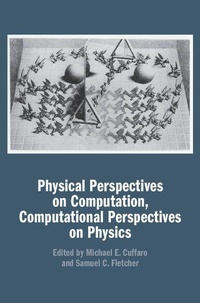
Physical Perspectives on Computation, Computational Perspectives on Physics
Published on 17. May 2018
Book
Hardback
324 pages
978-1-107-17119-0 (ISBN)
Description
Although computation and the science of physical systems would appear to be unrelated, there are a number of ways in which computational and physical concepts can be brought together in ways that illuminate both. This volume examines fundamental questions which connect scholars from both disciplines: is the universe a computer? Can a universal computing machine simulate every physical process? What is the source of the computational power of quantum computers? Are computational approaches to solving physical problems and paradoxes always fruitful? Contributors from multiple perspectives reflecting the diversity of thought regarding these interconnections address many of the most important developments and debates within this exciting area of research. Both a reference to the state of the art and a valuable and accessible entry to interdisciplinary work, the volume will interest researchers and students working in physics, computer science, and philosophy of science and mathematics.
More details
Language
English
Place of publication
Cambridge
United Kingdom
Target group
Professional and scholarly
Dimensions
Height: 235 mm
Width: 157 mm
Thickness: 22 mm
Weight
624 gr
ISBN-13
978-1-107-17119-0 (9781107171190)
Copyright in bibliographic data and cover images is held by Nielsen Book Services Limited or by the publishers or by their respective licensors: all rights reserved.
Schweitzer Classification
Other editions
Additional editions
Michael E. Cuffaro | Samuel C. Fletcher
Physical Perspectives on Computation, Computational Perspectives on Physics
Book
03/2020
Cambridge University Press
€49.30
Shipment within 15-20 days
Michael E. Cuffaro
Physical Perspectives on Computation, Computational Perspectives on Physics
E-Book
05/2018
Cambridge University Press
€26.99
Available for download
Michael E. Cuffaro | Samuel C. Fletcher
Physical Perspectives on Computation, Computational Perspectives on Physics
E-Book
05/2018
Cambridge University Press
€88.99
Available for download
Persons
Michael E. Cuffaro is a Postdoctoral Research Fellow of the Rotman Institute of Philosophy at the University of Western Ontario and an external member of the Munich Center for Mathematical Philosophy at Ludwig-Maximilians-Universitaet Muenchen. Samuel C. Fletcher is an Assistant Professor of Philosophy at the University of Minnesota, Twin Cities, a resident fellow of the Minnesota Center for Philosophy of Science, and an external member of the Munich Center for Mathematical Philosophy at Ludwig-Maximilians-Universitaet Muenchen.
Content
List of figures; List of tables; Preface; Introduction Michael E. Cuffaro and Samuel C. Fletcher; Part I. The Computability of Physical Systems and Physical Systems as Computers: 1. Ontic pancomputationalism Gualtiero Piccinini and Neal G. Anderson; 2. Zuse's thesis, Gandy's thesis, and Penrose's thesis B. Jack Copeland, Oron Shagrir and Mark Sprevak; 3. Church's thesis, Turing's limits, and Deutsch's principle Rossella Lupacchini; Part II. The Implementation of Computation in Physical Systems: 4. How to make orthogonal positions parallel: revisiting the quantum parallelism thesis Armond Duwell; 5. How is there a physics of information? On characterizing physical evolution as information processing Owen J. E. Maroney and Christopher G. Timpson; 6. Abstraction/representation theory and the natural science of computation Dominic Horsman, Viv Kendon and Susan Stepney; Part III. Physical Perspectives on Computer Science: 7. Physics-like models of computation Klaus Sutner; 8. Feasible computation: methodological contributions from computational science Robert H. C. Moir; 9. Relativistic computation Hajnal Andreka, Judit X. Madarasz, Istvan Nemeti, Peter Nemeti and Gergely Szekely; Part IV. Computational Perspectives on Physical Theory: 10. Intension in the physics of computation: lessons from the debate about Landauer's principle James Ladyman; 11. Maxwell's demon does not compute John D. Norton; 12. Quantum theory as a principle theory: insights from an information-theoretic reconstruction Adam Koberinski and Markus P. Mueller; Bibliography; Index.