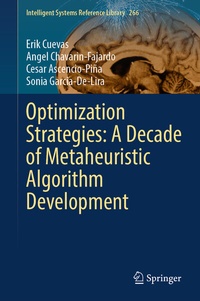
This book is to explore the development of metaheuristic algorithms over the past decade, focusing on key advancements in their components and structural features, which have driven progress in search techniques. This analysis aims to provide readers with a thorough understanding of the fundamental aspects of these methods, which are essential for their practical application. To offer a broad perspective on the evolution of metaheuristic algorithms, this book reviews 11 specific algorithms developed by the evolutionary computation group at the University of Guadalajara over the past 10 years. These algorithms illustrate the most significant mechanisms and structures discussed in the academic and research communities during their development. By studying these examples, readers will gain valuable insights into the innovative methods and strategic improvements that have shaped the field. The book is designed from a teaching standpoint, making it suitable for undergraduate and postgraduate students in science, electrical engineering, or computational mathematics. Moreover, engineering practitioners unfamiliar with metaheuristic computation will appreciate how these techniques have been adapted to address complex real-world engineering problems, moving beyond theoretical constructs.
Series
Language
Place of publication
Publishing group
Springer International Publishing
Target group
Professional and scholarly
Illustrations
73 s/w Abbildungen, 46 farbige Abbildungen
XIV, 447 p. 119 illus., 46 illus. in color.
Dimensions
Height: 241 mm
Width: 160 mm
Thickness: 31 mm
Weight
ISBN-13
978-3-031-81012-1 (9783031810121)
DOI
10.1007/978-3-031-81013-8
Schweitzer Classification
Dr. Erik Cuevas received his B.S. degree with distinction in Electronics and Communications Engineering from the University of Guadalajara, Mexico, in 1995, the M.Sc. degree in Industrial Electronics from ITESO, Mexico, in 2000, and the Ph.D. degree from Freie Universität Berlin, Germany in 2006. Since 2006 he has been with the University of Guadalajara, where he is currently a full-time Professor in the Department of Computer Science. Since 2008, he is a member of the Mexican National Research System (SNI III). He is the author of several books and articles. A list of his books and publications can be seen in the CV attached to this application. His current research interest includes Meta-heuristics, computer vision, and mathematical methods. He serves as an editor in Expert System with Applications, ISA Transactions, and Applied Soft Computing, Applied Mathematical Modeling and Mathematics and Computers in Simulation.
Alma Rodriguez earned her Bachelor of Science in Industrial Engineering and her Master's degree from CETI, Mexico, in 2005 and 2007, respectively. She went on to achieve her Doctorate in Engineering from the Universidad de Guadalajara, located in Guadalajara, Mexico, in 2021. Dr. Rodriguez has made her mark as an author of numerous engineering-related scientific publications. She contributed as a co-author to the publication "Recent Metaheuristic Computation Schemes in Engineering," released by Springer International Publishing. Her research primarily focuses on the areas of Metaheuristic Algorithms, Supplier Selection, Inventory Theory, and the broader field of optimization.Beatriz Rivera received a B.S. degree with distinction in Computer Engineering from UNIVA, México, a M.Sc. degree in Engineering Systems from UANL, México. Since 2014, she has been with The University of Guadalajara, where she is currently a Professor and enrolled in the Ph.D. program in Electronics and Computer Science. Her current research interests are metaheuristic algorithms and artificial intelligence.
Jesús López obtained a bachelor's degree in Communications and Electronics Engineering in 2009 and a Master of Science degree in Electronic and Computer Engineering in 2014 from Centro Universitario de Ciencias Exactas e Ingenierías (CUCEI) of the University of Guadalajara, Mexico. He is currently pursuing a Ph. D. in Science degree in Electronic and Computer Engineering from 2021 at the University of Guadalajara. Collaborator in the development of two patents: "Magnetic levitator system for balancing a biped robot" and "Variable transmission system based on gear assemblies forming a truncated sphere". His research interests include metaheuristics algorithms, artificial intelligence, robotics topics, artificial vision, and their applications.
Carlos Guzmán received the bachelor's degree in Mechatronics Engineering from Universidad Politécnica de Sinaloa, Mexico in 2020 and a M.Sc. degree in Electronic and Computer Engineering in 2023 from the University of Guadalajara, Mexico. He is currently pursuing a Ph.D degree in Electronics and Computer Science at the University of Guadalajara, Mexico. His research interests include artificial vision and their applications.