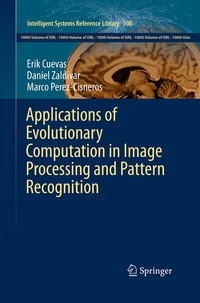
This book presents the use of efficient
Evolutionary Computation (EC) algorithms for solving diverse real-world image
processing and pattern recognition problems. It provides an overview of the
different aspects of evolutionary methods in order to enable the reader in
reaching a global understanding of the field and, in conducting studies on
specific evolutionary techniques that are related to applications in image
processing and pattern recognition. It explains the basic ideas of the proposed
applications in a way that can also be understood by readers outside of the
field. Image processing and pattern recognition practitioners who are not
evolutionary computation researchers will appreciate the discussed techniques
beyond simple theoretical tools since they have been adapted to solve
significant problems that commonly arise on such areas. On the other hand,
members of the evolutionary computation community can learn the way in which
image processing and pattern recognition problems can be translated into an
optimization task. The book has been structured so that each chapter can be
read independently from the others. It can serve as reference book for students
and researchers with basic knowledge in image processing and EC methods.
Series
Edition
Softcover reprint of the original 1st ed. 2016
Language
Place of publication
Publishing group
Springer International Publishing
Target group
Professional and scholarly
Illustrations
55 farbige Abbildungen, 56 s/w Abbildungen
XV, 274 p. 111 illus., 55 illus. in color.
Dimensions
Height: 235 mm
Width: 155 mm
Thickness: 16 mm
Weight
ISBN-13
978-3-319-37099-6 (9783319370996)
DOI
10.1007/978-3-319-26462-2
Schweitzer Classification
Dr. Erik Cuevas received his B.S. degree with distinction in Electronics and Communications Engineering from the University of Guadalajara, Mexico, in 1995, the M.Sc. degree in Industrial Electronics from ITESO, Mexico, in 2000, and the Ph.D. degree from Freie Universität Berlin, Germany in 2006. Since 2006 he has been with the University of Guadalajara, where he is currently a full-time Professor in the Department of Computer Science. Since 2008, he is a member of the Mexican National Research System (SNI III). He is the author of several books and articles. A list of his books and publications can be seen in the CV attached to this application. His current research interest includes Meta-heuristics, computer vision, and mathematical methods. He serves as an editor in Expert System with Applications, ISA Transactions, and Applied Soft Computing, Applied Mathematical Modeling and Mathematics and Computers in Simulation.
Alma Rodriguez earned her Bachelor of Science in Industrial Engineering and her Master's degree from CETI, Mexico, in 2005 and 2007, respectively. She went on to achieve her Doctorate in Engineering from the Universidad de Guadalajara, located in Guadalajara, Mexico, in 2021. Dr. Rodriguez has made her mark as an author of numerous engineering-related scientific publications. She contributed as a co-author to the publication "Recent Metaheuristic Computation Schemes in Engineering," released by Springer International Publishing. Her research primarily focuses on the areas of Metaheuristic Algorithms, Supplier Selection, Inventory Theory, and the broader field of optimization.Beatriz Rivera received a B.S. degree with distinction in Computer Engineering from UNIVA, México, a M.Sc. degree in Engineering Systems from UANL, México. Since 2014, she has been with The University of Guadalajara, where she is currently a Professor and enrolled in the Ph.D. program in Electronics and Computer Science. Her current research interests are metaheuristic algorithms and artificial intelligence.
Jesús López obtained a bachelor's degree in Communications and Electronics Engineering in 2009 and a Master of Science degree in Electronic and Computer Engineering in 2014 from Centro Universitario de Ciencias Exactas e Ingenierías (CUCEI) of the University of Guadalajara, Mexico. He is currently pursuing a Ph. D. in Science degree in Electronic and Computer Engineering from 2021 at the University of Guadalajara. Collaborator in the development of two patents: "Magnetic levitator system for balancing a biped robot" and "Variable transmission system based on gear assemblies forming a truncated sphere". His research interests include metaheuristics algorithms, artificial intelligence, robotics topics, artificial vision, and their applications.
Carlos Guzmán received the bachelor's degree in Mechatronics Engineering from Universidad Politécnica de Sinaloa, Mexico in 2020 and a M.Sc. degree in Electronic and Computer Engineering in 2023 from the University of Guadalajara, Mexico. He is currently pursuing a Ph.D degree in Electronics and Computer Science at the University of Guadalajara, Mexico. His research interests include artificial vision and their applications.