

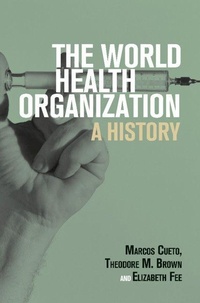
The World Health Organization
A History
Published on 11. April 2019
Book
Hardback
388 pages
978-1-108-48357-5 (ISBN)
Description
According to its Constitution, the mission of the World Health Organization (WHO) was nothing less than the 'attainment by all peoples of the highest possible level of health' without distinction of race, religion, political belief, economic status, or social condition. But how consistently and how well has the WHO pursued this mission since 1946? This comprehensive and engaging new history explores these questions by looking at its origins and its institutional antecedents, while also considering its contemporary and future roles. It examines how the WHO was shaped by the particular environments of the postwar period and the Cold War, the relative influence of the US and other approaches to healthcare, and its place alongside sometimes competing international bodies such as UNICEF, the World Bank, and the Gates Foundation. The authors re-evaluate the relative success and failure of critical WHO campaigns, from early malaria and smallpox eradication programs to struggles with Ebola today.
Reviews / Votes
'Finally, an up-to-date history of the World Health Organization. This deft account spans the institution's aspirational post-World War II beginnings, the tensions and turnarounds of the Cold War period, and the embattled contemporary era of private encroachment on WHO turf. The authors bring together the contentious politics, personae, and programs through a grand narrative and little-known inside stories.' Anne-Emanuelle Birn, University of Toronto 'This long-awaited volume by three distinguished historians of public health, does not disappoint. Though the general lines of this history are familiar, this extensively researched, clearly written volume greatly enriches this history, providing new details on nearly every page, and situating the WHO within the wider history of global political change.' Randall Packard, The Johns Hopkins University '... the authors are to be congratulated, not only for presenting us with this splendid, up-to-date and excellently contextualized history of the WHO, which constitutes a reference work about this international agency; but also for inviting us to engage in a historical reflection, and for drawing lessons from this history to be applied to the present and future of the mission of the WHO.' Maria-Isabel Porras-Gallo, MetascienceMore details
Series
Language
English
Place of publication
Cambridge
United Kingdom
Target group
Professional and scholarly
Illustrations
Worked examples or Exercises; 54 Halftones, black and white
Dimensions
Height: 235 mm
Width: 157 mm
Thickness: 25 mm
Weight
714 gr
ISBN-13
978-1-108-48357-5 (9781108483575)
Copyright in bibliographic data and cover images is held by Nielsen Book Services Limited or by the publishers or by their respective licensors: all rights reserved.
Schweitzer Classification
Other editions
Additional editions
Book
04/2019
Cambridge University Press
€46.00
Shipment within 15-20 days
E-Book
04/2019
Cambridge University Press
€26.99
Available for download
E-Book
04/2019
Cambridge University Press
€32.49
Available for download
Persons
Marcos Cueto is Professor of the Casa de Oswaldo Cruz, Fiocruz, Rio de Janeiro the main Brazilian biomedical institute, and is co-editor of the journal História, Ciências Saúde - Manguinhos. His book, co-authored with Steven Palmer, Medicine and Public Health in Latin America: A History (Cambridge, 2015) won the 2017 George Rosen award of the American Association for the History of Medicine.
Content
Introduction; 1. The making of an international health establishment; 2. The birth of the World Health Organization, 1945-8; 3. The start-up years, 1948-55; 4. The Cold War and eradication; 5. Overcoming the warming of the Cold War: smallpox eradication; 6. The transition from 'family planning' to 'sexual and reproductive rights'; 7. The vicissitudes of primary health care; 8. The response to the HIV/AIDS pandemic; 9. An embattled director-general and the persistence of the WHO; 10. The competitive world of global health; 11. The World Health Organization in the second decade of the twenty-first century.