

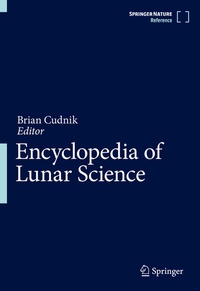
Encyclopedia of Lunar Science
Published on 27. April 2023
Book
Hardback
XXIII, 1282 pages
978-3-319-14540-2 (ISBN)
Description
The Encyclopedia of Lunar Science includes the latest topical data, definitions, and explanations of the many and varied facets of lunar science. This is a very useful reference work for a broad audience, not limited to the professional lunar scientist: general astronomers, researchers, theoreticians, practitioners, graduate students, undergraduate students, and astrophysicists as well as geologists and engineers. The title includes all current areas of lunar science, with the topical entries being established tertiary literature. The work is technically suitable to most advanced undergraduate and graduate students. The articles include topics of varying technical levels so that the top scientists of the field find this work a benefit as well as the graduate students and the budding lunar scientists. A few examples of topical areas are as follows: Basaltic Volcanism, Lunar Chemistry, Time and Motion Coordinates, Cosmic Weathering through Meteoritic Impact, Environment, Geology, Geologic History, Impacts and Impact Processes, Lunar Surface Processes, Origin and Evolution Theories, Regolith, Stratigraphy, Tectonic Activity, Topography, Weathering through ionizing radiation from the solar wind, solar flares, and cosmic rays.
More details
Edition
1st ed. 2023
Language
English
Place of publication
Cham
Switzerland
Publishing group
Springer International Publishing
Target group
Professional and scholarly
Research
Illustrations
206 s/w Abbildungen, 435 farbige Abbildungen
XXIII, 1282 p. 641 illus., 435 illus. in color. In 2 volumes, not available separately.
Dimensions
Height: 260 mm
Width: 183 mm
Thickness: 78 mm
Weight
3160 gr
ISBN-13
978-3-319-14540-2 (9783319145402)
DOI
10.1007/978-3-319-14541-9
Schweitzer Classification
Other editions
Additional editions
Brian Cudnik
Encyclopedia of Lunar Science
Book
01/2023
Springer
€962.99
The article will not be published
Person
Professor Brian Cudnik serves as Laboratory Specialist for the Physics Program at Prairie View A&M University (a part of the Texas A&M University system) in Texas. He has been at this position for almost 21 years and has been at Prairie View A&M for a total of 23 years. His prior position was that of Research Assistant at the Solar Observatory. He has served as coordinator of the Lunar Meteoritic Impact Search section of the Association of Lunar and Planetary Observers (ALPO) since January 2000, two months after making the first confirmed visual observation of a meteoroid impact on the Moon during the Leonid storm of November 1999.
He has published papers and posters on various astronomical subjects including peer-reviewed papers, posters at professional conferences and amateur astronomy publications. He has served as Board Member of the Houston Astronomical Society, is presently an Associate member of the American Astronomical Society, and a regular contributor of observationsto the American Association of Variable Star Observers. He taught astronomy at the University of St. Thomas every semester or summer session (one summer session per summer) from 2005 to 2015.
He has published papers and posters on various astronomical subjects including peer-reviewed papers, posters at professional conferences and amateur astronomy publications. He has served as Board Member of the Houston Astronomical Society, is presently an Associate member of the American Astronomical Society, and a regular contributor of observationsto the American Association of Variable Star Observers. He taught astronomy at the University of St. Thomas every semester or summer session (one summer session per summer) from 2005 to 2015.
Content
From the Contents: Albedo/photometric mapping.- Ancient Lunar Dynamo / magnetic field.- Atmosphere, evolution of.- Atmosphere, present (including sodium enhancements).- Basaltic volcanism.- Breccias.- Chemistry of lunar surface.- Core properties.- Craters-ages and evolution.- Craters-concentric.- Crater counting / densities.- Craters-secondaries.- Craters-sizes and morphologies.- Dark Halo Lunar Craters.- Differentiation and Internal Structure.