

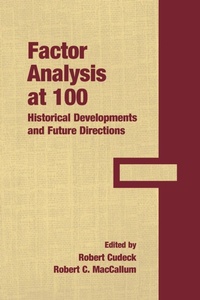
Factor Analysis at 100
Historical Developments and Future Directions
1st Edition
Published on 6. March 2007
Book
Paperback/Softback
400 pages
978-0-8058-6212-6 (ISBN)
Description
Factor analysis is one of the success stories of statistics in the social sciences. The reason for its wide appeal is that it provides a way to investigate latent variables, the fundamental traits and concepts in the study of individual differences. Because of its importance, a conference was held to mark the centennial of the publication of Charles Spearman's seminal 1904 article which introduced the major elements of this invaluable statistical tool. This book evolved from that conference. It provides a retrospective look at major issues and developments as well as a prospective view of future directions in factor analysis and related methods. In so doing, it demonstrates how and why factor analysis is considered to be one of the methodological pillars of behavioral research.
Featuring an outstanding collection of contributors, this volume offers unique insights on factor analysis and its related methods. Several chapters have a clear historical perspective, while others present new ideas along with historical summaries. In addition, the book reviews some of the extensions of factor analysis to such techniques as latent growth curve models, models for categorical data, and structural equation models.
Factor Analysis at 100 will appeal to graduate students and researchers in the behavioral, social, health, and biological sciences who use this technique in their research. A basic knowledge of factor analysis is required and a working knowledge of linear algebra is helpful.
Featuring an outstanding collection of contributors, this volume offers unique insights on factor analysis and its related methods. Several chapters have a clear historical perspective, while others present new ideas along with historical summaries. In addition, the book reviews some of the extensions of factor analysis to such techniques as latent growth curve models, models for categorical data, and structural equation models.
Factor Analysis at 100 will appeal to graduate students and researchers in the behavioral, social, health, and biological sciences who use this technique in their research. A basic knowledge of factor analysis is required and a working knowledge of linear algebra is helpful.
Reviews / Votes
'This text will certainly be exceptionally useful in a variety of contexts for a variety of audiences.' - Kevin L. Ladd, PsycCRITIQUES'This book is all about factor analysis (FA), its history, development, developers, theory, applications, and variations during the past 100 years [...] a volume full of interesting, both methodological and historical details [...] it is not just history. It is also a fresh look at the future [...] The book is worth reading just for curiosity, but many of the chapters will serve well as a supplementary material for courses of these topics.' - Kimmo Vehkalahti, International Statistical Review "This text will certainly be exceptionally useful in a variety of contexts for a variety of audiences."- Kevin L. Ladd, PsycCRITIQUES
"This book is all about factor analysis (FA), its history, development, developers, theory, applications, and variations during the past 100 years [...] a volume full of interesting, both methodological and historical details [...] it is not just history. It is also a fresh look at the future [...] The book is worth reading just for curiosity, but many of the chapters will serve well as a supplementary material for courses of these topics." - Kimmo Vehkalahti, International Statistical Review
"There is much of value in this volume. This volume presents a wide-ranging overview of factor analysis. We recommend it to anyone who wants to expand their perspective on modeling educational and psychological data." - Neil J. Dorans and Longjuan Liang, Educational Testing Service, Journal of Educational Measurement
More details
Language
English
Place of publication
New York
United States
Publishing group
Taylor & Francis Inc
Target group
College/higher education
Dimensions
Height: 229 mm
Width: 152 mm
Thickness: 22 mm
Weight
580 gr
ISBN-13
978-0-8058-6212-6 (9780805862126)
Copyright in bibliographic data and cover images is held by Nielsen Book Services Limited or by the publishers or by their respective licensors: all rights reserved.
Schweitzer Classification
Other editions
Additional editions

Robert Cudeck | Robert C. MacCallum
Factor Analysis at 100
Historical Developments and Future Directions
E-Book
03/2007
1st Edition
Routledge
€78.99
Available for download

Robert Cudeck | Robert C. MacCallum
Factor Analysis at 100
Historical Developments and Future Directions
E-Book
03/2007
Routledge
€78.99
Available for download
Robert Cudeck | Robert C. MacCallum
Factor Analysis at 100
Historical Developments and Future Directions
Book
03/2007
1st Edition
Routledge
€207.50
Shipment within 10-20 days
Persons
Robert Cudeck and Robert C. MacCallum
Content
Contents: Preface. D. Bartholomew, Three Faces of Factor Analysis. L. Jones, Remembering L. L. Thurstone. R.D. Bock, Rethinking Thurstone. K. J"reskog, Factor Analysis and Its Extensions. K. Bollen, On the Origins of the Latent Curve Model in the Factor Analysis and Growth Curve Traditions. J. McArdle, Factor Analysis of Longitudinal Repeated Measures Data. R. Millsap, W. Meredith, Factorial Invariance: Historical Trends and New Problems. R. MacCallum, M.W. Browne, L. Cai, Factor Analysis Models as Approximations. K.F. Widaman, Common Factors vs. Components: Principals and Principles, Errors, and Misconceptions. J. Horn, Understanding Human Intelligence: Where Have We Come Since Spearman? J.R. Nesselroade, Factoring at the Individual Level: Some Matters for the Second Century of Factor Analysis. M.W. Browne, G. Zhang, Developments in the Factor Analysis of Individual Time Series. I. Moustaki, Factor Analysis and Latent Structure of Categorical and Metric Data. R. Jennrich, Rotation Methods, Algorithms, and Standard Errors. M. Wall, Y. Amemiya, A Review of Nonlinear Factor Analysis and Nonlinear Structural Equation Modeling.