

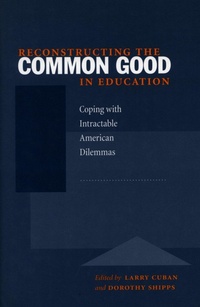
Reconstructing the Common Good in Education
Coping with Intractable American Dilemmas
Published on 1. May 2000
Book
Hardback
304 pages
978-0-8047-3862-0 (ISBN)
Description
For almost two centuries, Americans expected that their public schools would cultivate the personal, moral, and social development of individual students, create citizens, and bind diverse groups into one nation. Since the 1980s, however, a new generation of school reformers has been intent on using schools to solve the nation's economic problems. An economic justification for public schools-equipping students with marketable skills to help the nation compete in a global, information-based workplace-overwhelmed other historically accepted purposes for tax-supported public schools.
Private sector management has become the model for public school systems as schools and districts are "downsized," "restructured," and "outsourced." Recent reform proposals have called for government-funded vouchers to send children to private schools, the creation of self-governing charter schools, the contracting of schools to private entrepreneurs, and the partnerships with the business community in promoting new information technologies. But if there is a shared national purpose for education, should it be oriented only toward enhancing the country's economic success? Is everything public for sale? Are the interests of individuals or selected groups overwhelming the common good that the founders of tax-supported public schools so fervently sought?
This volume explores the ongoing debates about what constitutes the common good in American public education, assessing the long-standing tensions between shared purposes and individual interests in schooling. It shows how recent school reform efforts, driven by economic concerns, have worsened the conflict between the legitimate interests of individuals and society as a whole, and demonstrates that reconstructing the common good envisioned by the founders of public education in the United States remains essential and unfinished work.
Private sector management has become the model for public school systems as schools and districts are "downsized," "restructured," and "outsourced." Recent reform proposals have called for government-funded vouchers to send children to private schools, the creation of self-governing charter schools, the contracting of schools to private entrepreneurs, and the partnerships with the business community in promoting new information technologies. But if there is a shared national purpose for education, should it be oriented only toward enhancing the country's economic success? Is everything public for sale? Are the interests of individuals or selected groups overwhelming the common good that the founders of tax-supported public schools so fervently sought?
This volume explores the ongoing debates about what constitutes the common good in American public education, assessing the long-standing tensions between shared purposes and individual interests in schooling. It shows how recent school reform efforts, driven by economic concerns, have worsened the conflict between the legitimate interests of individuals and society as a whole, and demonstrates that reconstructing the common good envisioned by the founders of public education in the United States remains essential and unfinished work.
Reviews / Votes
"Every library with serious contemporary affairs or education collections will want this intelligent book."-C. A. Cunningham, University of Chicago ". . . . This book does something that is unique in our headlong rush to change, reform, punish, or criticize education. Its thoughtful essays pause and reflect on what public education means in America. . . . [Reconstructing the Common Good in Education] is relevant for both historians and those in education policy. . . .[It] provides useful ideas and material for both."-American Studies InternationalMore details
Edition
New edition
Language
English
Place of publication
Palo Alto
United States
Target group
College/higher education
Professional and scholarly
Edition type
New edition
Product notice
Cloth
Dimensions
Height: 236 mm
Width: 163 mm
Thickness: 22 mm
Weight
540 gr
ISBN-13
978-0-8047-3862-0 (9780804738620)
Copyright in bibliographic data and cover images is held by Nielsen Book Services Limited or by the publishers or by their respective licensors: all rights reserved.
Schweitzer Classification
Persons
Larry Cuban is Professor of Education at Stanford University. He is the author, most recently, of How Scholars Trumped Teachers: Change Without Reform in University Curriculum, Teaching, and Research. Dorothy Shipps is Assistant Professor of Education at Teachers College, Columbia University.
Content
Foreword Patricia Albjerg Graham; Introduction Larry Cuban and Dorothy Shipps; Part I. Ways of Seeing the Common Good in Public Education: The Past Informing the Present: 1. Public schools and the elusive search for the common good William J. Reese; 2. Turning points: reconstruction and the growth of national influence in education Ted Mitchell; 3. 'The is no escape ... from the ogre of indoctrination': George Counts and the civic dilemmas of democratic educators Daniel Perlstein; 4. 'No one here to put us down': hispano education in a Southern Colorado community, 1920-1963 Ruben Donato; 5. Echoes of corporate influence: managing away urban school troubles Dorothy Shipps; Part II. Ways of Seeing the Common Good in Public Education: Social and Political Implications: 6. No exit: public education as an inescapably public good David F. Labaree; 7. Bureaucracy left and right: thinking about the one best system Harvey Kantor and Robert Lowe; 8. Why is it so hard to get 'good' schools? Larry Cuban; Part III. Uncommon Ways of Seeing the Common Good: 9. Civic friendship: an aristotelian perspective Elisabeth Hansot; 10. Devotion and ambiguity in the struggles of a poor mother and her family: New York City, 1918-1919 Michael B. Katz; 11. Reflections on education as transcendence John Mayer; Afterword Dorothy Shipps and Larry Cuban; Notes; References; Index.