

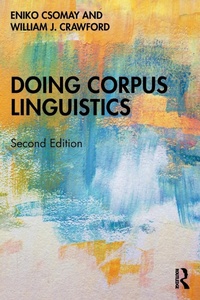
Doing Corpus Linguistics
2nd Edition
Published on 28. February 2024
Book
Paperback/Softback
176 pages
978-1-032-41471-3 (ISBN)
Description
Doing Corpus Linguistics offers a practical step-by-step introduction to corpus linguistics, making use of widely available corpora and of a register analysis-based theoretical framework to provide students in applied linguistics and TESOL with the understanding and skills necessary to meaningfully analyze corpora and carry out successful corpus-based research.
This second edition has been thoroughly revised and updated with fresh exercises, examples, and references, as well as an extensive list of English corpora around the world. It also provides more clarity around the approach used in the book, contains new sections on how to identify patterns in texts, and now covers Cohen's statistical method.
This practical and applied text emphasizes hands-on experience with performing language analysis research and interpreting findings in a meaningful and engaging way. Readers are given multiple opportunities to analyze language data by completing smaller tasks and corpus projects using publicly available corpora. The book also takes readers through the process of building a specialized corpus designed to answer a specific research question and offers detailed information on completing a final research project that includes both a written paper and an oral presentation of the reader's specific research projects.
Doing Corpus Linguistics provides students in applied linguistics and TESOL with the opportunity to gain proficiency in the technical and interpretive aspects of corpus research and to encourage them to participate in the growing field of corpus linguistics.
This second edition has been thoroughly revised and updated with fresh exercises, examples, and references, as well as an extensive list of English corpora around the world. It also provides more clarity around the approach used in the book, contains new sections on how to identify patterns in texts, and now covers Cohen's statistical method.
This practical and applied text emphasizes hands-on experience with performing language analysis research and interpreting findings in a meaningful and engaging way. Readers are given multiple opportunities to analyze language data by completing smaller tasks and corpus projects using publicly available corpora. The book also takes readers through the process of building a specialized corpus designed to answer a specific research question and offers detailed information on completing a final research project that includes both a written paper and an oral presentation of the reader's specific research projects.
Doing Corpus Linguistics provides students in applied linguistics and TESOL with the opportunity to gain proficiency in the technical and interpretive aspects of corpus research and to encourage them to participate in the growing field of corpus linguistics.
More details
Edition
2nd edition
Language
English
Place of publication
London
United Kingdom
Publishing group
Taylor & Francis Ltd
Target group
College/higher education
Postgraduate
Illustrations
31 s/w Photographien bzw. Rasterbilder, 5 s/w Zeichnungen, 44 s/w Tabellen, 36 s/w Abbildungen
44 Tables, black and white; 5 Line drawings, black and white; 31 Halftones, black and white; 36 Illustrations, black and white
Dimensions
Height: 229 mm
Width: 152 mm
Thickness: 11 mm
Weight
287 gr
ISBN-13
978-1-032-41471-3 (9781032414713)
Copyright in bibliographic data and cover images is held by Nielsen Book Services Limited or by the publishers or by their respective licensors: all rights reserved.
Schweitzer Classification
Other editions
Additional editions
Eniko Csomay | William J. Crawford
Doing Corpus Linguistics
E-Book
02/2024
2nd Edition
Taylor & Francis
€53.99
Available for download
Eniko Csomay | William J. Crawford
Doing Corpus Linguistics
Book
02/2024
2nd Edition
Routledge
€206.00
Shipment within 10-20 days
Eniko Csomay | William J. Crawford
Doing Corpus Linguistics
E-Book
02/2024
2nd Edition
Taylor & Francis
€53.99
Available for download
Previous edition
Eniko Csomay | William J. Crawford
Doing Corpus Linguistics
Book
10/2015
1st Edition
Routledge
€80.65
Article exhausted; check for reprint
Persons
Eniko Csomay is a Professor in the Department of Linguistics and Asian/Middle Eastern Languages at San Diego State University, USA.
William J. Crawford is a Professor in the Department of English at Northern Arizona University, USA.
William J. Crawford is a Professor in the Department of English at Northern Arizona University, USA.
Content
List of Tables
List of Figures
Preface
Acknowledgments
PART I
Introduction to Doing Corpus Linguistics and Register Analysis
1 Linguistics, Corpus Linguistics, and Language Variation
1.1 Language and Rules/Systems
1.2 What Is Corpus Linguistics?
1.3 Register, Genre, and Style - Is There a Difference?
1.4 Outline of the Book
2 Register (Functional) Approach to Language Analysis
2.1 Why Register?
2.2 What Is a Register (Functional) Analysis?
2.3 Describing Situational Characteristics and Identifying Variables
2.4 Providing a Functional Interpretation
2.5 Units of Analysis and Register Studies
2.6 End of Chapter Exercises
PART II
Searches in Available Corpora
3 Searching a Corpus
3.1 Words
3.2 Collocates
3.3 N-Grams
3.4 POS Tags
4 Projects Using Publicly Available Corpora4.1 Word- and Phrase-Based Projects
4.2 Grammar-Based Projects
PART III
Building Your Own Corpus, Analyzing Your Quantitative Results, and Making Sense of Data
5 Building Your Own Corpus
5.1 Do-It-Yourself Corpora
5.2 Deciding on a Corpus Project
5.3 Building a Corpus
5.4 Software Programs and Your Corpus
6 Basic Statistics
6.1 Why Do Statistical Analyses?
6.2 Basic Terms, Concepts, and Assumptions
6.3 How to Go About Getting the Statistical Results
6.4 End of Chapter Exercises
7 Statistical Tests (ANOVAs, Chi-square, Pearson Correlation)
7.1 Difference Tests
7.2 Relationship Tests
7.3 How to Go About Getting the Statistical Results
7.4 Effect Size
7.5 End of Chapter Exercises
8 Doing Corpus Linguistics
8.1 Doing a Register Analysis of Your Project
8.2 Situational Analysis
8.3 Linguistic Analysis
8.4 Functional Interpretation
8.5 Reporting on Your Project
9 A Way Forward
Available Corpora
Index
List of Figures
Preface
Acknowledgments
PART I
Introduction to Doing Corpus Linguistics and Register Analysis
1 Linguistics, Corpus Linguistics, and Language Variation
1.1 Language and Rules/Systems
1.2 What Is Corpus Linguistics?
1.3 Register, Genre, and Style - Is There a Difference?
1.4 Outline of the Book
2 Register (Functional) Approach to Language Analysis
2.1 Why Register?
2.2 What Is a Register (Functional) Analysis?
2.3 Describing Situational Characteristics and Identifying Variables
2.4 Providing a Functional Interpretation
2.5 Units of Analysis and Register Studies
2.6 End of Chapter Exercises
PART II
Searches in Available Corpora
3 Searching a Corpus
3.1 Words
3.2 Collocates
3.3 N-Grams
3.4 POS Tags
4 Projects Using Publicly Available Corpora4.1 Word- and Phrase-Based Projects
4.2 Grammar-Based Projects
PART III
Building Your Own Corpus, Analyzing Your Quantitative Results, and Making Sense of Data
5 Building Your Own Corpus
5.1 Do-It-Yourself Corpora
5.2 Deciding on a Corpus Project
5.3 Building a Corpus
5.4 Software Programs and Your Corpus
6 Basic Statistics
6.1 Why Do Statistical Analyses?
6.2 Basic Terms, Concepts, and Assumptions
6.3 How to Go About Getting the Statistical Results
6.4 End of Chapter Exercises
7 Statistical Tests (ANOVAs, Chi-square, Pearson Correlation)
7.1 Difference Tests
7.2 Relationship Tests
7.3 How to Go About Getting the Statistical Results
7.4 Effect Size
7.5 End of Chapter Exercises
8 Doing Corpus Linguistics
8.1 Doing a Register Analysis of Your Project
8.2 Situational Analysis
8.3 Linguistic Analysis
8.4 Functional Interpretation
8.5 Reporting on Your Project
9 A Way Forward
Available Corpora
Index