

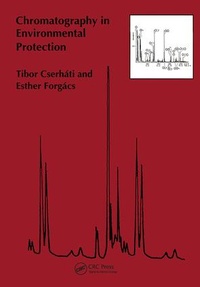
Chromatography in Environmental Protection
1st Edition
Published on 21. December 2000
Book
Hardback
320 pages
978-90-5823-161-1 (ISBN)
Description
Chromatography has been developed as a powerful and rapid technique for the separation of compounds with highly similar molecular characteristics, even from complicated matrices.
Due to their excellent separation characteristics and Versatility, chromatographic methods have found growing acceptance and application in environmental protection for residue analysis in air, ground and surface waters, sewage, sludge, soil matrices, etc
The book will be of interest to analytical chemists in legalisation and research and to analytical control specialists, as well as to researchers and students.
Due to their excellent separation characteristics and Versatility, chromatographic methods have found growing acceptance and application in environmental protection for residue analysis in air, ground and surface waters, sewage, sludge, soil matrices, etc
The book will be of interest to analytical chemists in legalisation and research and to analytical control specialists, as well as to researchers and students.
More details
Language
English
Place of publication
London
United Kingdom
Target group
Professional and scholarly
Dimensions
Height: 254 mm
Width: 178 mm
Weight
929 gr
ISBN-13
978-90-5823-161-1 (9789058231611)
Copyright in bibliographic data and cover images is held by Nielsen Book Services Limited or by the publishers or by their respective licensors: all rights reserved.
Schweitzer Classification
Other editions
Additional editions
Tibor Cserhati | Esther Forgacs
Chromatography in Environmental Protection
E-Book
12/2000
1st Edition
CRC Press
€337.99
Available for download
Tibor Cserhati | Esther Forgacs
Chromatography in Environmental Protection
E-Book
12/2000
CRC Press
€337.99
Available for download
Persons
Content
1. Separation Strategies for Environmental Pollutants: Theory and Practice 2. Hydrocarbons and Hydrocarbon-Based Pollutants 3. Aromatic and Polyaromatic Pollutants 4. Pesticides