

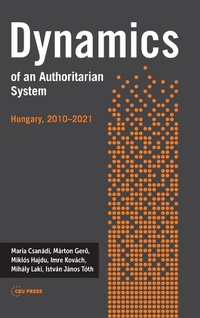
Dynamics of an Authoritarian System
Hungary, 2010-2021
Published on 10. August 2022
Book
Hardback
375 pages
978-963-386-577-4 (ISBN)
Description
This conceptually synthetic and empirically rich book demonstrates the vulnerability of democratic settings to authoritarianism and populism. Six scholars from various professional fields explore here the metamorphosis of a political party into a centralized authoritarian system. Viktor Orban and his Fidesz party needed less than ten years to accomplish this transformation in Hungary. In 2010, after winning a majority that could make changes in the constitution - two-thirds of the parliamentary seats, they evolved and stabilized the system, which produced again the two-thirds majority in 2014 and 2018.
The authors reveal how a democratic setting can be used as a device for political capture. They show how a political entity managed to penetrate almost all sub-fields of the economy to arrive at institutionalized corruption, and how the centralized power structure reproduces itself. With the help of a powerful empirical apparatus-among others analyses of more than 220,000 public tenders, redistributions of state subsidies, and the interconnectedness of those privileged with the political elite - the authors detail the functioning of a crony system and the network aspects of political connections in the rapid enrichment of politically-linked businesses. Their studies demonstrate the role of political capture in this redistribution and how this capture leads to a new social stratification.
The authors reveal how a democratic setting can be used as a device for political capture. They show how a political entity managed to penetrate almost all sub-fields of the economy to arrive at institutionalized corruption, and how the centralized power structure reproduces itself. With the help of a powerful empirical apparatus-among others analyses of more than 220,000 public tenders, redistributions of state subsidies, and the interconnectedness of those privileged with the political elite - the authors detail the functioning of a crony system and the network aspects of political connections in the rapid enrichment of politically-linked businesses. Their studies demonstrate the role of political capture in this redistribution and how this capture leads to a new social stratification.
Reviews / Votes
"This is a dazzling book, researched in depth, elegantly presented and brilliantly argued. I am not aware of any other book that analyses the workings of the Orban regime as comprehensively and as insightfully as this volume. This impressive book brings the Orban dictatorship into full focus and should be in every serious university library."https://doi.org/10.1080/09668136.2023.2205320 -- Sabrina P. Ramet * Europe-Asia Studies *
More details
Language
English
Place of publication
Oxford
Hungary
Target group
Professional and scholarly
Academic
Dimensions
Height: 235 mm
Width: 157 mm
Thickness: 25 mm
Weight
692 gr
ISBN-13
978-963-386-577-4 (9789633865774)
Copyright in bibliographic data and cover images is held by Nielsen Book Services Limited or by the publishers or by their respective licensors: all rights reserved.
Schweitzer Classification
Other editions
Additional editions
E-Book
07/2022
1st Edition
Central European University Press
€98.99
Available for download
Persons
Maria Csanadi is DSc in political science, scientific advisor, emerita at Institute of Economics of the Centre for Economic and Regional Studies in Hungary. Imre Kovach is DSc in sociology, Scientific advisor, Institute of Sociology CSS, professor, University of Debrecen, head of Sociology PhD program. Marton Gero is Assistant professor of sociology at the Eoetvoes Lorand University, Faculty of Social Sciences and a research fellow at the Centre for Social Sciences. Miklos Hajdu is MSc in survey statistics, assistant lecturer at the Corvinus University of Budapest. Istvan Janos Toth is a senior research fellow at the Institute of Economics of Centre for Economic and Regional Studies at the Hungarian Academy of Sciences and managing director of Corruption Research Center Budapest (CRCB).
Content
List of Figures
List of Tables
Preface
Maria Csanadi
Introduction
Maria Csanadi, Marton Gero, Mihaly Laki, and Istvan Janos Toth
PART I. Metamomorphosis of a Party into a System
1. Paths to Political Capture and Institutionalized Corruption in Hungary, 2010-2021
Maria Csanadi
System evolutions in comparative perspective
Political-economic context of systemic evolution
From political dominance to political capture
Diffusion of political capture into autonomous national, local and grass-roots institutions
Forced resource redeployment as instruments of self reproduction of the evolving system
Politically selective resource distribution and those most privileged by forced resource redeployment
The domestic and external factors of persistent self-reproduction during evolution
Conclusions
PART II. Reproduction through Redistribution
2. Redistribution and Integration
Marton Gero and Imre Kovach
Introduction
Welfare redistribution, social integration and inequalities
Project-based redistribution
Recombinant redistribution
Conclusions
3. Cronyism in the Orban Regime: An Empirical Analysis of Public Tenders, 2005-2020
Istvan Janos Toth and Miklos Hajdu
Introduction
Literature
Data and Indicators
The Orban Regime and MGTS+ companies: descriptive statistics
Models and estimations
Conclusions
References
Annex
4. Political Connectedness in Hungarian State Capitalism: The Case of the "Fidesz-Connected" Meszaros Group of Companies
Mihaly Laki
Introduction
Methodology: data collection and processing
Fidesz-connected entrepreneurs on the list of the 100 wealthiest Hungarians
Regulatory and procurement advantages or favors
Lorincz Meszaros: family and business
Annex
Summary
Maria Csanadi
List of Authors
Bibliography
Subject Index
Name Index
List of Tables
Preface
Maria Csanadi
Introduction
Maria Csanadi, Marton Gero, Mihaly Laki, and Istvan Janos Toth
PART I. Metamomorphosis of a Party into a System
1. Paths to Political Capture and Institutionalized Corruption in Hungary, 2010-2021
Maria Csanadi
System evolutions in comparative perspective
Political-economic context of systemic evolution
From political dominance to political capture
Diffusion of political capture into autonomous national, local and grass-roots institutions
Forced resource redeployment as instruments of self reproduction of the evolving system
Politically selective resource distribution and those most privileged by forced resource redeployment
The domestic and external factors of persistent self-reproduction during evolution
Conclusions
PART II. Reproduction through Redistribution
2. Redistribution and Integration
Marton Gero and Imre Kovach
Introduction
Welfare redistribution, social integration and inequalities
Project-based redistribution
Recombinant redistribution
Conclusions
3. Cronyism in the Orban Regime: An Empirical Analysis of Public Tenders, 2005-2020
Istvan Janos Toth and Miklos Hajdu
Introduction
Literature
Data and Indicators
The Orban Regime and MGTS+ companies: descriptive statistics
Models and estimations
Conclusions
References
Annex
4. Political Connectedness in Hungarian State Capitalism: The Case of the "Fidesz-Connected" Meszaros Group of Companies
Mihaly Laki
Introduction
Methodology: data collection and processing
Fidesz-connected entrepreneurs on the list of the 100 wealthiest Hungarians
Regulatory and procurement advantages or favors
Lorincz Meszaros: family and business
Annex
Summary
Maria Csanadi
List of Authors
Bibliography
Subject Index
Name Index