

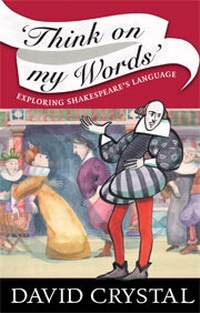
Think On My Words
Exploring Shakespeare's Language
Published on 21. February 2008
Book
Paperback/Softback
266 pages
978-0-521-70035-1 (ISBN)
Description
'You speak a language that I understand not.' Hermione's words to Leontes in The Winter's Tale are likely to ring true with many people reading or watching Shakespeare's plays today. For decades, people have been studying Shakespeare's life and times, and in recent years there has been a renewed surge of interest into aspects of his language. So how can we better understand Shakespeare? How did he manipulate language to produce such an unrivalled body of work, which has enthralled generations both as theatre and as literature? David Crystal addresses these and many other questions in this lively and original introduction to Shakespeare's language. Covering in turn the five main dimensions of language structure - writing system, pronunciation, grammar, vocabulary, and conversational style - the book shows how examining these linguistic 'nuts and bolts' can help us achieve a greater appreciation of Shakespeare's linguistic creativity.
Reviews / Votes
'In this authoritative and attractively written book David Crystal asks all the right questions about the language that Shakespeare used and the ways in which he used it. Here is a linguist who knows not only how words work but how they work in the theatre. Anyone who cares for Shakespeare will be informed and entertained by this intriguing and wide-ranging study.' Stanley Wells '... a fascinating and very readable book ... one that could be recommended to the Shakespeare novice.' Stratford-upon-Avon Observer '... he explores Shakespeare's linguistic art his grammar, his poetic brain and the ways in which he manipulated ordinary words, his building blocks, into the breathtaking poetry we have today.' Stratford-upon-Avon Herald 'An accessible book examining the 'nuts and bolts' of Shakespeare's language thus seems timely, and David Crystal ... is just the man to write it.' The Times Higher Education Supplement 'Crystal's new book is a summation of his work on Shakespeare over many years, essentially a user-friendly book about language. An invaluable resource particularly for work in both language and literature at A Level.' Keith Davidson, Committee for Language in Education 'David Crystal once again offers an incredibly learned overview of linguistic issues in an accessible, engaging, and thought-provoking book on Shakespeare ... The book is invaluable, in that it is accessible, highly enjoyable both to the specialized reader and the broader audience; and in that it argues persuasively that it is impossible to get very far in appreciating Shakespeare if his language is not looked at within the context of early modern linguistic practices.' Iolanda Plescia, Memori Di ShakespeareMore details
Language
English
Place of publication
Cambridge
United Kingdom
Target group
College/higher education
Product notice
Paperback (trade)
Illustrations
2 Tables, unspecified; 4 Halftones, unspecified
Dimensions
Height: 215 mm
Width: 138 mm
Thickness: 16 mm
Weight
382 gr
ISBN-13
978-0-521-70035-1 (9780521700351)
Copyright in bibliographic data and cover images is held by Nielsen Book Services Limited or by the publishers or by their respective licensors: all rights reserved.
Schweitzer Classification
Other editions
New editions

Book
03/2012
Cambridge University Press
€24.90
Shipment within 15-20 days
Additional editions
E-Book
04/2008
1st Edition
Cambridge University Press
€17.49
Available for download
Person
David Crystal is a writer, editor, lecturer and broadcaster. He is Honorary Professor of Linguistics at the University of Bangor.
Content
1. 'You speak a language that I understand not': myths and realities; 2. 'Now, sir, what is your text?': knowing the sources; 3. 'In print I found it': Shakespeare graphology; 4. 'Know my stops': Shakespearean punctuation; 5. 'Speak the speech': Shakespearean phonology; 6. 'Trippingly upon the tongue': Shakespearean pronunciation; 7. 'Think on my words': Shakespearean vocabulary; 8. 'Talk of a noun and a verb': Shakespearean grammar; 9. 'Hear sweet discourse': Shakespearean conversation; Epilogue: 'Your daring tongue': Shakespearean creativity; Appendix: an A-to-Z of Shakespeare's false friends.