

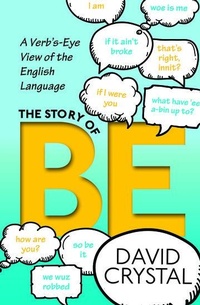
The Story of Be
A Verb's-Eye View of the English Language
Published on 4. May 2017
Book
Hardback
208 pages
978-0-19-879109-6 (ISBN)
Description
It's the most simple, unassuming, innocent-looking verb: 'to be'. Yet it is jam-packed with more different meanings, forms, and uses than any other English word. As he reveals be's multiple incarnations, David Crystal takes us to the heart of our flexible and changing language. He tells the intriguing story in 26 chapters, each linked to a particular usage. We meet circumstantial be ('how are you?'), numerical be ('two and two is four'), quotative be ('so I was like, "wow"'), and ludic be ('oh no he isn't!'), and a whole swarm of other meanings. Bringing the ideas to life are a host of examples from sources as varied as Beowulf, Jane Austen, pantomime, Hamlet (of course), and Star Wars, with cartoons from Ed McLachlan and Punch peppered throughout. Full of fascinating nuggets of information, it is a book to delight any lover of words and language.
Reviews / Votes
The Story of Be does a brilliant job: it offers a language enthusiast an entertaining overview of the history of be along with social changes affecting its use, dialect features, and much more. * Bookbag *More details
Language
English
Place of publication
Oxford
United Kingdom
Illustrations
20
Dimensions
Height: 203 mm
Width: 134 mm
Thickness: 20 mm
Weight
319 gr
ISBN-13
978-0-19-879109-6 (9780198791096)
Copyright in bibliographic data and cover images is held by Nielsen Book Services Limited or by the publishers or by their respective licensors: all rights reserved.
Schweitzer Classification
Other editions
Additional editions
E-Book
04/2017
1st Edition
OUP eBook
€7.49
Available for download
E-Book
04/2017
1st Edition
OUP eBook
€7.49
Available for download
Person
David Crystal is known throughout the world as a writer, editor, lecturer, and broadcaster on language. He has published extensively on the history and development of English, including The Stories of English (2004), Evolving English (2010), Begat: The King James Bible and the English Language (2010), The Story of English in 100 Words (2011), Spell It Out: The Singular Story of English Spelling (2012), Wordsmiths and Warriors: The English-Language Tourist's Guide to Britain (with Hilary Crystal, 2013), and The Oxford Dictionary of Original Shakespearean Pronunciation (2016).
Content
Prologue: In the beginning
1: To be or not to be
2: Time being
3: Being, as was
4: Have you been?
5: I am to resign
6: Has the doctor been?
7: How are you?
8: I've been with someone
9: Two and two is four
10: I might be being obsessive, but...
11: My kids are all grown up
12: Wannabes and has-beens
13: That is to say
14: You're cheeky, you are
15: Been and done it
16: Business is business
17: So be it
18: I live in Wales, innit?
19: So I was, like, wow
20: Woe is me
21: All shall be well
22: How old are you?
23: Is you is or is you ain't?
24: Oh no he isn't
25: Lane closed ahead
26: It's just a book, after all
Appendix: Old English pronunciations
1: To be or not to be
2: Time being
3: Being, as was
4: Have you been?
5: I am to resign
6: Has the doctor been?
7: How are you?
8: I've been with someone
9: Two and two is four
10: I might be being obsessive, but...
11: My kids are all grown up
12: Wannabes and has-beens
13: That is to say
14: You're cheeky, you are
15: Been and done it
16: Business is business
17: So be it
18: I live in Wales, innit?
19: So I was, like, wow
20: Woe is me
21: All shall be well
22: How old are you?
23: Is you is or is you ain't?
24: Oh no he isn't
25: Lane closed ahead
26: It's just a book, after all
Appendix: Old English pronunciations