

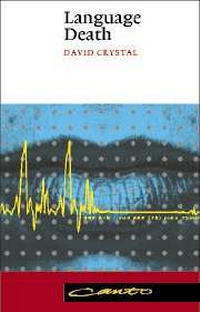
Language Death
Published on 29. April 2002
Book
Paperback/Softback
210 pages
978-0-521-01271-3 (ISBN)
Description
The rapid endangerment and death of many minority languages across the world is a matter of widespread concern, not only among linguists and anthropologists but among all concerned with issues of cultural identity in an increasingly globalized culture. By some counts, only 600 of the 6,000 or so languages in the world are 'safe' from the threat of extinction. A leading commentator and popular writer on language issues, David Crystal asks the fundamental question, 'Why is language death so important?', reviews the reasons for the current crisis, and investigates what is being done to reduce its impact. This 2002 book contains not only intelligent argument, but moving descriptions of the decline and demise of particular languages, and practical advice for anyone interested in pursuing the subject further.
Reviews / Votes
'... this work is directed at anyone with an interest in humanities and a concern about our future as mankind. Its wealth of information, observation and analysis enlightens the mind and invigorates the spirit of community and identity.' Language International 'This is the most personal and passionate of the many excellent books that Crystal has written in the past two decades.' The Times Higher Education Supplement 'David Crystal [is] the most charismatic lexicographer since Dr Johnson.' Boyd Tonkin, Independent 'A serious study of why so many languages across the world are dying.' Hasan Suroor, The Hindu '... this book lucidly reveals the complex truth about language death, and suggests a practical programme to avoid it.' Good Book Guide 'Crystal provides a very readable and non-technical analysis.' Christianpolitics '... this book so succinctly fulfils the goals which the author set himself ...'. Bulletin of the School of Oriental & African Studies 'Language Death is an excellent book with which Crystal sharpens our sense of the complexity of language endangerment and eventual language loss.' Anglia (Zeitschrift fuer Englische Philologie)More details
Series
Language
English
Place of publication
Cambridge
United Kingdom
Product notice
Paperback (trade)
Illustrations
1 Tables, unspecified
Dimensions
Height: 216 mm
Width: 139 mm
Thickness: 13 mm
Weight
290 gr
ISBN-13
978-0-521-01271-3 (9780521012713)
Copyright in bibliographic data and cover images is held by Nielsen Book Services Limited or by the publishers or by their respective licensors: all rights reserved.
Schweitzer Classification
Other editions
New editions
Previous edition
David Crystal
Language Death
Book
06/2000
Cambridge University Press
€18.57
Article exhausted; check for reprint
Person
David Crystal is one of the world's foremost authorities on language, and as editor of the Cambridge Encyclopedia database has used the Internet for research purposes from its earliest manifestations. His work for the technology company AND Classification Data Limited has involved him in the development of an information classification system with several Internet applications and he has extensive professional experience of Web issues. Professor Crystal is author of the hugely successful Cambridge Encyclopedia of Language (1987; Second Edition 1997), Cambridge Encyclopedia of the English Language (1995), English as a Global Language (1997), Language Death (2000) and Language and the Internet (2001). An internationally renowned writer, journal editor, lecturer and broadcaster, he received an OBE in 1995 for his services to the study and teaching of language. His edited books include The Cambridge Encyclopedia (1990; Second Edition 1994; Third Edition 1997; Fourth Edition 2000), The Cambridge Paperback Encyclopedia (1993; Second Edition 1995; Third Edition 1999), The Cambridge Biographical Encyclopedia (1994; Second Edition 1997) and The Cambridge Factfinder (1994; Second Edition 1997; Third Edition 1998; Fourth Edition 2000).
Content
Preface; 1. What is language death?; 2. Why should we care?; 3. Why does languages die?; 4. Where do we begin?; 5. What can be done?; List of organisations; Further reading; Index of languages; Subject index.