

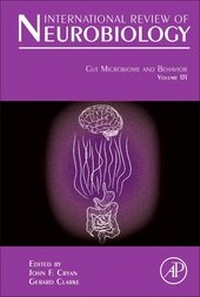
Gut Microbiome and Behavior: Volume 131
Published on 27. October 2016
Book
Hardback
432 pages
978-0-12-803949-6 (ISBN)
Description
Gut Microbiome and Behavior, the latest volume in the International Review of Neurobiology series, provides a comprehensive overview of the gut microbiome on the brain and behavior, fully encapsulating the latest research in the field and defining the scope of this influence to outline potential mechanisms and possible implications.
More details
Series
Language
English
Place of publication
San Diego
United States
Publishing group
Elsevier Science Publishing Co Inc
Target group
Professional and scholarly
Neuroscientists, Psychiatrists, Neurogastroenterologists, Microbiologists, Nutritionists, and researchers within developmental Biology and Medicine.
Dimensions
Height: 229 mm
Width: 152 mm
Weight
820 gr
ISBN-13
978-0-12-803949-6 (9780128039496)
Copyright in bibliographic data and cover images is held by Nielsen Book Services Limited or by the publishers or by their respective licensors: all rights reserved.
Schweitzer Classification
Other editions
Additional editions
Persons
Professor Cryan is a professor at the Department of Anatomy and Neuroscience and APC Microbiome Institute, University College Cork, Cork, Ireland Prof. Gerard Clarke, Ph.D., is a Professor of Neurobehavioral Science in
the Department of Psychiatry and Neurobehavioral Science and a Principal
Investigator in APC Microbiome Ireland at University College Cork. His
research program includes a focus on translational biomarkers of stress-related
neuropsychiatric disorders, the impact of the gut microbiome on
brain and behavior across the life span, and microbial regulation of tryptophan
metabolism. Key achievements of his lab in the generation of
knowledge around the microbiota - gut - brain axis include the demonstration
that the gut microbiome regulates the hippocampal serotonergic
system in a sex-dependent manner, findings that paved the way for
numerous lines of inquiry on the effects of the gut microbiome on neurodevelopment,
brain function, and behavior. He is regularly included in
Clarivate Analytics Highly Cited Researchers list, placing him among the
world's top one percent of researchers by citation. His current approach is
based on advancing frontier knowledge in microbiome research to yield
potential new therapeutic targets for the effective treatment of the central
nervous system and gastrointestinal disorders.
the Department of Psychiatry and Neurobehavioral Science and a Principal
Investigator in APC Microbiome Ireland at University College Cork. His
research program includes a focus on translational biomarkers of stress-related
neuropsychiatric disorders, the impact of the gut microbiome on
brain and behavior across the life span, and microbial regulation of tryptophan
metabolism. Key achievements of his lab in the generation of
knowledge around the microbiota - gut - brain axis include the demonstration
that the gut microbiome regulates the hippocampal serotonergic
system in a sex-dependent manner, findings that paved the way for
numerous lines of inquiry on the effects of the gut microbiome on neurodevelopment,
brain function, and behavior. He is regularly included in
Clarivate Analytics Highly Cited Researchers list, placing him among the
world's top one percent of researchers by citation. His current approach is
based on advancing frontier knowledge in microbiome research to yield
potential new therapeutic targets for the effective treatment of the central
nervous system and gastrointestinal disorders.
Content
1. Role of the Intestinal Microbiota in Host Responses to Stressor Exposure
A.R. Mackos, V.A. Varaljay, R. Maltz, T.L. Gur and M.T. Bailey
2. The Influence of Prebiotics on Neurobiology and Behaviour
A.C.C. Kao, S. Harty and P.W.J. Burnet
3. Gut Microbiome and Behaviour: Focus on Neuroimmune Interactions
J.A. Foster
4. Neuropeptides, Microbiota and Behaviour
P. Holzer
5. Microbes and Oxytocin: Benefits for Host Physiology and Behaviour
S.E. Erdman and T. Poutahidis
6. Intestinal Barrier and Behaviour
M. Julio-Pieper and J.A. Bravo
7. Toxoplasma Gondii-A Gastrointestinal Pathogen Associated with Human Brain Diseases
E.G. Severance, J. Xiao, L. Jones-Brando, S. Sabunciyan, Y. Li, M. Pletnikov, E. Prandovszky and R. Yolken
8. Exercise and Prebiotics Produce Stress Resistance: Converging Impacts on Stress-Protective and Butyrate-Producing Gut Bacteria
A. Mika, N. Rumian, A.B. Loughridge and M. Fleshner
9. Circadian Rhythm and the Gut Microbiome
R.M. Voigt, C.B. Forsyth, S.J. Green, P.A. Engen and A. Keshavarzian
10. Sleep and Microbes
J.M. Krueger and M.R. Opp
11. Cognitive Function and the Microbiome
M. Gareau
A.R. Mackos, V.A. Varaljay, R. Maltz, T.L. Gur and M.T. Bailey
2. The Influence of Prebiotics on Neurobiology and Behaviour
A.C.C. Kao, S. Harty and P.W.J. Burnet
3. Gut Microbiome and Behaviour: Focus on Neuroimmune Interactions
J.A. Foster
4. Neuropeptides, Microbiota and Behaviour
P. Holzer
5. Microbes and Oxytocin: Benefits for Host Physiology and Behaviour
S.E. Erdman and T. Poutahidis
6. Intestinal Barrier and Behaviour
M. Julio-Pieper and J.A. Bravo
7. Toxoplasma Gondii-A Gastrointestinal Pathogen Associated with Human Brain Diseases
E.G. Severance, J. Xiao, L. Jones-Brando, S. Sabunciyan, Y. Li, M. Pletnikov, E. Prandovszky and R. Yolken
8. Exercise and Prebiotics Produce Stress Resistance: Converging Impacts on Stress-Protective and Butyrate-Producing Gut Bacteria
A. Mika, N. Rumian, A.B. Loughridge and M. Fleshner
9. Circadian Rhythm and the Gut Microbiome
R.M. Voigt, C.B. Forsyth, S.J. Green, P.A. Engen and A. Keshavarzian
10. Sleep and Microbes
J.M. Krueger and M.R. Opp
11. Cognitive Function and the Microbiome
M. Gareau