

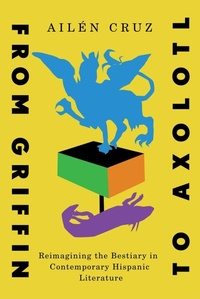
From Griffin to Axolotl
Reimagining the Bestiary in Contemporary Hispanic Literature
Will be published approx. on 16. December 2025
Book
Paperback/Softback
224 pages
978-0-2280-2631-0 (ISBN)
Description
The fox is cunning, the lion is brave. These familiar ideas span back to the medieval bestiary - short, animal-centred texts, often illustrated, used to disseminate Christian teachings in medieval society. Translated into dozens of languages, bestiaries were wildly popular until the twelfth century.
After centuries of obscurity, six of Latin America's most prominent writers - Juan Jose Arreola, Jorge Luis Borges, Nicolas Guillen, Augusto Monterroso, Pablo Neruda, and Jose Emilio Pacheco - took up the bestiary during the experimental Latin American avant-garde and Boom periods. From Griffin to Axolotl presents the bestiary as a distinct genre within Hispanic literature, examining its resurgence in the contemporary canon. Analyzing a corpus of over eighty bestiaries collected through field research in Canada, Argentina, Mexico, and Spain, Ailen Cruz explores the evolutions of the genre. Reimagined through both prose and art, and moving beyond religious teachings, these bestiaries range from the rebellious to the nonsensical, touching on a spectrum of topics - from preservation of Indigenous Latin American cultures to environmental crises and the human condition.
From Griffin to Axolotl promotes an understudied genre of Hispanic literature, demonstrating that the bestiary is not extinct, but has been remoulded for modern society.
After centuries of obscurity, six of Latin America's most prominent writers - Juan Jose Arreola, Jorge Luis Borges, Nicolas Guillen, Augusto Monterroso, Pablo Neruda, and Jose Emilio Pacheco - took up the bestiary during the experimental Latin American avant-garde and Boom periods. From Griffin to Axolotl presents the bestiary as a distinct genre within Hispanic literature, examining its resurgence in the contemporary canon. Analyzing a corpus of over eighty bestiaries collected through field research in Canada, Argentina, Mexico, and Spain, Ailen Cruz explores the evolutions of the genre. Reimagined through both prose and art, and moving beyond religious teachings, these bestiaries range from the rebellious to the nonsensical, touching on a spectrum of topics - from preservation of Indigenous Latin American cultures to environmental crises and the human condition.
From Griffin to Axolotl promotes an understudied genre of Hispanic literature, demonstrating that the bestiary is not extinct, but has been remoulded for modern society.
Reviews / Votes
"Ailen Cruz has done a phenomenal job of linking the resurgence of the bestiary genre to contemporary Hispanic literature. From Griffin to Axolotl is in a category by itself." - Odile Cisneros, University of Alberta"Beautifully illustrated, this book provides an illuminating study of bestiaries in the Hispanic tradition." - Adam Sharman, University of Nottingham
More details
Series
Language
English
Place of publication
Montreal
Canada
Target group
Professional and scholarly
Product notice
Paperback (trade)
Unsewn / adhesive bound
Illustrations
33 images, full colour throughout
Dimensions
Height: 228 mm
Width: 152 mm
Thickness: 16 mm
Weight
363 gr
ISBN-13
978-0-2280-2631-0 (9780228026310)
Copyright in bibliographic data and cover images is held by Nielsen Book Services Limited or by the publishers or by their respective licensors: all rights reserved.
Schweitzer Classification
Person
Ailen Cruz is a post-doctoral researcher at Mount Allison University and writes the bilingual Substack Prone to Hyperbole.
Content
Figures ix
Introduction 3
1 Origins of the Bestiary Genre 10
2 The Bestiary's Migration to the Americas 21
3 Animals Beyond Morality 67
4 Appropriating the Bestiary 90
5 Blurring the Confines of the Genre 115
6 Usurping Beast Territory 146
Conclusion 173
Appendix: Bestiary Corpus 181
Notes 185
References 195
Index 207
Introduction 3
1 Origins of the Bestiary Genre 10
2 The Bestiary's Migration to the Americas 21
3 Animals Beyond Morality 67
4 Appropriating the Bestiary 90
5 Blurring the Confines of the Genre 115
6 Usurping Beast Territory 146
Conclusion 173
Appendix: Bestiary Corpus 181
Notes 185
References 195
Index 207