

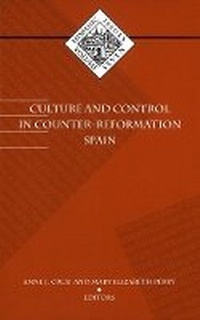
Culture and Control in Counter-Reformation Spain
Published on 15. December 1991
Book
Paperback/Softback
288 pages
978-0-8166-2026-5 (ISBN)
Description
Contemporary cultural historians have located the Counter-Reformation as the most significant point in the material, intellectual, and spiritual development of Spain. Robust and full of productive contradictions, Spanish culture took a critical turn in 1492 when Ferdinand II, in his quest for purity and orthodoxy, expelled the Jews and Arabs from Spain.
Culture and Control in Counter-Reformation Spain examines the various modes of repression and social control exerted by Spanish institutions during the Counter-Reformation as they attempted to coerce marginalized groups (women and religious minorities - the moriscos and conversos) into political and cultural integration. This penetrating exploration demonstrates how the Catholic Church - mainly through the disciplinary technology of the Inquisition - assumed and exerted its authority as the "official" guardian of cultural and literary production. Culture and Control in Counter-Reformation Spain details the ways in which marginalized groups, through the communal linkage of their diverse social practices, were nonetheless able to resist repression and preserve cultural heterogeneity within the dominant society.
Culture and Control in Counter-Reformation Spain examines the various modes of repression and social control exerted by Spanish institutions during the Counter-Reformation as they attempted to coerce marginalized groups (women and religious minorities - the moriscos and conversos) into political and cultural integration. This penetrating exploration demonstrates how the Catholic Church - mainly through the disciplinary technology of the Inquisition - assumed and exerted its authority as the "official" guardian of cultural and literary production. Culture and Control in Counter-Reformation Spain details the ways in which marginalized groups, through the communal linkage of their diverse social practices, were nonetheless able to resist repression and preserve cultural heterogeneity within the dominant society.
More details
Language
English
Place of publication
Minnesota
United States
Target group
College/higher education
Professional and scholarly
Dimensions
Height: 216 mm
Width: 140 mm
Thickness: 15 mm
ISBN-13
978-0-8166-2026-5 (9780816620265)
Copyright in bibliographic data and cover images is held by Nielsen Book Services Limited or by the publishers or by their respective licensors: all rights reserved.
Schweitzer Classification
Persons
Anne J. Cruz is associate professor of Spanish at the University of California, Irvine. She has published numerous essays on cultural formation and gender in Spanish Golden Age literature. Mary Elizabeth Perry is adjunct professor of history at Occidental College and the author of Crime and Society in Early Modern Seville and Cultural Encounters: The Impact of the Inquisition in Spain and the New World.